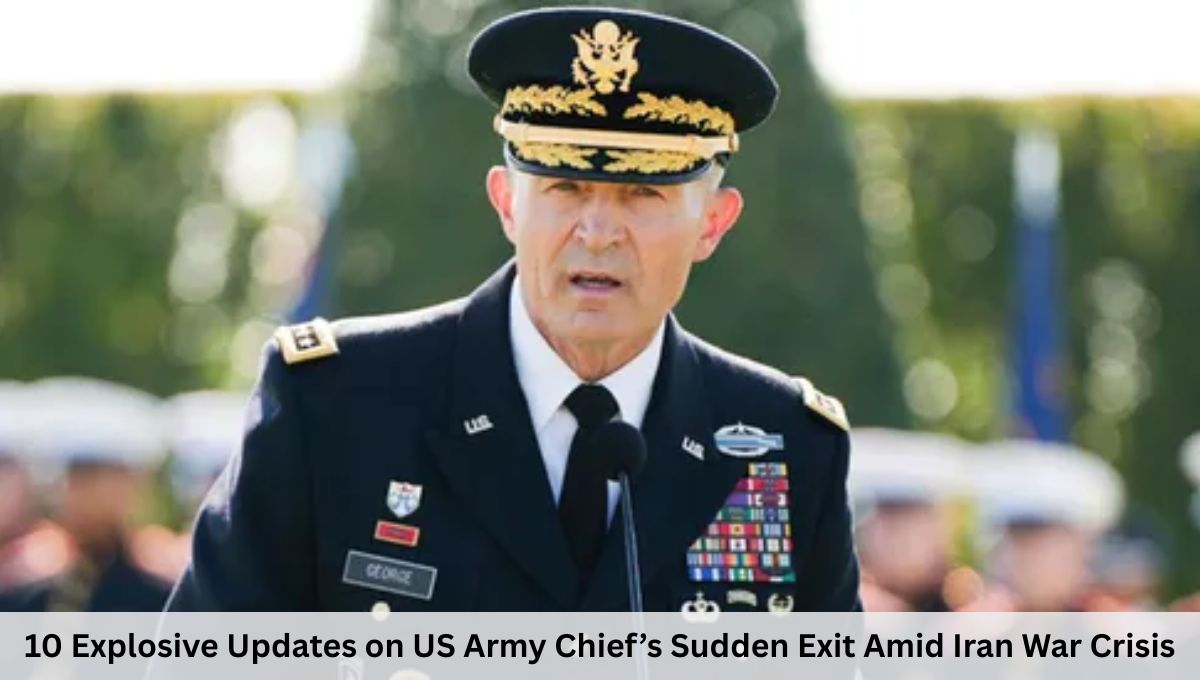
10 Explosive Updates on US Army Chief’s Sudden Exit Amid Iran War Crisis that spark global concern. In a dramatic and unexpected move, US Defense Secretary Pete Hegseth has asked Army Chief of Staff General Randy George to step down and retire immediately. The decision comes at a highly sensitive moment, as the United States remains actively engaged in a growing military conflict with Iran.
Thank you for reading this post, don't forget to subscribe!The abrupt removal of one of the most senior military leaders during an ongoing war has raised serious questions across political, military, and global strategic circles.
With no official explanation provided, speculation has intensified about internal Pentagon dynamics, leadership alignment, and broader strategic objectives.
This article breaks down the key developments, underlying factors, and potential global consequences of this high-profile military shake-up.
10 Explosive Updates on US Army Chief’s Sudden Exit Amid Iran War Crisis
1. What Happened: A Sudden Exit Without Explanation
General Randy George, the 41st Chief of Staff of the US Army, was asked to retire immediately by Defense Secretary Pete Hegseth.
The Pentagon confirmed his departure, stating only that he would be stepping down effective immediately.
Notably, no formal reason was provided for the decision—an unusual move given the significance of the position and the timing during active military operations.
Reports indicate that George was informed via a phone call, and even senior Army leadership was caught off guard, learning of the decision at the same time as the public announcement.
2. Leadership Change Amid Active War with Iran
The timing of George’s removal is particularly significant.
The US is currently engaged in a high-stakes military confrontation with Iran, involving airstrikes, naval operations, and troop deployments in the Middle East.
The Army plays a critical role in:
- Air and missile defense systems
- Ground force readiness
- Strategic logistics and deployment
Removing the Army’s top officer during such operations is highly unconventional and has raised concerns about continuity and operational stability.
3. The Rise of Christopher LaNeve
Following George’s exit, Vice Chief of Staff General Christopher LaNeve is expected to take over as acting Army Chief.
LaNeve’s rapid ascent is notable:
- Previously served as Hegseth’s senior military aide
- Commanded the Eighth Army in South Korea
- Led the 82nd Airborne Division
His close professional relationship with Hegseth suggests that trust and alignment with leadership vision may have played a role in his elevation.
4. A Broader Pentagon Purge
George’s removal is not an isolated event. Since taking office, Hegseth has overseen the dismissal or early retirement of more than a dozen senior military officers.
These include:
- Top Navy leadership
- Air Force senior commanders
- Joint Chiefs leadership
This pattern indicates a systematic effort to reshape the Pentagon’s leadership structure.
5. Alignment with Presidential Vision
Sources suggest that the decision may be linked to a desire for leadership that aligns more closely with President Donald Trump’s military and national security agenda.
A senior defense official reportedly indicated that the administration wants:
- Faster implementation of strategic priorities
- Greater alignment across military branches
- Leadership that supports current policy direction
This raises important questions about the balance between military independence and political alignment.
6. Internal Tensions Within the Pentagon
Reports point to underlying tensions between Hegseth and segments of Army leadership.
Key issues may include:
- Personnel and promotion decisions
- Strategic direction of the Army
- Relationships with civilian leadership
General George was known to have strong working ties with other senior officials, which may have contributed to friction within the leadership structure.
7. Additional Firings Add to Uncertainty
Alongside George’s removal, two other senior Army officials were also dismissed:
- General David Hodne (Training and Transformation Command)
- Major General William Green Jr. (Chief of Chaplains)
Again, no official reasons were provided, deepening concerns about transparency and decision-making within the Pentagon.
8. Why This Move Is Unprecedented
Firing or forcing the retirement of a top military leader during wartime is extremely rare in modern US history.
Typically:
- Military leadership transitions are carefully planned
- Changes occur outside active conflict periods
- Continuity is prioritized during war
This departure from established norms has sparked debate among defense analysts and policymakers.
9. George’s Military Legacy
General Randy George had a long and distinguished military career:
- Commissioned in 1988
- Served in the Gulf War, Iraq, and Afghanistan
- Held senior advisory roles at the Pentagon
- Became Army Chief of Staff in 2023
His tenure, though relatively short, was marked by efforts to modernize the Army and improve operational efficiency.
10. Global Implications of the Shake-Up
The leadership change has implications far beyond the United States.
For Allies
- Concerns about stability and consistency in US military leadership
- Questions about coordination in joint operations
For Adversaries
- Potential perception of internal instability
- Opportunities to exploit leadership transitions
For Global Markets
- Increased uncertainty amid ongoing geopolitical tensions
- Possible impact on defense spending and energy markets
Strategic Context: War, Politics, and Power Dynamics
This development highlights the intersection of military strategy and political authority.
While civilian control of the military is a cornerstone of US governance, the scale and speed of these leadership changes raise important questions about:
- Decision-making processes
- Institutional stability
- Long-term strategic planning
What Happens Next?
Several key developments will determine the impact of this shake-up:
1. Confirmation of Permanent Leadership
Will Christopher LaNeve be formally appointed as Army Chief?
2. Continuity of Military Operations
How will ongoing operations in the Middle East be affected?
3. Further Leadership Changes
Will additional senior officers be removed or replaced?
4. Congressional and Public Response
Will lawmakers demand greater transparency or oversight?
Conclusion: A Defining Moment for US Military Leadership
The sudden removal of General Randy George marks a significant moment in US military and political history.
Occurring during an active conflict, the decision underscores a broader transformation within the Pentagon under current leadership.
Whether this move strengthens strategic alignment or introduces instability remains to be seen.
What is clear, however, is that the ripple effects will be felt not only within the US military but across the global security landscape.
As the Iran conflict continues and leadership transitions unfold, the world will be watching closely.
Also Read: 10 Explosive Updates on US–Iran Ceasefire Talks and Hormuz Crisis
Also Read: Why Trump Sacked His Army Chief Gen Randy George?
Related Posts:
- 3 Explosive Conditions Iran Sets to End War with US…

- 7 Explosive Signs Russia Is Quietly Backing Iran in…
- 9 Explosive Claims as Trump Says US Winning Iran War

- 10 Explosive Strikes: Israel Bombs Tehran Oil Depots…

- 10 Explosive Warnings as Donald Trump Calls Iran…
- 10 Explosive Signals: Trump Rates Iran War “15/10”…