
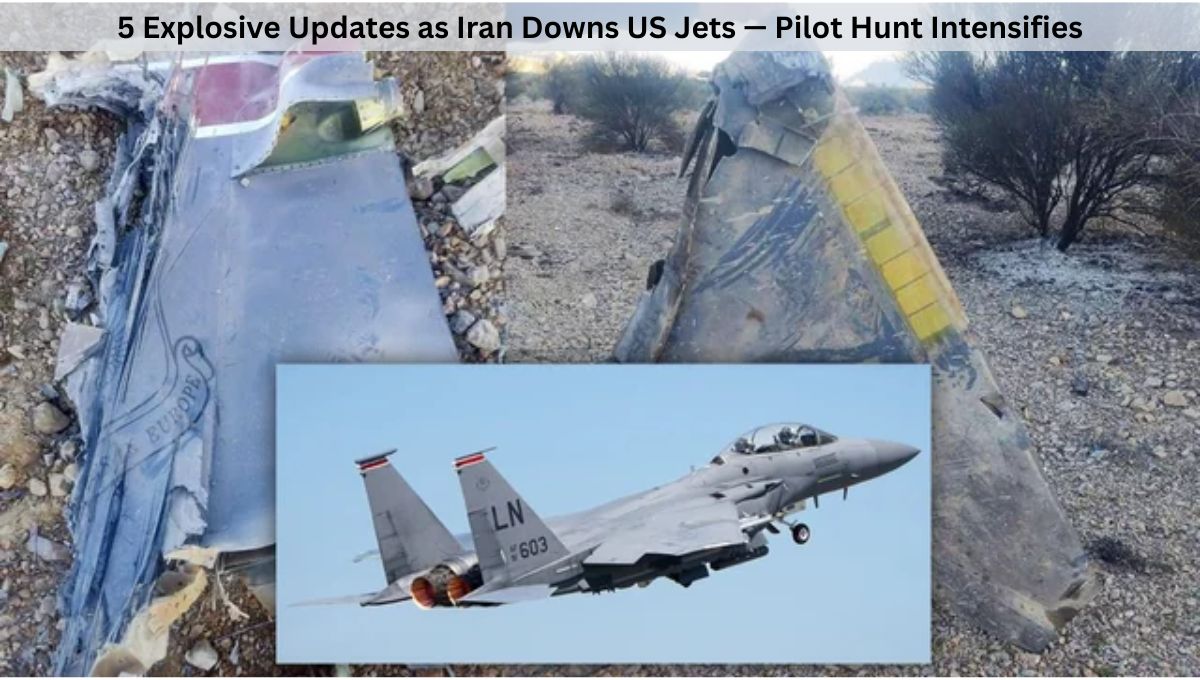
5 Explosive Updates as Iran Downs US Jets — Pilot Hunt Intensifies, war risks escalate. In a dramatic and potentially game-changing escalation of the ongoing war, Iran has reportedly shot down two United States military aircraft within 24 hours. The incidents have triggered an urgent search-and-rescue operation, with two pilots successfully recovered and one still missing deep inside Iranian territory.
This development marks the first confirmed downing of a US fighter jet by Iran since the conflict began on February 28, significantly raising the stakes in an already volatile region.
With both nations issuing strong statements and military operations intensifying, the situation has rapidly evolved into one of the most dangerous phases of the war so far.
5 Explosive Updates as Iran Downs US Jets — Pilot Hunt Intensifies
What Happened — The Downing of Two US Warplanes
First Aircraft — F-15E Strike Eagle Shot Down
The first incident involved a US F-15E Strike Eagle, a highly advanced dual-role fighter jet designed for both air-to-air and air-to-ground missions.
- The aircraft was reportedly hit by Iranian air defense systems over southwestern Iran.
- The jet carried two crew members: a pilot and a weapons systems officer.
- Both crew members ejected safely before the crash.
Shortly after, US special forces launched a high-risk rescue operation:
- One crew member was successfully located and rescued.
- The second crew member remains missing, prompting an intense search effort.
The exact identity of the rescued crew member—whether pilot or weapons officer—has not been disclosed.
Second Aircraft — A-10 Warthog Hit Near Kuwait
The second incident occurred hours later and involved an A-10 Warthog, a ground-attack aircraft known for its durability and close air support capabilities.
- The aircraft was struck by Iranian fire near the Strait of Hormuz.
- The pilot managed to eject before the crash.
- The plane ultimately went down over Kuwait.
Unlike the F-15 incident:
- The A-10 pilot was successfully rescued and confirmed safe.
Rescue Mission Under Fire — Black Hawk Helicopters Targeted
The rescue operation itself came under attack, highlighting the extreme risks involved.
- Two Black Hawk helicopters deployed for search-and-rescue were hit by Iranian fire.
- Despite sustaining damage, both helicopters managed to exit Iranian airspace.
- Some crew members reportedly suffered minor injuries.
This marks a rare instance where rescue missions themselves become direct targets, underscoring the intensity of the conflict.
The Missing Pilot — A High-Stakes Hunt
Perhaps the most critical aspect of the unfolding situation is the missing F-15 crew member.
Iran Launches Ground Search
Iranian authorities have taken aggressive steps:
- Revolutionary Guard forces are combing mountainous regions in southwestern Iran.
- Local officials have urged civilians to assist in locating the pilot.
- Rewards have reportedly been offered for capturing the pilot alive.
Why This Matters
The capture of a US pilot could have massive implications:
- It could be used for propaganda purposes.
- It may complicate diplomatic negotiations.
- It could trigger a risky US special operations rescue mission.
This situation represents a nightmare scenario for military planners, where time is critical and risks are extremely high.
Conflicting Claims and Fog of War
As with many wartime developments, early reports were conflicting:
- Iranian media initially claimed a F-35 stealth fighter was shot down.
- Later confirmations from US officials clarified it was an F-15E.
Iran has previously made claims of downing US aircraft that were not confirmed, adding to skepticism around initial reports.
However, this time:
- US officials have acknowledged the loss of aircraft.
- Multiple sources confirm the incidents occurred.
Official Reactions — US and Iran Respond
United States Response
- The White House confirmed that the President has been briefed.
- No detailed statement has been released by the Pentagon.
- Officials have remained cautious due to the sensitive nature of rescue operations.
The US President, speaking publicly, stated:
“No, not at all. No, it’s war.”
This suggests that the incidents are unlikely to alter ongoing military or diplomatic strategies.
Iran’s Response
Iranian leadership has reacted strongly:
- Officials celebrated the downing of US aircraft.
- Public statements framed the event as a strategic victory.
- Authorities encouraged civilians to participate in locating the missing pilot.
The rhetoric indicates Iran is leveraging the incident both militarily and psychologically.
A Turning Point in the War?
This development could mark a critical turning point for several reasons:
1. Challenge to US Air Dominance
Until now, US officials had repeatedly claimed:
- Total control over Iranian airspace
- Destruction of Iran’s air defenses
The successful downing of advanced aircraft challenges that narrative.
2. Proof of Iran’s Remaining Capabilities
Despite heavy bombardment:
- Iran has demonstrated it can still strike high-value targets
- Its air defense systems remain operational
This could reshape military calculations moving forward.
3. Increased Risk of Escalation
The situation introduces multiple escalation triggers:
- Potential capture of a US pilot
- Possible US ground or special operations missions
- Retaliatory strikes by either side
Each carries significant geopolitical consequences.
The Human Element — Survival Behind Enemy Lines
When a pilot ejects over hostile territory, survival becomes a race against time.
US pilots are trained under SERE (Survival, Evasion, Resistance, Escape) doctrine:
- Equipped with survival kits, radios, and navigation tools
- Trained to evade capture and signal rescue teams
- Capable of surviving in harsh environments for days
However, survival depends on several factors:
- Terrain (mountains, forests, deserts)
- Enemy presence
- Speed of rescue operations
In this case, the missing pilot is believed to be in a rugged mountainous region, making rescue efforts even more challenging.
Global Impact — Why This Matters Beyond the Battlefield
The implications extend far beyond the immediate conflict:
Oil and Economic Impact
- The Strait of Hormuz remains a critical chokepoint
- Any escalation threatens global oil supply
- Markets have already shown volatility
Regional Stability
- Gulf countries remain at risk
- Infrastructure attacks have increased
- Civilian casualties are rising
Diplomatic Fallout
- Peace talks appear stalled
- Tensions between global powers are rising
- The risk of a prolonged conflict is increasing
What Happens Next?
Several scenarios could unfold in the coming days:
- Successful Rescue
- The missing pilot is recovered
- Tensions remain high but contained
- Pilot Captured
- Major propaganda victory for Iran
- Increased pressure on US leadership
- Escalation of Military Operations
- Expanded airstrikes or ground missions
- Broader regional conflict
- Diplomatic Breakthrough (Less Likely)
- Renewed negotiations
- Temporary de-escalation
Conclusion: A War Entering a Dangerous Phase
The downing of two US warplanes and the ongoing hunt for a missing pilot represent one of the most intense moments in the conflict so far.
What began as a campaign of air superiority has now evolved into a complex and unpredictable war, where even the most advanced military assets are vulnerable.
As search operations continue and tensions rise, the world watches closely—because what happens next could determine not just the outcome of this conflict, but the stability of the entire region.
Also Read: 9 Explosive Signals as U.S.–Iran Tensions Near a Breaking Point
Also Read: Explained: How Iran Downed 2 US Fighter Jets
Related Posts:
- Trump’s 20-Point Gaza Peace Plan Gains Urgent Global…

- 7 Alarming Facts About Super Typhoon Fung-wong

- Afghanistan–Pakistan War 2025: Inside the 48-Hour Ceasefire

- China Hosts SCO Summit 2025 and Military Parade as…

- 3 Explosive Conditions Iran Sets to End War with US…

- US Strike on Venezuelan Boat Kills 6 in Fifth…
