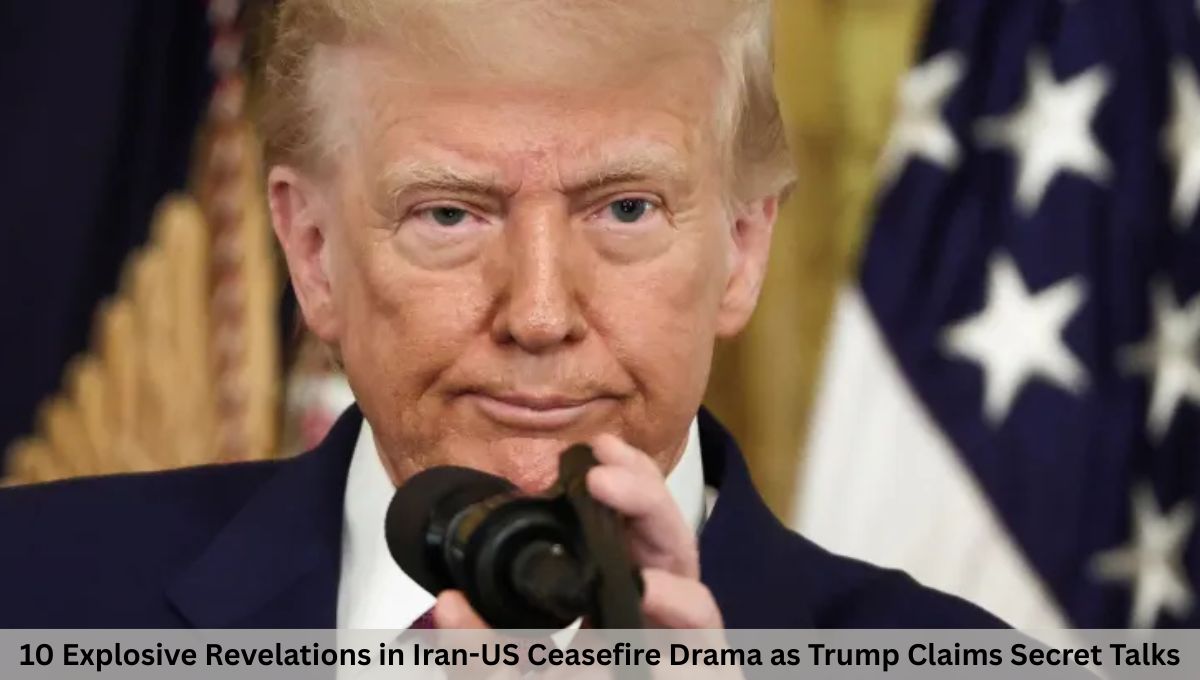
10 Explosive Revelations in Iran-US Ceasefire Drama as Trump Claims Secret Talks amid ongoing conflict. The ongoing conflict between the United States, Iran, and its regional adversaries has entered a critical and volatile phase. While military exchanges continue across the Middle East, a parallel war of narratives is unfolding — one defined by sharp contradictions, strategic messaging, and high-stakes diplomacy.
At the center of this information battle are conflicting claims:
the United States insists negotiations are underway and a deal is within reach, while Iran firmly denies any formal talks, dismissing such claims as misinformation. This divergence is not merely rhetorical.
It reflects deeper geopolitical strategies, domestic pressures, and global economic consequences tied to one of the most dangerous conflicts in recent years.
10 Explosive Revelations in Iran-US Ceasefire Drama as Trump Claims Secret Talks
10 Explosive Developments Shaping the Crisis
1. Conflicting Claims Over Ceasefire Talks
The most striking development is the outright contradiction between Washington and Tehran.
The US leadership claims that Iran is actively seeking a deal and engaging in negotiations through undisclosed channels.
In contrast, Iran’s foreign ministry has categorically denied any direct or indirect negotiations aimed at ending the conflict.
Iran maintains that while messages may have been exchanged via intermediaries, this does not constitute formal dialogue or negotiations.
This discrepancy raises a fundamental question:
are talks genuinely happening behind closed doors, or is this a strategic narrative battle?
2. Backchannel Communication Without Formal Negotiations
Iran has acknowledged that communication exists — but only through intermediaries such as regional allies and diplomatic partners.
These exchanges involve:
- Conveying warnings
- Clarifying positions
- Responding to proposals
However, Iranian officials insist that such communication should not be interpreted as negotiations.
This distinction is crucial, as it allows Iran to maintain a firm public stance while still engaging diplomatically behind the scenes.
3. Trump’s Bold Claims Intensify Controversy
The US president has made a series of bold and controversial statements, including:
- Iran is “desperate” for a deal
- Iranian leaders are secretly negotiating
- They are afraid to publicly admit talks
In an extraordinary claim, he even suggested that Iranian leadership had informally proposed making him the country’s Supreme Leader — a statement widely dismissed by analysts as rhetorical exaggeration.
These remarks have added fuel to an already complex geopolitical narrative.
4. Leadership Crisis Inside Iran
The conflict has reportedly triggered a severe leadership vacuum within Iran.
Following the reported killing of the country’s supreme leader early in the conflict, power has shifted to a successor who has not appeared publicly.
This lack of visibility has:
- Raised questions about internal stability
- Fueled speculation about decision-making structures
- Complicated diplomatic engagement
A fragmented leadership structure could explain inconsistent messaging and cautious diplomatic positioning.
5. A 15-Point Ceasefire Proposal Emerges
A comprehensive ceasefire proposal reportedly sent by the United States includes major demands:
- Reopening the Strait of Hormuz
- Eliminating enriched uranium stockpiles
- Limiting ballistic missile programs
- Ending support for regional proxy groups
These conditions represent a sweeping attempt to reshape Iran’s military and geopolitical posture.
However, Iran has reacted coldly, with sources suggesting it has either rejected or countered the proposal with its own terms.
6. Iran’s Counter-Proposal and Strategic Conditions
Iran is believed to have introduced its own framework for ending the conflict.
Key elements reportedly include:
- Inclusion of regional conflicts (especially involving allied groups)
- Broader ceasefire guarantees
- Security assurances against future attacks
Iran’s stance reflects a desire not just to end the war, but to reshape the regional balance of power in its favor.
7. Strait of Hormuz Crisis Sparks Global Shockwaves
One of the most significant consequences of the conflict has been the disruption of the Strait of Hormuz — a critical global energy artery.
The closure or restriction of this route has:
- Affected nearly 20% of global oil supply
- Disrupted liquefied natural gas shipments
- Triggered sharp increases in fuel prices
This has created what many describe as the worst energy shock in modern history.
8. Global Economic Fallout Intensifies
The ripple effects of the conflict extend far beyond the Middle East.
Industries worldwide are facing:
- Rising fuel costs
- Supply chain disruptions
- Declining consumer demand
Affected sectors include:
- Airlines struggling with fuel expenses
- Agriculture facing diesel shortages
- Retail markets adjusting to inflationary pressures
Governments are even considering economic support measures reminiscent of the COVID-era stimulus programs.
9. Military Escalation Continues Despite Diplomacy
Despite ongoing claims of diplomacy, military operations remain intense.
Key developments include:
- Thousands of targets reportedly struck within Iran
- Significant damage to naval and missile capabilities
- Continued missile and drone exchanges across the region
The United States has also increased troop deployments, signaling readiness for potential escalation, including ground operations.
This dual-track approach — diplomacy alongside military pressure — reflects a classic coercive negotiation strategy.
10. Public Opinion and Political Pressure Mount
Domestic pressure is becoming a critical factor, especially in the United States.
Recent polling indicates:
- A majority of Americans oppose military strikes
- Approval ratings for leadership have declined
- Economic concerns are influencing political sentiment
With elections approaching, there is growing urgency to resolve the conflict before it further impacts voters and markets.
The Narrative War: Strategy Behind the Statements
The stark contrast between US and Iranian claims may not be accidental.
Why the US Emphasizes Negotiations
- Calm financial markets
- Reduce oil price volatility
- Signal progress to domestic audiences
- Buy time for military positioning
Why Iran Denies Talks
- Maintain internal political strength
- Avoid appearing weak
- Increase economic pressure on adversaries
- Control the narrative regionally
Both sides are leveraging information as a strategic tool, making it difficult to discern the reality of diplomatic efforts.
Energy Crisis and Humanitarian Concerns
The prolonged conflict is not just a geopolitical issue — it is a humanitarian crisis in the making.
Key concerns include:
- Fuel shortages affecting essential services
- Rising food insecurity globally
- Economic instability in vulnerable regions
Estimates suggest that tens of millions could face acute hunger if disruptions continue.
Regional Dynamics and Expanding Conflict Risks
The conflict is no longer contained within bilateral tensions.
It now involves:
- Regional allies and proxy groups
- Strategic waterways
- Global economic systems
There are growing fears that:
- The war could expand into neighboring regions
- Additional countries may be drawn in
- A broader global conflict could emerge
Diplomatic Pathways: Is a Resolution Possible?
Despite the chaos, diplomatic opportunities still exist.
Potential pathways include:
- Mediated talks through neutral countries
- Incremental confidence-building measures
- Limited ceasefire agreements tied to specific conditions
However, major obstacles remain:
- Deep mistrust between parties
- Conflicting strategic goals
- Domestic political constraints
Market Reactions: Volatility Returns
Financial markets have reacted sharply to developments.
- Initial optimism around ceasefire talks boosted stocks
- Renewed skepticism triggered declines
- Oil prices have resumed their upward trajectory
This volatility highlights the sensitivity of global markets to geopolitical uncertainty.
Conclusion: A Conflict Defined by Uncertainty
The Iran-US conflict has evolved into a complex interplay of military action, economic disruption, and information warfare.
At its core lies a fundamental uncertainty:
- Are negotiations truly happening?
- Or are they part of a broader strategic narrative?
What is clear, however, is the global impact:
- Energy markets remain unstable
- Economies are under pressure
- The risk of wider conflict persists
As both sides continue to project conflicting narratives, the world watches closely — aware that the next development could either pave the way for peace or push the region further toward escalation.
Also Read: Iran-US Nuclear Talks Get Another Chance Amidst Persistent Uranium Enrichment Standoff
Also Read: Trump plays up ceasefire talks while Iran responds with distrust