
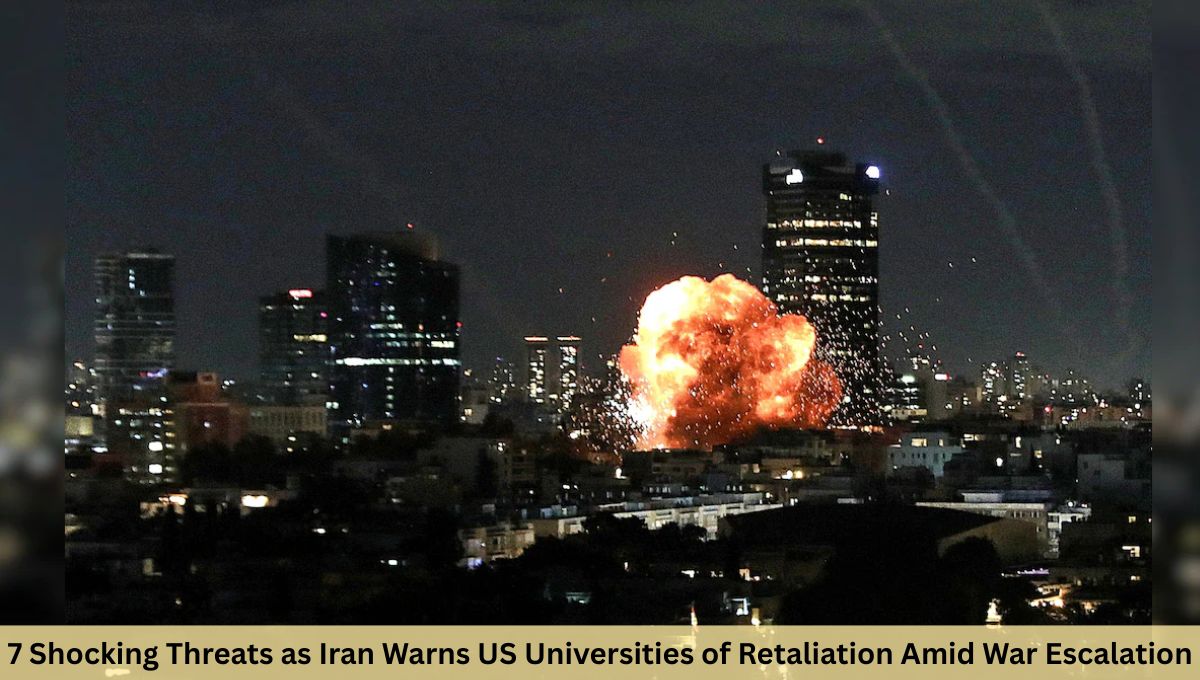
7 Shocking Threats as Iran Warns US Universities of Retaliation Amid War Escalation and rising geopolitical implications. The ongoing conflict in West Asia has taken a deeply alarming turn, as Iran’s elite military force, the Islamic Revolutionary Guard Corps (IRGC), issued a stark warning that American-linked universities across the region could become targets.
This unprecedented threat comes after Tehran accused the United States and Israel of deliberately striking Iranian academic institutions, including the prominent Iran University of Science and Technology.
With tensions escalating rapidly, the targeting of educational institutions signals a troubling expansion of the battlefield—one that now risks engulfing civilian and academic spaces.
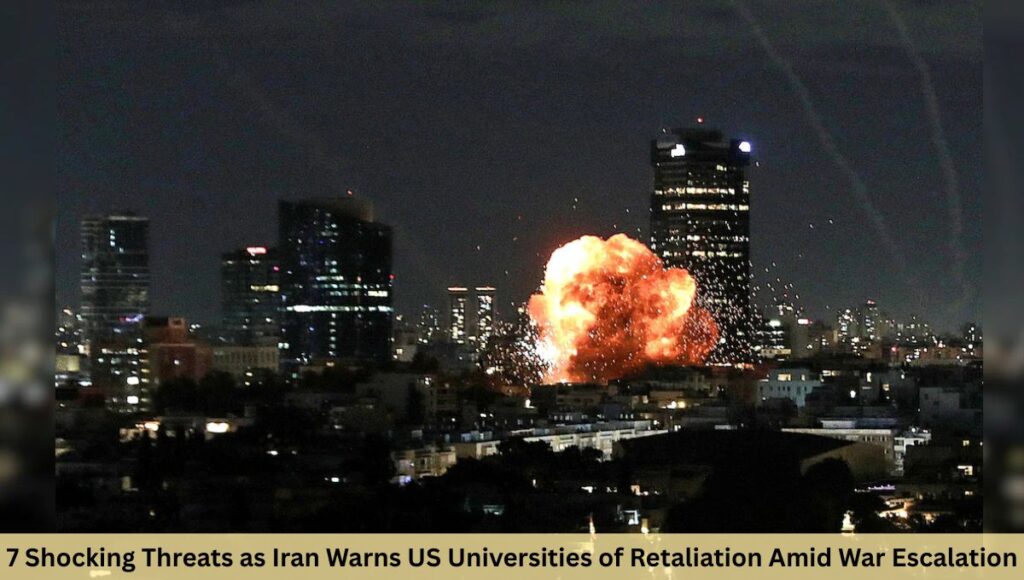
7 Shocking Threats as Iran Warns US Universities of Retaliation Amid War Escalation
Iran’s Ultimatum: A 12 Noon Deadline
In a strongly worded statement, the IRGC issued an ultimatum to Washington:
- The United States must officially condemn the alleged bombing of Iranian universities
- The deadline: 12 noon, March 30 (Tehran time)
- Failure to comply could trigger retaliation
The warning explicitly stated that if the US does not respond, American universities in West Asia may be treated as “legitimate targets.”
This is one of the most direct threats issued by Iran against non-military, civilian-linked institutions tied to the United States.
Which Institutions Are at Risk?
Several high-profile American universities operate campuses in the Gulf region.
Among them:
- Texas A&M University
- New York University
These institutions are widely respected global education hubs, hosting thousands of international students.
The IRGC’s warning also advised:
- Students, faculty, and staff to stay at least one kilometre away from such campuses
- Residents near these institutions to exercise caution
This advisory underscores the seriousness of the threat and raises immediate concerns about civilian safety.
What Triggered the Threat?
The escalation stems from alleged strikes on Iranian academic institutions.
According to Iranian officials:
- Multiple universities were targeted in recent weeks
- The most notable incident involved damage to the Iran University of Science and Technology
- Buildings were reportedly hit, though no casualties were confirmed
Iran claims these attacks are part of a broader strategy aimed at crippling its scientific and cultural infrastructure.
Iran’s Accusations Against the US and Israel
Iranian officials have sharply criticized both Washington and Tel Aviv, accusing them of deliberately targeting:
- Universities
- Research centres
- Scientists
- Cultural heritage sites
Iran’s Foreign Ministry spokesperson, Esmaeil Baqaei, described the attacks as:
“An attempt to cripple our country’s scientific foundation and cultural heritage.”
He dismissed Western claims about nuclear threats as “fabrications,” arguing that the real objective is to weaken Iran’s intellectual backbone.
A War That Began With Airstrikes
The roots of the current escalation trace back to February 28, when the United States and Israel launched coordinated airstrikes across Iran.
The consequences were severe:
- Significant infrastructure damage
- Escalation into a broader regional conflict
- Reported death of Iran’s Supreme Leader, Ali Khamenei
This marked a turning point, triggering widespread retaliation from Iran and its allied forces.
Expansion of Targets: A Strategic Shift
Traditionally, military conflicts focus on strategic and defense-related targets.
However, the latest developments suggest a shift toward:
1. Symbolic Targets
Universities represent knowledge, progress, and national identity. Targeting them carries psychological and cultural implications.
2. Civilian Infrastructure
Attacks on non-military institutions blur the line between combatants and civilians.
3. Psychological Warfare
Threatening educational institutions sends a global message, amplifying fear and uncertainty.
Analysts believe this shift indicates a more complex and dangerous phase of warfare.
International Law and the Protection of Universities
Under international humanitarian law:
- Universities are classified as civilian objects
- They are protected under conventions such as the Geneva Conventions
- Attacks are only justified if used for military purposes
Legal experts argue that:
- Deliberate strikes on purely civilian institutions could constitute war crimes
- Retaliatory targeting of universities would further violate international norms
This raises serious legal and ethical concerns about the trajectory of the conflict.
Global Academic Community on Edge
The IRGC’s warning has sent shockwaves through the global education sector.
Immediate Concerns Include:
- Safety of students and faculty
- Potential campus evacuations
- Suspension of academic activities
- Insurance and liability risks
International universities operating abroad now face an unprecedented security dilemma.
Diplomatic Efforts Continue Behind the Scenes
Despite rising tensions, diplomatic channels remain active.
Key developments include:
- Donald Trump signaling openness to dialogue
- Indirect talks between Washington and Tehran
- Mediation efforts led by Pakistan
- Possible multi-country negotiations involving regional powers
Iran’s Foreign Minister, Abbas Araghchi, confirmed that indirect exchanges have taken place via “friendly countries.”
However, he emphasized that these should not yet be considered formal negotiations.
Pakistan’s Emerging Role as Mediator
Pakistan has stepped in as a potential diplomatic bridge:
- Hosting discussions with regional leaders
- Facilitating communication between conflicting parties
- Advocating for de-escalation
Islamabad’s involvement highlights the urgency of preventing a wider regional war.
A Broader Regional Escalation
The conflict is no longer confined to Iran alone.
It has expanded across:
- Gulf nations hosting US bases
- Allied groups in neighboring regions
- Maritime chokepoints like the Strait of Hormuz
This multi-front escalation increases the risk of a prolonged and destabilizing conflict.
The Role of Non-State Actors
Adding complexity, Iran-backed groups have also entered the conflict.
For example:
- Houthi forces in Yemen launched missile and drone attacks
- Coordinated actions with regional allies
These developments indicate a shift toward a broader coalition-based conflict structure.
Why This Threat Matters Globally
This situation is not just a regional issue—it has global implications.
1. Education Sector Risk
International universities could become geopolitical targets.
2. Economic Impact
Instability in West Asia affects energy markets and global trade.
3. Security Concerns
Civilian infrastructure becoming targets increases global insecurity.
4. Diplomatic Fallout
Escalation complicates already fragile international relations.
What Happens Next? Key Scenarios
Several possible outcomes could unfold:
Scenario 1: De-escalation
- US condemns attacks
- Diplomatic talks progress
- Threats are withdrawn
Scenario 2: Limited Retaliation
- Symbolic strikes or warnings
- Continued tensions without full-scale escalation
Scenario 3: Major Escalation
- Attacks on university campuses
- Broader regional conflict
- Severe global repercussions
Expert Analysis: A Dangerous Precedent
Security analysts warn that targeting universities sets a troubling precedent.
Key concerns include:
- Normalization of civilian targets
- Expansion of conflict zones
- Increased unpredictability in warfare
Such developments could reshape how future conflicts are conducted.
Conclusion: A Critical Moment for Global Stability
The IRGC’s threat to target US-linked universities marks a critical inflection point in the ongoing conflict.
What began as a military confrontation has now expanded into:
- Cultural
- Academic
- Civilian domains
With a strict deadline issued and tensions at a boiling point, the coming days will be crucial.
Whether diplomacy prevails or escalation continues will determine not only the future of West Asia but also the broader trajectory of global security.
Final Word
The world is watching closely as this crisis unfolds. The inclusion of universities in the conflict narrative underscores how deeply the war has penetrated civilian life.
If unresolved, this could redefine the boundaries of modern warfare—where even places of learning are no longer safe from geopolitical confrontation.
Also Read: 13 Shocking Impacts of Iran Missile Blitz on US Bases — A Game-Changing War Shift
Also Read: Iran warns retaliation amid fresh wave of attacks
Related Posts:
- 3 Explosive Conditions Iran Sets to End War with US…
- 5 Major Takeaways from the US Supreme Court's…

- 7 Powerful Facts About Ayatollah Ali Khamenei’s…
- 10 Explosive Warnings as Donald Trump Calls Iran…
- 9 Explosive Claims as Trump Says US Winning Iran War

- 10 Explosive Strikes: Israel Bombs Tehran Oil Depots…
