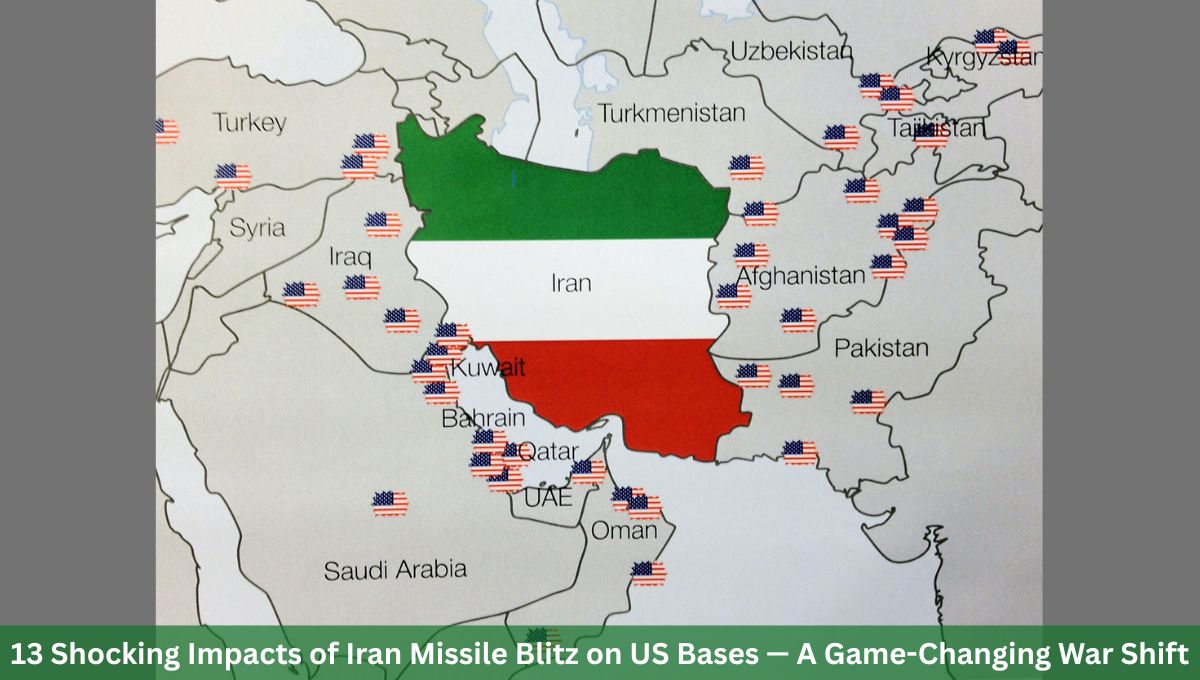
13 Shocking Impacts of Iran Missile Blitz on US Bases — A game-changing war shift to ‘Remote Warfare.’ The ongoing conflict between Iran and the United States has entered a dangerous and unprecedented phase, as a sustained wave of Iranian missile and drone attacks has severely damaged American military infrastructure across the Middle East.
Thank you for reading this post, don't forget to subscribe!What was once a network of fortified, high-tech US bases has now become a fragmented battlefield.
Reports indicate that at least 13 major installations are either heavily damaged or completely uninhabitable, forcing thousands of US troops to abandon traditional bases and operate from temporary locations such as hotels, office buildings, and remote facilities.
This dramatic shift is not just tactical—it represents a fundamental transformation in how modern wars are fought.
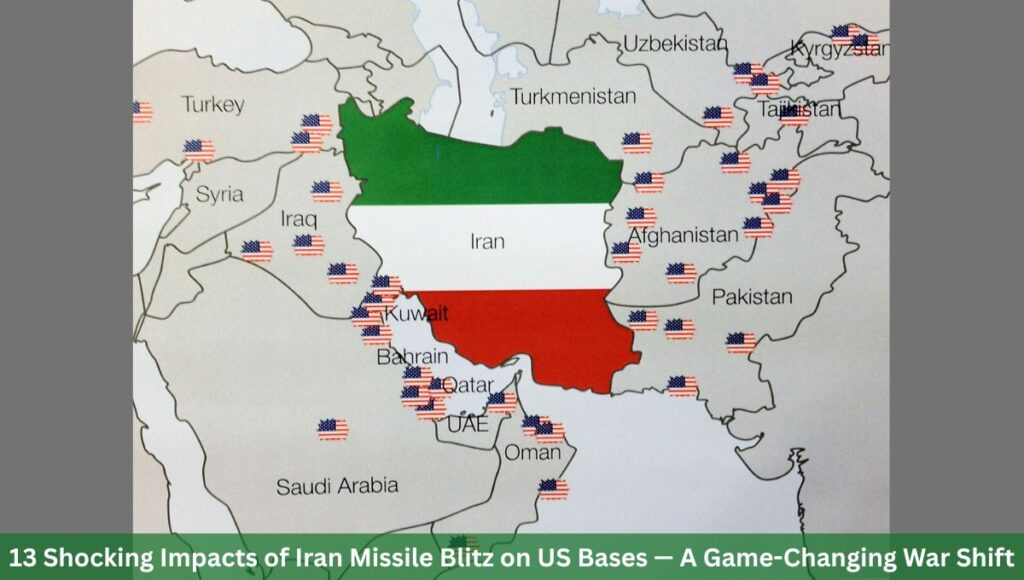
13 Shocking Impacts of Iran Missile Blitz on US Bases — A Game-Changing War Shift
A New Reality: War Without Bases
For decades, the US military has relied on large, centralized bases across the Middle East to project power, coordinate operations, and maintain regional dominance.
That model is now under direct threat.
According to multiple reports, Iranian strikes have targeted critical infrastructure, including:
- Command and control centers
- Communication networks
- Fuel storage facilities
- Radar systems
- Aircraft support infrastructure
As a result, US ground forces are now dispersed across the region, effectively conducting what officials describe as “remote warfare.”
Unlike traditional combat environments, where troops operate from secure installations, many US personnel are now working from improvised setups—dramatically altering operational efficiency.
13 US Bases Hit: Scale of the Damage
The scale of destruction is extensive and geographically widespread.
Key US military installations in countries such as:
- Kuwait
- Qatar
- Bahrain
- Saudi Arabia
have all reportedly suffered significant damage.
Major Bases Affected
- Port Shuaiba (Kuwait): Tactical operations center destroyed
- Ali Al Salem Air Base: Infrastructure and logistics severely hit
- Camp Buehring: Operational disruption and casualties reported
- Al Udeid Air Base (Qatar): Critical radar systems damaged
- US Fifth Fleet HQ (Bahrain): Communications equipment targeted
- Prince Sultan Air Base (Saudi Arabia): Fuel and tanker systems hit
These installations were not just symbolic—they formed the backbone of US military coordination in the region.
Why This Changes Everything
The shift from fortified bases to dispersed operations introduces several critical challenges:
1. Reduced Coordination
Military operations rely heavily on centralized command structures. Dispersal weakens real-time coordination and decision-making.
2. Slower Response Times
Without proximity to key infrastructure, response times to threats and opportunities are significantly delayed.
3. Loss of Operational Capability
Experts warn that essential equipment cannot simply be replicated in temporary locations.
4. Increased Vulnerability
Operating from civilian or semi-civilian environments raises serious security risks.
As one military expert noted, “You can’t replicate a fully equipped base on the top floor of a hotel.”
Iran’s Strategy: Precision and Persistence
The strikes are being attributed largely to Iran’s elite military wing, the Islamic Revolutionary Guard Corps (IRGC), which has demonstrated a significant advancement in missile and drone warfare capabilities.
Unlike past adversaries faced by the US in Iraq or Afghanistan, Iran possesses:
- Long-range precision missiles
- Advanced drone swarms
- Integrated targeting systems
- Cyber and electronic warfare capabilities
This has allowed Tehran to strike US positions with unprecedented accuracy and consistency.
Remote Warfare: A Pandemic-Era Concept Meets the Battlefield
The term “remote warfare” has taken on a literal meaning in this conflict.
While fighter jets and air crews continue to operate from functional airfields, much of the ground-based military is now:
- Coordinating missions digitally
- Managing logistics remotely
- Operating from temporary command hubs
In essence, parts of the US military are now fighting a high-intensity war without traditional battlefield infrastructure.
Civilian Risk Escalates
One of the most alarming developments is the increasing overlap between military and civilian spaces.
Iran has warned that locations housing US troops—even civilian sites like hotels—could be considered legitimate targets.
This raises serious concerns about:
- Civilian safety
- International law implications
- Escalation into broader regional conflict
Iranian officials have even urged civilians to report suspected US troop locations, intensifying fears of surveillance and targeting within populated areas.
Pentagon Response: Pressing Forward Despite Setbacks
Despite the setbacks, US officials insist that operations continue at full pace.
Pete Hegseth, the US Defense Secretary, has stated that American forces have carried out thousands of strikes on Iranian targets, signaling continued offensive momentum.
However, internal assessments suggest the situation is far from stable.
Officials acknowledge that:
- Operations are becoming more complex
- Logistics chains are under strain
- Sustaining long-term engagement is increasingly difficult
Troop Relocation and Reinforcements
To mitigate risks, the Pentagon has initiated a large-scale relocation effort.
Key Moves Include:
- Deployment of additional fighter squadrons
- Movement of troops to safer locations, including parts of Europe
- Reinforcement with rapid-response units like airborne and Marine forces
Some units, including elements of elite divisions, are being positioned closer to potential flashpoints, indicating preparation for further escalation.
Strait of Hormuz Crisis Adds Global Pressure
The conflict is no longer confined to military installations.
Iran’s actions have disrupted one of the world’s most critical energy chokepoints—the Strait of Hormuz.
Global Impact Includes:
- Massive vessel congestion (hundreds of ships stranded)
- Rising oil and gas prices
- Threats to global supply chains
- Increased shipping insurance costs
Given that nearly 20% of global oil trade passes through this route, the economic implications are profound.
Satellite Imagery Restrictions Signal Escalation
In a parallel development, major US-based satellite companies have begun restricting access to high-resolution imagery of the conflict zone.
This move is intended to prevent adversaries from using commercial data to:
- Identify troop movements
- Target infrastructure
- Exploit battlefield vulnerabilities
The decision highlights how modern warfare now extends beyond physical combat into the realm of data and information control.
Strategic Miscalculation?
Some analysts believe the US may have underestimated Iran’s response capability.
For years, American bases in the Middle East were designed to counter insurgent threats—not a technologically advanced state actor like Iran.
This has exposed a critical vulnerability:
Fixed military infrastructure is increasingly obsolete in the face of precision missile warfare.
A Fragmented Battlefield Emerges
The result of these developments is a highly fragmented battlefield where:
- Command structures are decentralized
- Troops are scattered across multiple locations
- Traditional frontlines are blurred
This environment makes the conflict harder to predict, control, and ultimately resolve.
Diplomatic Uncertainty and Rising Tensions
Even as military operations intensify, diplomatic signals remain mixed.
Donald Trump has suggested that negotiations with Iran may be underway, though Tehran has denied any such talks.
This disconnect underscores the uncertainty surrounding the conflict’s future trajectory.
What Comes Next?
The current situation raises several critical questions:
Can the US sustain operations without secure bases?
The logistical and operational challenges suggest long-term sustainability may be difficult.
Will the conflict expand further?
With civilian areas increasingly at risk, the potential for regional escalation is high.
Is this the future of warfare?
The shift toward decentralized, remote operations may signal a broader transformation in military strategy worldwide.
Conclusion: A War Redefined
The Iran-US conflict has entered a phase that challenges conventional military doctrine.
What began as a regional confrontation has evolved into a complex, high-tech war where:
- Precision strikes replace traditional battles
- Data control becomes a strategic weapon
- And soldiers fight not from bases—but from dispersed, improvised locations
The concept of “remote warfare” is no longer theoretical. It is unfolding in real time, reshaping not just this conflict—but potentially the future of global warfare itself.
As tensions continue to rise, the world watches closely—aware that the consequences of this evolving conflict will extend far beyond the Middle East.
Also Read: 9 Shocking Signals as Iran Targets Diego Garcia in 4,000 Km Missile Escalation
Also Read: Iran’s missile blitz cripples US bases, triggers shift to remote warfare in Middle East
Related Posts:
- 3 Explosive Conditions Iran Sets to End War with US…

- 9 Explosive Claims as Trump Says US Winning Iran War

- 7 Powerful Facts About Ayatollah Ali Khamenei’s…

- 5 Major Takeaways from the US Supreme Court's…

- 7 Heartbreaking Facts About Venezuela's Earthquake Disaster

- 10 Explosive Warnings as Donald Trump Calls Iran…