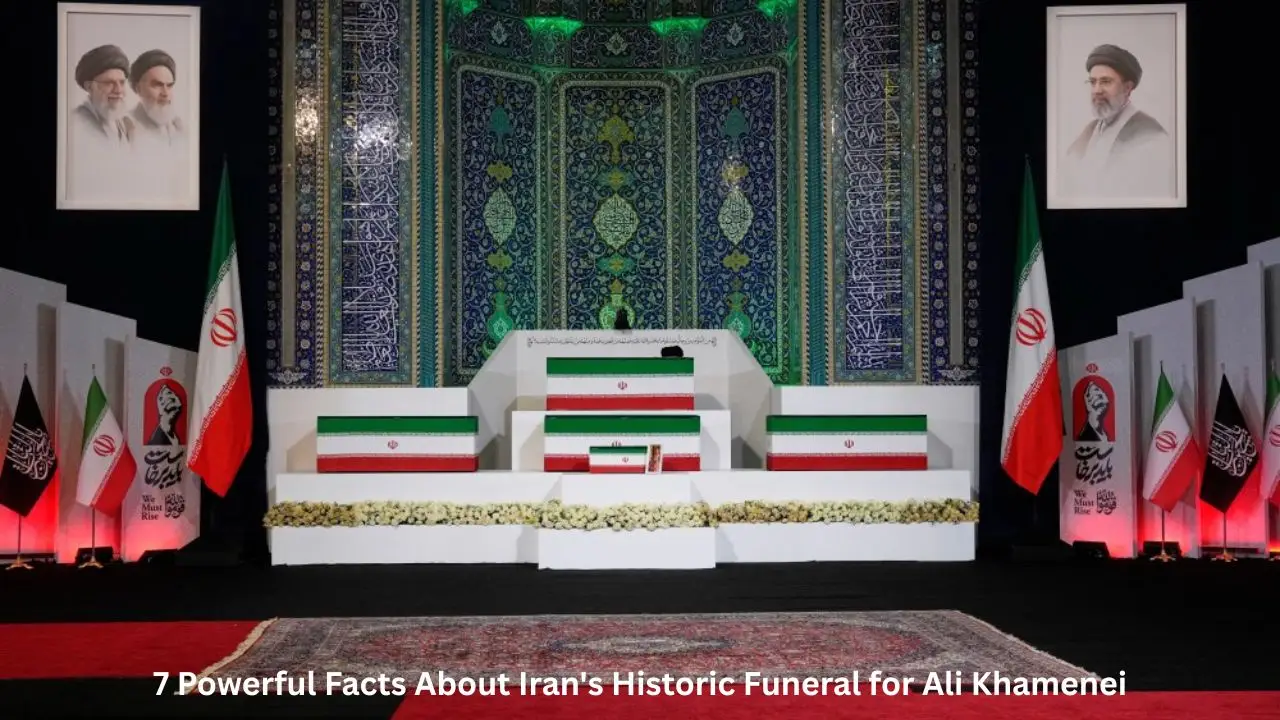
7 Powerful Facts About Iran’s Historic Funeral for Ali Khamenei that drew massive crowds, foreign delegations, and global attention. Iran has launched one of the largest and most politically significant state funerals in its modern history, as millions of mourners, foreign delegations, senior military commanders, and religious leaders gather to honor former Supreme Leader Ayatollah Ali Khamenei.
The week-long ceremonies, which began in Tehran on July 3, are far more than a farewell to a leader who ruled Iran for nearly four decades. They represent a carefully choreographed display of national unity, religious symbolism, and geopolitical messaging following months of war, regional instability, and leadership transition.
From emotional scenes inside Tehran’s Grand Mosalla to the arrival of delegations from dozens of countries, the funeral has become one of the world’s biggest news events. Here are the seven most important takeaways.
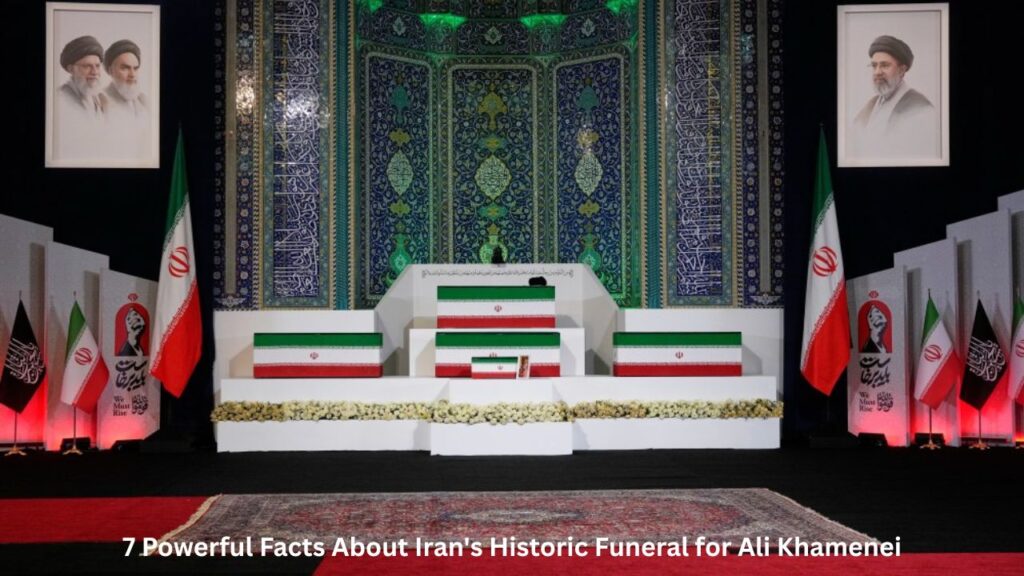
7 Powerful Facts About Iran’s Historic Funeral for Ali Khamenei
1. Iran Is Holding One of Its Largest State Funerals in Decades
The funeral ceremonies officially began in Tehran after Khamenei’s coffin was placed in state at the Imam Khomeini Grand Mosalla, where thousands of mourners lined up to pay their final respects.
Authorities expect millions of people to participate throughout the week as ceremonies continue across several cities before the final burial in Mashhad.
Black mourning banners, massive portraits of Khamenei, and security personnel dominate the streets of Tehran as the government attempts to demonstrate national solidarity during one of the most challenging periods in the country’s recent history.
2. The Funeral Became a Powerful Symbol of National Unity
Iranian leaders are portraying the funeral not simply as a religious ceremony but as a national statement.
Officials have repeatedly described public participation as proof that the Islamic Republic remains resilient despite months of conflict, international sanctions, economic hardship, and domestic unrest.
Government agencies arranged transportation, accommodation, food distribution, and logistical support to encourage large public participation throughout the mourning period.
3. Emotional Scenes Dominated the Ceremony
Television broadcasts showed emotional moments throughout the opening ceremonies.
Senior Iranian officials—including Parliament Speaker Mohammad Bagher Ghalibaf and Foreign Minister Abbas Araghchi—were seen visibly emotional while paying tribute to the late leader.
Many mourners carried Iranian flags, religious banners, and portraits of Khamenei while chanting religious slogans and prayers.
Families of those killed during recent conflicts also participated in the ceremonies, adding another emotional dimension to the state event.
4. Foreign Delegations Turned the Funeral Into a Major Diplomatic Event
The funeral attracted representatives from numerous countries across Asia, the Middle East, Africa, and beyond.
Delegations from countries maintaining close ties with Iran attended alongside religious organizations and regional political groups.
India also sent a parliamentary delegation that included political leaders from Jammu and Kashmir, while officials from several neighboring countries participated in official ceremonies.
Although not every major world leader attended personally, the broad international representation highlighted Iran’s continuing diplomatic relationships despite ongoing geopolitical tensions.
5. Security Was Extraordinary Throughout Tehran
Security measures surrounding the funeral have been among the most extensive seen in Iran in years.
Military personnel, police units, intelligence services, and members of the Islamic Revolutionary Guard Corps maintained an extensive presence around major venues.
Temporary restrictions on airspace and transportation were introduced as authorities sought to prevent any disruption during the ceremonies.
Iranian officials also warned that any external attack during the mourning period would receive a strong response, reflecting the fragile regional security environment following the recent conflict involving Iran, Israel, and the United States.
6. Questions Remain Over Iran’s Leadership Transition
While the funeral focuses on honoring Khamenei’s legacy, attention has inevitably shifted toward Iran’s political future.
His son and successor, Mojtaba Khamenei, has reportedly remained absent from public events because of injuries sustained during the conflict, according to multiple reports.
The leadership transition comes at a critical moment as Iran faces economic challenges, diplomatic isolation from many Western nations, and continuing tensions across the Middle East.
Analysts believe the new leadership will face immediate pressure to stabilize the economy, manage regional alliances, and navigate relations with global powers.
7. The Funeral Carries Deep Religious and Historical Significance
Beyond politics, the ceremonies are deeply rooted in Shiite Islamic traditions.
Khamenei’s coffin has been draped with religious symbols reflecting his position as Iran’s highest religious authority for nearly 37 years.
The funeral route includes important religious cities such as Qom, Najaf, Karbala, and finally Mashhad, where Khamenei is expected to be buried near the revered Imam Reza shrine.
For many supporters, the ceremonies symbolize sacrifice, martyrdom, and continuity within Iran’s religious leadership, themes that have long played a central role in the country’s political identity.
Global Reaction
The funeral has generated worldwide attention, prompting extensive coverage from international media outlets.
Governments have responded cautiously, with some sending official representatives while others limited participation due to diplomatic considerations and regional security concerns.
The ceremonies are unfolding against the backdrop of continuing uncertainty over Iran’s relations with the United States, Israel, Gulf Arab states, and the wider international community.
Political analysts say the funeral represents both an ending and a beginning—closing one of the longest chapters in Iran’s leadership while opening another whose direction remains uncertain.
What Happens Next?
Following the ceremonies in Tehran, Khamenei’s remains will be taken to major Shiite religious centers before the final burial in Mashhad.
Iran has declared an extended national mourning period, with memorial events expected across the country.
The coming weeks are likely to focus increasingly on the policies of Iran’s new leadership, the country’s regional strategy, and efforts to navigate a changing geopolitical landscape.
International observers will also closely monitor how the leadership transition affects negotiations, security policy, and Iran’s relationships with neighboring countries.
Conclusion
The funeral of Ayatollah Ali Khamenei has become far more than a state ceremony. It is a defining political and religious event that showcases Iran’s effort to project unity during a period of profound uncertainty.
Massive crowds, emotional tributes, international delegations, and unprecedented security measures underscore the significance of the occasion. At the same time, the transition to new leadership raises important questions about Iran’s domestic direction, regional influence, and future role on the global stage.
As the week-long ceremonies continue, the world will be watching not only how Iran remembers one of its most influential leaders but also how it prepares for the next chapter in its modern history.
Also Read: 7 Shocking Facts About Israel’s ‘Blue Sparrow’ Missile That Killed Ali Khamenei
Also Read: Khamenei’s funeral tests Iran’s diplomatic standing in post-war Middle East