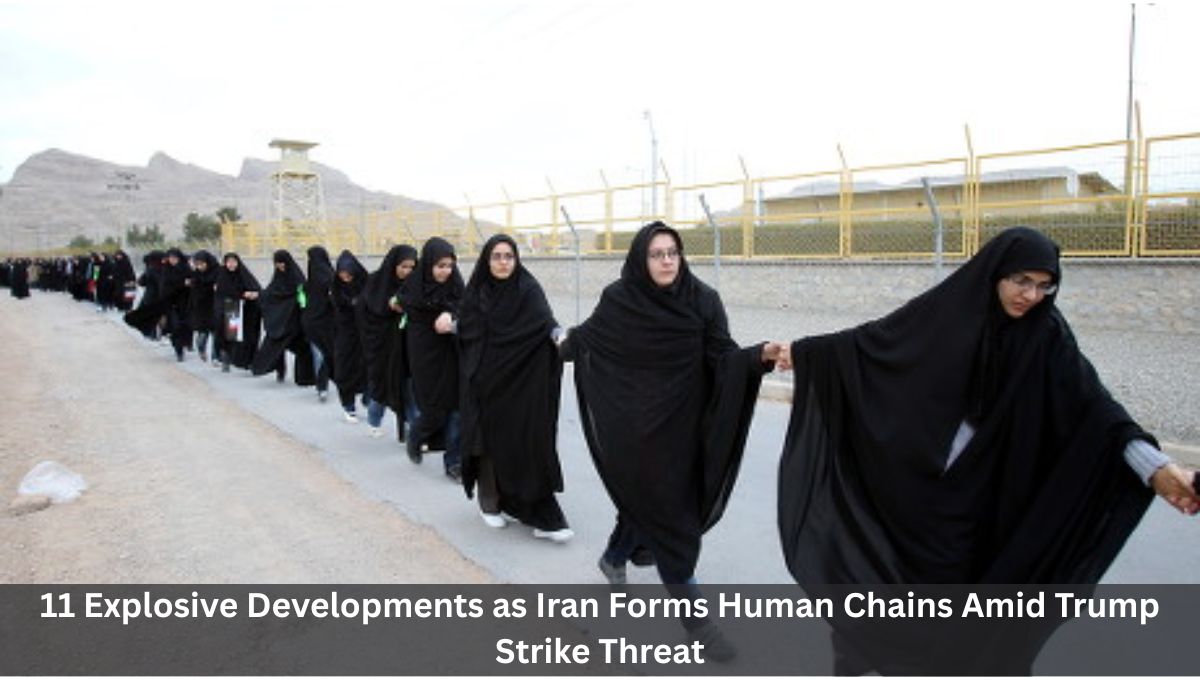
11 Explosive Developments as Iran Forms Human Chains Amid Trump Strike Threat and deadline. As tensions between the United States and Iran reach a critical boiling point, Tehran has made a dramatic and highly symbolic move—calling on its citizens to form human chains around key power plants across the country.
Thank you for reading this post, don't forget to subscribe!The unprecedented appeal comes just hours before a deadline set by US President Donald Trump, who has warned of sweeping strikes on Iran’s infrastructure if Tehran does not comply with demands related to the reopening of the Strait of Hormuz.
This moment marks a dangerous escalation in both rhetoric and strategy, blending military threats, civilian mobilisation, and global economic stakes into a volatile geopolitical flashpoint.
11 Explosive Developments as Iran Forms Human Chains Amid Trump Strike Threat
Iran’s Call: Human Chains to Protect Infrastructure
Iran’s Ministry of Sports and Youth has urged citizens—particularly young people, students, athletes, and artists—to gather around power plants and form symbolic human chains.
What the Initiative Involves:
- Nationwide mobilisation of civilians
- Gathering at power plants from 2:00 PM local time
- Formation of “human chains” or “human rings”
- Participation encouraged across social and cultural groups
The campaign, titled “Iran’s Youth Human Chain for a Bright Future,” is being framed as a peaceful act of solidarity.
Official Messaging:
Iranian officials describe the move as:
- A demonstration of unity
- A protest against potential attacks on civilian infrastructure
- A statement that such attacks would constitute war crimes
Deputy Minister Alireza Rahimi emphasized that the initiative originated from youth groups themselves, reinforcing the narrative of grassroots participation.
Why Power Plants Are at the Center of the Crisis
Power plants have become a focal point due to explicit threats from Washington.
President Trump has repeatedly warned that if Iran fails to meet his demands:
- All power plants could be destroyed
- Bridges would be targeted simultaneously
- The country’s infrastructure could be “taken out in one night”
Strategic Importance of Power Plants:
- Backbone of civilian life (electricity, water systems)
- Critical for hospitals and emergency services
- Essential for industrial and economic activity
Targeting such infrastructure would have devastating humanitarian and economic consequences.
Trump’s Ultimatum: “Power Plant Day” Warning
In a series of statements and social media posts, Donald Trump has issued one of the starkest ultimatums of the conflict.
Key Elements of the Threat:
- Deadline tied to reopening the Strait of Hormuz
- Warning of “complete demolition” of infrastructure
- Timeline suggesting rapid execution of strikes
Trump’s language has drawn widespread attention—not only for its severity but also for its tone, which included unusually direct and aggressive phrasing.
Core Demand:
Iran must ensure unrestricted shipping through the Strait of Hormuz, a critical artery for global oil trade.
Failure to comply, according to Trump, would trigger immediate military action.
The Strait of Hormuz: The Real Battleground
At the heart of the crisis lies the Strait of Hormuz.
Why It Matters:
- Carries nearly 20% of global oil supply
- Vital for energy exports from Gulf countries
- Central to global economic stability
Iran’s effective restriction of traffic through the strait has already caused:
- Oil prices to surge
- Shipping disruptions
- Global economic anxiety
The U.S. views reopening the strait as non-negotiable, making it a key trigger point for potential escalation.
Human Chains as Strategy: Symbolism or Shield?
The formation of human chains is not just symbolic—it carries strategic implications.
Possible Objectives:
- Deterrence
Creating a civilian presence at potential targets may complicate military planning. - Global Messaging
Highlighting the humanitarian risks of infrastructure strikes. - Domestic Unity
Reinforcing national solidarity during wartime.
Historical Context: Civilian Shields in Conflict
The tactic of placing civilians near strategic sites has precedent in modern warfare.
Examples:
- Use of civilian presence around sensitive facilities during the Gulf War
- Similar strategies in other high-intensity conflicts
While controversial, such actions are often intended to:
- Raise the political cost of military strikes
- Influence international opinion
Legal and Ethical Questions: War Crimes Debate
The situation has reignited debate over international law.
Key Issues:
- Is targeting power plants a war crime?
- What protections do civilians have under international law?
- Does the presence of civilians change military legality?
International organizations, including the United Nations, have previously warned that:
- Attacks on civilian infrastructure may violate humanitarian law
- Civilian casualties must be minimized
Trump, however, has dismissed concerns about legal implications, arguing that broader security goals take precedence.
Iran’s Defiant Response
Iran has shown no signs of backing down.
Official Stance:
- Rejecting temporary ceasefire proposals
- Demanding a permanent end to hostilities
- Warning of retaliation against US and allied assets
Iranian officials have framed US threats as:
- “Reckless”
- “Baseless rhetoric”
- Evidence of strategic pressure tactics
Diplomatic Efforts: Still in Motion
Despite escalating rhetoric, negotiations continue behind closed doors.
Key Developments:
- Iran has proposed a 10-point peace framework
- Mediation efforts involve countries like Pakistan
- Talks reportedly ongoing despite public hostility
A regional official involved in discussions stated that:
“We are still talking to both sides.”
This suggests that diplomacy, while fragile, is not yet dead.
Social Media War: Iran’s Unusual Counterstrategy
Beyond military and diplomatic fronts, Iran has also engaged in a social media campaign.
Notable Features:
- Sarcastic responses to Trump’s statements
- Mockery of “Stone Age” threats
- Viral engagement with global audiences
This digital strategy:
- Shapes public perception
- Amplifies messaging beyond traditional media
- Adds a psychological dimension to the conflict
Military Escalation Across the Region
The broader conflict continues to intensify.
Recent Developments:
- Airstrikes on Iranian infrastructure
- Missile attacks targeting regional assets
- Escalation involving Israel and allied forces
The risk of a wider regional war remains high.
Oil Markets on Edge
The crisis has already disrupted global energy markets.
Current Impact:
- Oil prices exceeding $110 per barrel
- Supply chain instability
- Increased fuel costs worldwide
Future Risks:
- Prolonged energy shortages
- Inflationary pressures
- Economic slowdown in import-dependent countries
Civilian Risk: The Human Cost of Escalation
At the center of the crisis are ordinary civilians.
Key Concerns:
- Potential mass casualties
- Disruption of essential services
- Long-term humanitarian impact
The call for human chains highlights the extent to which civilians are being drawn into the conflict.
Could Trump Delay the Strike?
Despite strong rhetoric, there are indications that military action may not be immediate.
Factors That Could Delay Action:
- Progress in negotiations
- Pressure from allies
- Risk of global backlash
Reports suggest that Trump may reconsider if a deal appears imminent.
Iran’s Strategic Messaging
Iran’s actions reflect a broader communication strategy.
Key Themes:
- Resistance against external pressure
- Framing conflict as defensive
- Emphasizing sovereignty and resilience
The human chain initiative fits within this narrative.
What Happens If Strikes Begin?
If the US proceeds with strikes:
Immediate Consequences:
- Destruction of infrastructure
- Civilian casualties
- Escalation of military retaliation
Broader Impact:
- Regional war expansion
- Global economic shock
- Diplomatic fallout
Global Reactions: A World Watching Closely
Governments worldwide are closely monitoring developments.
Key Concerns:
- Stability of energy supplies
- Risk of wider conflict
- Impact on global markets
The crisis has become a defining moment for international diplomacy.
The Role of the United Nations
The UN Security Council is actively engaged.
Possible Actions:
- Passing resolutions on maritime security
- Encouraging diplomatic solutions
- Coordinating international response
However, divisions among major powers may limit effectiveness.
A New Phase of Modern Warfare
This crisis highlights evolving dynamics in warfare:
Emerging Trends:
- Civilian involvement in strategic defense
- Information warfare and social media influence
- Blurring lines between military and civilian targets
Conclusion: A Dangerous Turning Point
The call for human chains around Iran’s power plants represents a striking escalation in a rapidly intensifying conflict.
As Trump’s deadline approaches, the world faces a critical moment:
- Will diplomacy prevail?
- Will military action reshape the region?
- Or will uncertainty continue to dominate?
What happens next will not only determine the future of the US-Iran conflict but could also redefine global energy security and geopolitical stability for years to come.
Also Read: 9 Shocking Moments as Trump Invokes Faith in Iran Rescue, Sparking Global Backlash
Also Read: Trump warns a ‘whole civilization will die tonight’ if a deal with Iran isn’t reached
Related Posts:
- 11 Explosive Warnings as Trump Vows to ‘Knock the…

- 9 Explosive Claims as Trump Says US Winning Iran War

- Trump's 3 Blunt Warnings to China and Russia Over…
- 3 Explosive Conditions Iran Sets to End War with US…
- 10 Explosive Warnings as Donald Trump Calls Iran…
- 11 Explosive Revelations From Ted Cruz’s Leaked…