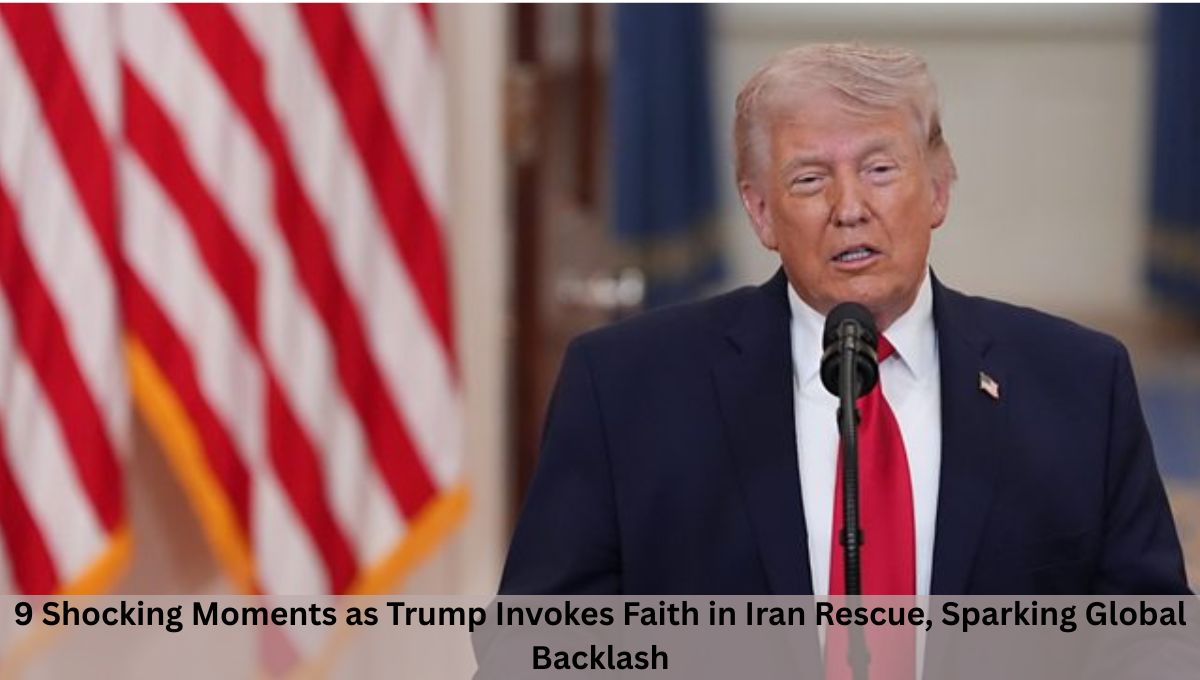
9 Shocking Moments as Trump Invokes Faith in Iran Rescue, Sparking Global Backlash and raising concerns over US policy. A high-risk U.S. military operation deep inside Iran successfully rescued a stranded American airman, marking one of the most daring missions in recent history. But what should have been a unifying moment of military success has instead ignited a fierce global debate.
At the center of the controversy is President Donald Trump, whose decision to frame the rescue in religious terms—calling it an “Easter miracle”—has drawn sharp criticism from political leaders, religious groups, and analysts worldwide.
The intersection of faith, warfare, and political messaging has once again come under scrutiny, raising deeper questions about how modern conflicts are communicated and justified.
9 Shocking Moments as Trump Invokes Faith in Iran Rescue, Sparking Global Backlash
The Dramatic Rescue Inside Iran
A Mission Against All Odds
The rescue operation began after an American F-15E Strike Eagle was shot down over Iran.
While one crew member was quickly recovered, the second—a weapons systems officer—remained stranded deep in hostile territory.
For over 36 hours, the injured airman evaded capture in rugged mountainous terrain, relying on survival training and limited communication tools.
Key Highlights of the Operation
- Nearly 200 special operations forces were deployed
- The airman hid in a mountain crevice while being hunted
- A coordinated deception campaign misled Iranian forces
- Advanced surveillance and drone support tracked movements
- Extraction involved intense firefights and aerial cover
Despite mechanical failures that stranded aircraft inside Iran, U.S. forces successfully extracted the airman, destroying disabled equipment to prevent it from falling into enemy hands.
The Message That Sparked Alarm
During the ordeal, the stranded officer transmitted a short radio message:
“God is good.”
While seemingly simple, the phrase triggered immediate concern among U.S. officials.
Why It Raised Suspicion
Military communication protocols are highly structured, especially in hostile environments.
The unexpected religious phrasing led to fears that:
- The airman might have been captured
- The message could be a trap
- Iranian forces might be manipulating communication
Ultimately, officials confirmed the airman’s identity and status, but the moment highlighted the fragility of decision-making in war.
Trump’s “Easter Miracle” Remark
Following the successful mission, Donald Trump publicly described the rescue as an “Easter miracle.”
Religious Framing of Military Success
Trump’s remarks were echoed by senior officials:
- Treasury Secretary referenced Easter as “the greatest victory in history”
- Defense leadership used phrases like “God is good”
- Public messaging linked the mission to divine intervention
This marked a notable departure from traditional, more neutral presidential messaging during religious holidays.
Blurring the Line Between Faith and Policy
Criticism from Political and Religious Groups
The use of religious language in a military context quickly drew backlash.
Key Concerns Raised
- Weaponization of religion in political messaging
- Undermining the separation of church and state
- Risk of framing war as divinely justified
Organizations like the Council on American-Islamic Relations condemned the rhetoric, particularly Trump’s use of Islamic phrases alongside threats of violence.
Controversial Language and Global Reaction
In addition to religious references, Trump’s messaging included aggressive threats toward Iran, including potential strikes on infrastructure.
What Sparked Outrage
- Use of explicit language in official communication
- Threats targeting power plants and bridges
- Use of “Praise be to Allah” in a threatening context
Critics argued that such rhetoric risks escalating tensions and alienating global audiences.
Voices of Dissent Within the US
Criticism was not limited to opposition parties.
Internal Political Pushback
Even figures within Trump’s broader political sphere expressed concern:
- Calls for prioritizing peace over escalation
- Warnings about moral and ethical implications
- Concerns about global perception of U.S. leadership
Lawmakers also raised alarms about reports of religious narratives influencing military justification.
Iran’s Response: Propaganda and Counter-Narratives
Iran responded with a mix of denial, criticism, and propaganda.
Key Claims by Iran
- The rescue mission was a “failure”
- Multiple U.S. aircraft were destroyed
- The operation was a deception attempt
Information Warfare Intensifies
Iranian officials and state media launched a coordinated messaging campaign:
- Mocking U.S. leadership on social media
- Referencing past U.S. military failures
- Highlighting civilian impact of the conflict
The Role of Deception in Modern Warfare
One of the most striking aspects of the operation was the use of deception.
CIA’s Strategic Misdirection
U.S. intelligence reportedly spread false information suggesting:
- The airman had already been rescued
- A ground convoy was transporting him out
This tactic diverted Iranian forces away from the actual rescue site.
Why It Worked
- Exploited existing communication channels
- Created confusion among Iranian search teams
- Bought critical time for extraction
A High-Stakes Extraction Operation
What Nearly Went Wrong
The mission was far from smooth:
- Aircraft suffered mechanical failures
- Rescue teams risked being stranded
- Iranian forces were closing in
At one point, commanders faced a critical decision: proceed or abort.
The Final Outcome
- The airman was successfully rescued
- No U.S. personnel were captured
- Disabled aircraft were destroyed
The mission ended as a tactical success—but with significant risks and costs.
Wider Implications for the Iran War
Escalating Conflict
The rescue took place amid a broader and intensifying conflict involving:
- U.S. and Israeli strikes
- Iranian retaliation across the region
- Rising tensions in the Strait of Hormuz
Economic Impact
- Oil prices surged globally
- Energy markets faced severe disruption
- Supply chains came under pressure
Religion in Warfare: A Dangerous Precedent?
Historical Context
Religion has often been invoked in times of war, but modern democratic systems typically maintain a clear separation between faith and state policy.
Why This Matters Now
The current situation raises concerns about:
- Legitimizing war through religious narratives
- Increasing polarization domestically and globally
- Undermining diplomatic efforts
Global Perception and Diplomatic Fallout
Impact on Allies
Allies may view such rhetoric as:
- Unpredictable
- Escalatory
- Counterproductive to diplomacy
Impact on Adversaries
For adversaries, it can:
- Reinforce existing narratives
- Justify retaliatory propaganda
- Complicate negotiations
The Human Story Behind the Headlines
Amid geopolitical tensions, the rescue remains a deeply human story.
A Fight for Survival
- A wounded airman alone in hostile territory
- Constant threat of capture
- Reliance on training, instinct, and resilience
A Massive Effort to Bring Him Home
- Hundreds of personnel involved
- Advanced technology deployed
- Coordinated intelligence and military strategy
Conclusion: Victory, Controversy, and Uncertainty
The rescue of the stranded airman stands as a remarkable military achievement.
It demonstrated coordination, precision, and the willingness to take extraordinary risks to save a single life.
However, the way the event has been framed—particularly through religious rhetoric—has sparked a broader debate about leadership, communication, and the role of faith in modern warfare.
As the Iran conflict continues to unfold, the world is watching closely—not just the actions on the battlefield, but the narratives that shape them.
In an era where perception can be as powerful as reality, the language used by leaders may prove just as consequential as the decisions they make.
Also Read: 10 Explosive Updates on Iran Bridge Strike as Trump Warns ‘More to Follow’
Also Read: Trump’s ‘Easter miracle’ rescue praise fuels war rhetoric backlash
Related Posts:
- 7 Daring Moments in US Pilot Rescue Inside Iran That…
- 10 Explosive Warnings as Donald Trump Calls Iran…
- 11 Explosive Warnings as Trump Vows to ‘Knock the…

- 12 Explosive Claims as Donald Trump Says Iran War…
- 9 Explosive Claims as Trump Says US Winning Iran War

- 3 Explosive Conditions Iran Sets to End War with US…