Trump’s tariffs survive first legal hurdleas US Appeals Court Lets Trump’s ‘Liberation Day’ Tariffs Stand – For Now. In a significant win for President Donald Trump’s economic agenda, the U.S. Court of Appeals for the Federal Circuit ruled Tuesday that his sweeping “Liberation Day” tariffs can remain in place at least temporarily while legal challenges are reviewed.
This decision marks a critical development in the ongoing battle over Trump’s use of emergency powers to reshape American trade policy, particularly with nations like China, Canada, and Mexico. The ruling allows the Trump administration to continue collecting tariffs that critics argue are crippling small businesses and unsettling global markets.
But the court also signaled the gravity of the issue by fast-tracking the appeal, with oral arguments scheduled for July 31.
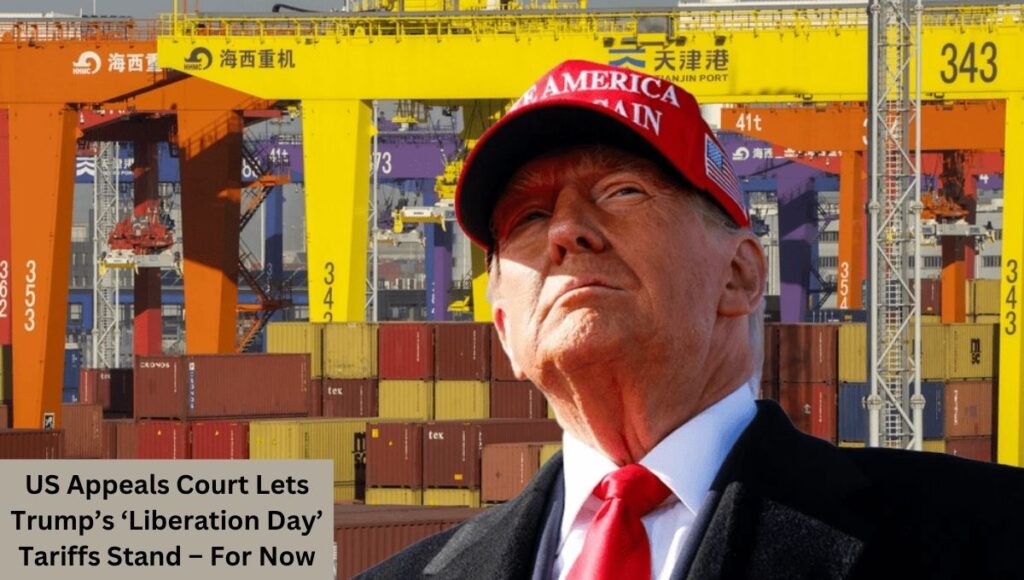
US Appeals Court Lets Trump’s ‘Liberation Day’ Tariffs Stand – For Now
Background: The Controversial ‘Liberation Day’ Tariffs
Trump’s tariffs nicknamed “Liberation Day” duties by the White House are among the broadest ever implemented under presidential authority. Citing national emergencies including persistent trade deficits and the fentanyl crisis, Trump invoked the International Emergency Economic Powers Act (IEEPA) to impose a 10% tariff on most imports in April.
An additional set of tariffs targeting Canada, China, and Mexico was introduced in February. These tariffs were pitched as leverage in trade negotiations and as deterrents against illegal immigration and drug trafficking.
Yet many legal experts and business groups argue that Trump’s actions exceed the constitutional powers granted to the president, raising questions about the broader implications for American governance and economic stability.
Legal Challenges: Federal Courts Push Back
On May 28, a three-judge panel from the U.S. Court of International Trade ruled against Trump’s tariffs, concluding that the IEEPA does not authorize the president to impose wide-ranging import taxes.
The court held that the U.S. Constitution grants Congress not the executive branch the power to impose tariffs, except under narrowly defined circumstances.
This ruling emerged from lawsuits filed by small businesses and 12 states, led by Oregon, which argued that the tariffs were not a lawful or effective way to address either trade deficits or drug trafficking.
These plaintiffs emphasized that America’s long-standing trade imbalance does not constitute a “national emergency” under the 1977 IEEPA statute.
Appeals Court Ruling: Tariffs Stay, But Questions Remain
In response to the lower court decision, the Trump administration swiftly appealed. On June 10, the Federal Circuit Court of Appeals in Washington, D.C., granted a stay, meaning the tariffs can continue to be enforced while the case moves forward.
While the court did not rule on the merits of the case, it acknowledged that the issue involves “questions of exceptional importance,” prompting the rare step of scheduling an expedited full-court (en banc) hearing. The appeals court’s order effectively extends the administration’s authority at least until the July 31 hearing.
White House Reacts: “Welcome Development”
The Trump White House welcomed the decision, claiming the administration is well within its legal rights to act under the emergency powers granted by Congress.
Spokesperson Kush Desai said in a statement, “The Trump administration is legally using the powers granted to the executive branch by the Constitution and Congress to address our country’s national emergencies of persistent goods trade deficits and drug trafficking.”
This statement underscores the administration’s position that economic and border-related threats justify emergency trade actions a view not universally shared by legal scholars or economists.
Impact on Businesses and Global Trade
While the legal debate continues, the economic effects are already being felt. The on-again, off-again nature of Trump’s tariff policies has created confusion and volatility for U.S. businesses and international trading partners.
Supply chains have been disrupted, production costs have surged, and companies across sectors are struggling to make pricing decisions amid uncertainty. Some firms have considered relocating production to the U.S. to avoid future tariffs, but such transitions are costly and time-intensive.
According to JPMorgan economists, without the IEEPA-related tariffs, the U.S. effective tariff rate would drop from 13–14% to around 5%, still nearly double the 2024 levels. For many companies, that difference represents millions in lost margins and added financial risk.
What Happens Next: July 31 Hearing Looms Large
The next key milestone will be the July 31 oral arguments before the full 11-member panel of the Federal Circuit. This expedited process could yield a definitive ruling on whether Trump’s tariffs under IEEPA are lawful.
Notably, the ruling does not affect other tariffs imposed under Section 232 of the Trade Expansion Act, which allows the president to impose duties in cases involving national security. That means sector-specific tariffs on items like steel, aluminum, and car parts will remain intact, regardless of the outcome of this broader legal challenge.
Expert Opinions: A Divided Legal Landscape
Legal experts are divided on how the appeals court will rule. Jeffrey Schwab, attorney for the small businesses challenging the tariffs, said the ruling was disappointing but far from final.
“Every court to rule on the merits so far has found these tariffs unlawful, and we have faith that this court will likewise see what is plain as day: that IEEPA does not allow the president to impose whatever tax he wants whenever he wants.”
Others, like Ilya Somin, a law professor at George Mason University, emphasized the importance of a speedy resolution, stating, “We hope to get a ruling on the merits faster than usual.”
Conclusion: Tariffs Stay, But the Stakes Are Rising
As the legal battle over Trump’s ‘Liberation Day’ tariffs intensifies, the stakes extend far beyond short-term economics. At the core of the dispute is a fundamental question: How much authority does the president have to reshape U.S. trade policy under the guise of national emergency?
With the Federal Circuit set to rule later this summer, businesses, lawmakers, and global partners are watching closely. Whether the court affirms or rejects Trump’s use of emergency economic powers will have profound implications not just for tariffs, but for the balance of power in American government and the future of international trade.
Also Read: Donald Trump’s “Liberation Day” Tariffs Set to Restructure Global Trade