Today, April 2, 2025 Donald Trump’s “Liberation Day” Tariffs Set to Restructure Global Trade. A landmark announcement on tariffs will be made today by US President Donald Trump. He is set to make the announcement today – a move he calls “Liberation Day.” The decision, will impose new duties on imports from a wide range of countries. This has sent shockwaves through global markets and has raised concerns about a possible trade war.
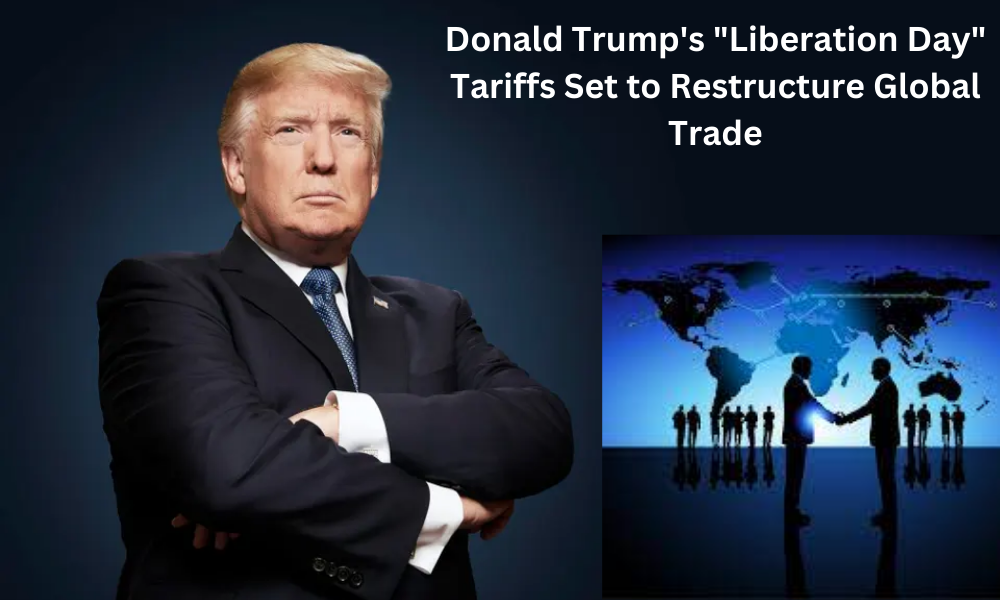
Donald Trump’s “Liberation Day” Tariffs Set to Restructure Global Trade
Trump’s “Liberation Day” Tariffs: What to Expect
Today, at 4 PM EST (20:00 GMT) Trump will unveil a sweeping set of tariffs at the White House Rose Garden. This is aimed at bringing down the US’s dependence on foreign goods.
The much-awaited announcement comes after months of speculation about how aggressive the new trade measures would be. Trump insists that the tariffs will go into effect immediately.
The tariffs on aluminum, steel, and various Chinese imports have already been employed by the administration. A 25% tariff on imported vehicles will start from April 3rd onwards.
More over the important revelation will be whether the tariff will be imposed on specific trading partners or on all countries.
How High Will the Tariffs Be?
One of the biggest facts that has been looming until today is how severe the tariffs would be. According to the reports Trump’s advisors have considered 20% tariff on all imports universally. However, the White House has hinted that the tariffs would vary by country.
Earlier this week Trump indicated that the tariffs imposed by the US on other nations would be less compared to the tariff charged by other countries on US.
However, he said that the goal is to level the playing field and act against non-tariff barriers, such as vehicle safety rules and value-added tax (VAT) policies that disbenefit American businesses.
Which Countries Will Be Hit the Hardest?
US could put pressure on many key US trading partners, which would include Canada, Mexico, the European Union, China, and India with a broad tariff policy. The Office of the US Trade Representative have already identified the nations that it would be particularly interested in targeting.
They include the major US trade partners namely Canada, Mexico, China, Japan, the EU, and the UK, nations with emerging economies and marked US trade ties such as India, Indonesia, Thailand, Vietnam, Malaysia, and Turkey and Oil-exporting nations which are Saudi Arabia and Russia.
Earlier Trump had always condemned the US’s trade deficit with the European Union and China. BBC news reported that Trump had raised tariff as high as 60% on Chinese imports. But it is still very unclear that in today’s announcement Trump will take the same stance.
India’s Response to Trump’s Tariff Plan
Among the other countries, India is one of the nations that is trying to ease the economic impact of these new tariffs. Trump has often pointed out India for imposing high tariff on American agricultural products.
White House Press Secretary Karoline Leavitt claimed that India charged 100% tariff on American agricultural goods and Trump’s new tariffs would curb such policies.
Meanwhile India and the United States have been working toward a bilateral trade agreement, with Commerce Minister Piyush Goyal which they say is progressing positively. But today’s announcement could complicate the situations and compel India to reconsider its trade polices with the United States.
How Global Markets Are Reacting
The lack of certainty surrounding Trump’s tariffs has already shaken global markets. Yesterday Indian stock indices fell sharply, with the Sensex dropping 1,390 points (1.8%) and the NSE Nifty sliding by 353 points (1.5%).
The impact is being felt among other countries as well. The euro was trading at $1.0792, US dollar has strengthened slightly against other currencies, and the British pound at $1.2924. Moreover, investors’ confidence is brought down by concerns about a potential trade war while in the US economy some analysts warn of possible stagflation.
International Backlash and Retaliation
Many nations have said that they are prepared and ready to retaliate against US tariffs. According to a Chinese state broadcaster, China, Japan, and South Korea have together agreed to coordinate their response to the US tariffs.
The European Commission President Ursula von der Leyen has stated that EU hopes for a negotiation and that all options are on the table, along with counter-tariffs on American goods.
On $20.7 billion worth of US imports Canada has already imposed a 25% tariff, and Mexican officials stated that they are also considering similar measures.
How Will Trump’s Tariffs Impact the US Economy?
On Trumps tariffs, economists warn of unforeseen consequences while Trump and his advisors argue that tariffs will reduce reliance on foreign imports and restore American manufacturing.
A former White House trade advisor, Kelly Ann Shaw said that everything starts on April 2nd and does not end there. She then went on to say that they are at the beginning of what is called a complete overhaul of the global trading system.
Deutsche Bank Economists estimate that uncertainty caused by tariffs could bring down US GDP growth by 1% over several quarters. Chief Policy Officer at the US Chamber of Commerce, Neil Bradley, stated that it is not a positive in having certainty about economically harmful policies.
Could Tariffs Lead to a Recession?
Many of the economists are worried about the likelihood of a trade war and its ripple effects on supply chains and inflation.
According to Nicholas Bloom, economist in Stanford University, today’s announcement could open doors to a series of ongoing tariff hikes or clarify the future of US trade policy.
He stated that if today’s announcement is a one-time announcement, April could reduce the uncertainty about tariffs. He also added that he thinks it will be a series of ongoing announcements.
On Tuesday US manufacturing data released pointed out a contraction in March with factory inflation hitting a three-year high. Analysts at Wells Fargo noted, A front-running of tariffs and a shift to minimize import exposure is escalating prices where persistent uncertainty is crimping demand.
What Comes Next?
While in Trump’s second term, today’s announcement is expected to set the tone for US trade policy it is not likely to be the final word. The administration, based on reactions from the international allies and business community may make further changes.
However, as Trump’s Liberation Day unfolds, businesses, global markets, and policymakers are holding their breath. Whether this move ignites a global trade war or strengthens the US economy is yet to be seen.
Also Read: Trump Announces April 2nd as ‘Liberation Day’ with Sweeping Tariffs Set to Reset Global Trade
Also Read: Inside Trump’s “Liberation Day” Plan, How Tariffs Can Impact World Economy
Related Posts:
- What’s Next for Donald Trump After Court Rules His…

- Trump’s 2025 Gaza Peace Plan Signing and Historic…

- Trump to Host 2026 G20 Summit at His Florida Golf…

- 7 Shocking Reasons FIFA’s Peace Prize for Trump…

- Trump’s 2025 Tariffs: Shocking Impacts on Global Peace
- Trump Targets Sri Lanka, BRICS with Sweeping Tariffs