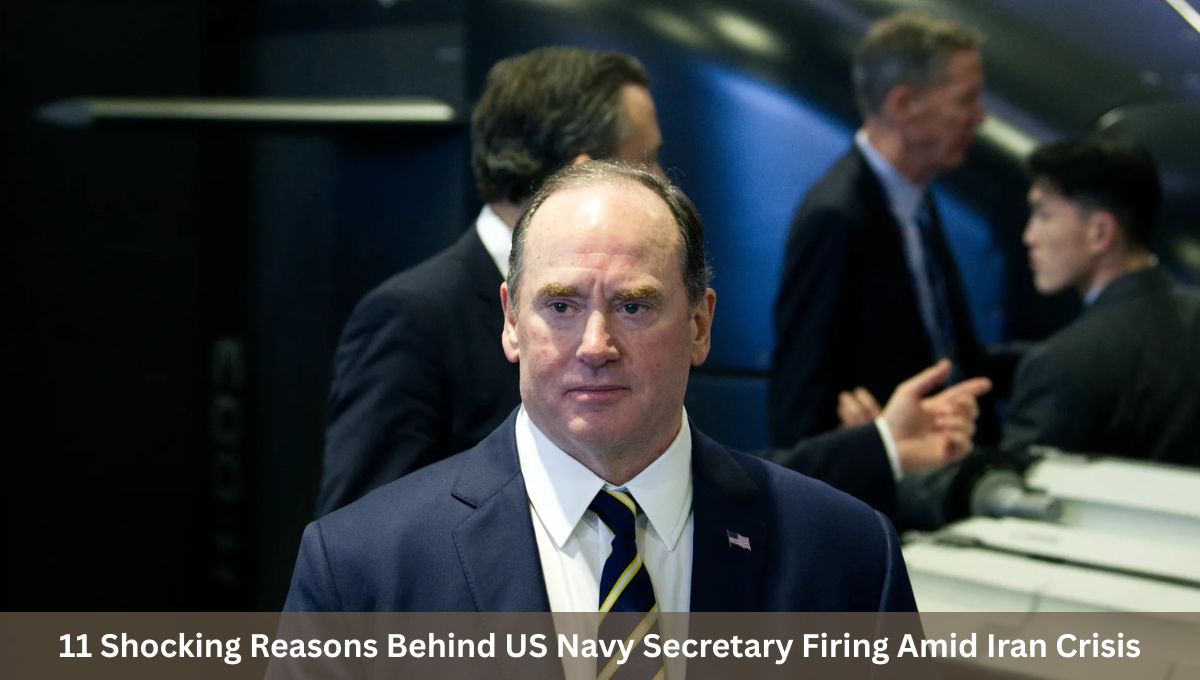
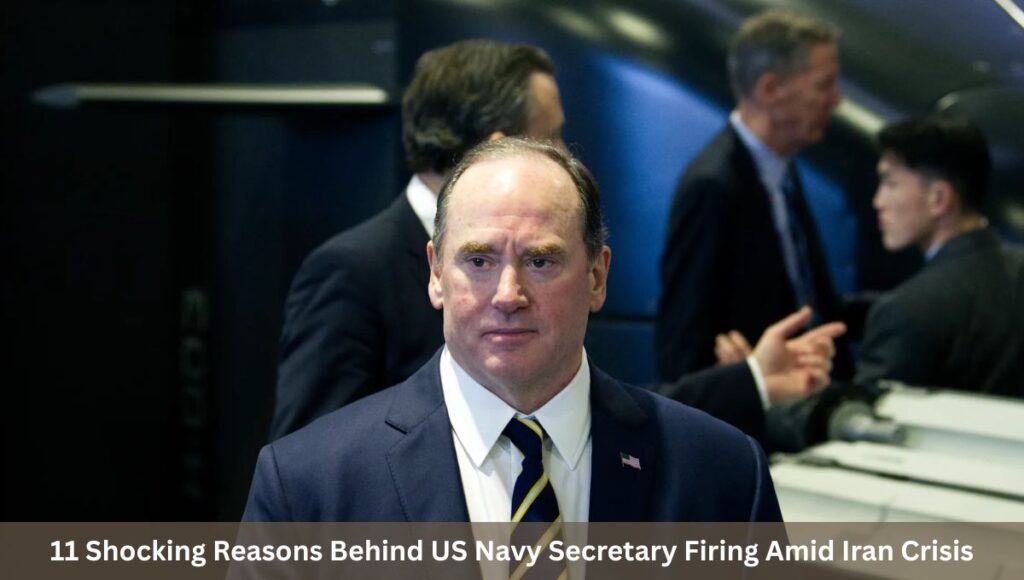
11 Shocking Reasons Behind US Navy Secretary Firing Amid Iran Crisis — Another major military shakeup. In a dramatic and unexpected move, the United States has removed its top Navy civilian leader at a critical moment in global geopolitics. John Phelan, the Secretary of the Navy, was abruptly dismissed “effective immediately” as tensions with Iran continue to escalate in the Strait of Hormuz.
The decision—reportedly driven by internal Pentagon conflicts and strategic disagreements—comes while the US Navy is actively enforcing a high-stakes blockade of Iranian ports during a fragile ceasefire.
The timing has stunned analysts and raised serious questions about leadership stability within the US Department of Defense.
A Sudden Exit That Shocked Washington
The Pentagon confirmed Phelan’s departure late Wednesday, offering minimal explanation.
The announcement came via spokesperson Sean Parnell, who thanked Phelan for his service but did not clarify whether the move was voluntary.
Behind the scenes, however, multiple reports indicate that Phelan was effectively forced out following direct intervention from Donald Trump and Defense Secretary Pete Hegseth.
According to insiders, Phelan was told to resign or face termination after a high-level White House meeting focused on naval shipbuilding and military readiness.
The Core Reason: Conflict Over Shipbuilding Reforms
At the heart of the controversy lies a critical issue—US naval modernization.
Slow Progress Frustrated Leadership
The Trump administration has prioritized rapid expansion of the Navy under its ambitious “Golden Fleet” initiative.
However, Phelan was reportedly seen as moving too slowly on implementing key shipbuilding reforms.
Senior defense officials believed the pace of modernization was insufficient, especially given rising competition from China’s rapidly expanding naval capabilities.
Strategic Urgency
The US aims to dramatically scale up its fleet with billions allocated toward new warships and support vessels.
Delays in execution were viewed not just as bureaucratic inefficiency—but as a national security risk.
Internal Power Struggles Inside the Pentagon
Beyond policy disagreements, Phelan’s exit was shaped by internal dynamics within the Pentagon.
Tensions with Hegseth
Relations between Phelan and Defense Secretary Hegseth had reportedly deteriorated over months.
Key points of friction included:
- Disagreements over shipbuilding priorities
- Differing management styles
- Conflicts over chain-of-command protocols
Allegations of Bypassing Authority
Phelan’s direct communication with President Trump reportedly angered Hegseth, who viewed it as undermining his authority.
Role of Senior Officials
Deputy Defense Secretary Steve Feinberg and other top leaders also reportedly clashed with Phelan over control of naval acquisitions and reform strategies.
The Role of President Trump
President Trump played a decisive role in the outcome.
White House Meeting Turning Point
During a meeting focused on naval capabilities, Trump reportedly expressed frustration with the slow pace of progress.
After discussions with Hegseth, he concluded that new leadership was necessary.
Direct Instruction
Trump allegedly told Hegseth to “take care of it,” effectively greenlighting Phelan’s removal.
Final Confirmation
Phelan later sought direct confirmation from Trump, eventually meeting him briefly at the White House—where his dismissal was confirmed.
Timing Raises Serious Concerns
Perhaps the most striking aspect of Phelan’s firing is its timing.
Ongoing Iran Conflict
The US Navy is currently engaged in one of its most complex operations in recent years:
- Enforcing a blockade of Iranian ports
- Monitoring the Strait of Hormuz
- Intercepting and redirecting vessels
Fragile Ceasefire
The removal comes during a delicate ceasefire between the US and Iran—raising concerns about continuity in military leadership.
Active Operations
US forces have already:
- Redirected over 30 vessels
- Boarded multiple ships
- Increased naval presence in the region
Despite the leadership change, officials say operational command remains unaffected.
Following Phelan’s departure, Hung Cao has been appointed as Acting Secretary of the Navy.
Background and Experience
Cao brings a significantly different profile:
- 25-year Navy veteran
- Combat experience in Iraq, Afghanistan, and Somalia
- Former political candidate
Leadership Style
Known for his strong views on military readiness and discipline, Cao is expected to take a more aggressive approach to reforms and strategic execution.
Immediate Challenges
Cao steps into the role at a time when:
- Naval operations are at peak intensity
- Strategic decisions carry global implications
- Internal Pentagon dynamics remain complex
A Broader Pentagon Shake-Up
Phelan’s removal is not an isolated event—it is part of a wider restructuring within the US military leadership.
Recent High-Profile Dismissals
Under Hegseth’s leadership, several senior officials have been removed, including:
- Randy George
- Charles Q. Brown Jr.
- Lisa Franchetti
Pattern of Change
These moves suggest a deliberate effort to reshape military leadership in line with the administration’s strategic priorities.
Political Reactions
Critics have raised concerns about instability and politicization within the Department of Defense, while supporters argue the changes are necessary for reform.
The Iran Factor: Why It Matters Now
The leadership change cannot be viewed in isolation from the ongoing Iran crisis.
Strategic Importance of the Strait of Hormuz
The US Navy’s role in controlling this critical waterway is central to global energy security.
The blockade aims to:
- Restrict Iran’s oil exports
- Pressure Tehran into negotiations
- Limit its economic capabilities
Rising Tensions
Iran has responded with:
- Seizure of commercial vessels
- Threats to maritime traffic
- Increased military signaling
Impact on Global Security and Markets
The implications of this leadership shake-up extend far beyond Washington.
Military Readiness
Changes at the top can affect:
- Decision-making speed
- Strategic coherence
- Operational confidence
Global Oil Markets
Any instability in the Strait of Hormuz directly impacts:
- Oil prices
- Supply chains
- Inflation worldwide
Investor Sentiment
Markets are highly sensitive to geopolitical uncertainty, and sudden leadership changes can amplify volatility.
Questions Surrounding Phelan’s Tenure
Phelan’s background and tenure have also come under scrutiny.
Non-Military Background
Unlike many predecessors, Phelan was a businessman with no prior military service—a factor that may have influenced perceptions of his leadership.
Political Connections
He was a major donor and fundraiser for Trump’s campaign, which played a role in his appointment.
Controversies
Reports also referenced past associations and internal investigations, though their direct impact on his dismissal remains unclear.
With new leadership in place, the direction of US naval strategy may shift.
Accelerated Shipbuilding
Expect faster implementation of fleet expansion plans.
Stronger Military Posture
A more assertive stance in contested regions like the Middle East and Indo-Pacific.
Increased Accountability
Greater emphasis on performance and execution within defense leadership.
What Happens Next?
Several key developments will shape the coming weeks:
Continued Iran Standoff
The naval blockade and maritime tensions are likely to persist.
Leadership Consolidation
Hung Cao will need to stabilize internal dynamics and assert control quickly.
Diplomatic Uncertainty
The fragile ceasefire remains at risk, with no clear roadmap for negotiations.
Conclusion
The abrupt firing of John Phelan marks a significant moment in US military and geopolitical strategy.
Occurring at the intersection of internal power struggles and external conflict, the decision underscores the high stakes involved in managing both defense policy and global crises.
As the US Navy continues its critical operations in the Strait of Hormuz, the leadership transition adds another layer of complexity to an already volatile situation.
For global audiences, the message is clear:
the Iran–US conflict is not just a regional issue—it is a defining geopolitical challenge with far-reaching consequences for security, trade, and economic stability.
The coming days will reveal whether this leadership shake-up strengthens US strategy—or deepens uncertainty at a critical moment in world affairs.
Also Read: 7 Explosive Updates as US Navy Enforces Hormuz Blockade, Oil Trade Halted
Also Read: Why did Trump ‘fire’ US navy secretary abruptly amid Hormuz blockade? What reports claim
Related Posts:
- 3 Explosive Conditions Iran Sets to End War with US…

- 7 Powerful Facts About Ayatollah Ali Khamenei’s…

- 9 Explosive Claims as Trump Says US Winning Iran War

- 5 Major Takeaways from the US Supreme Court's…

- 7 Heartbreaking Facts About Venezuela's Earthquake Disaster

- 10 Explosive Warnings as Donald Trump Calls Iran…