
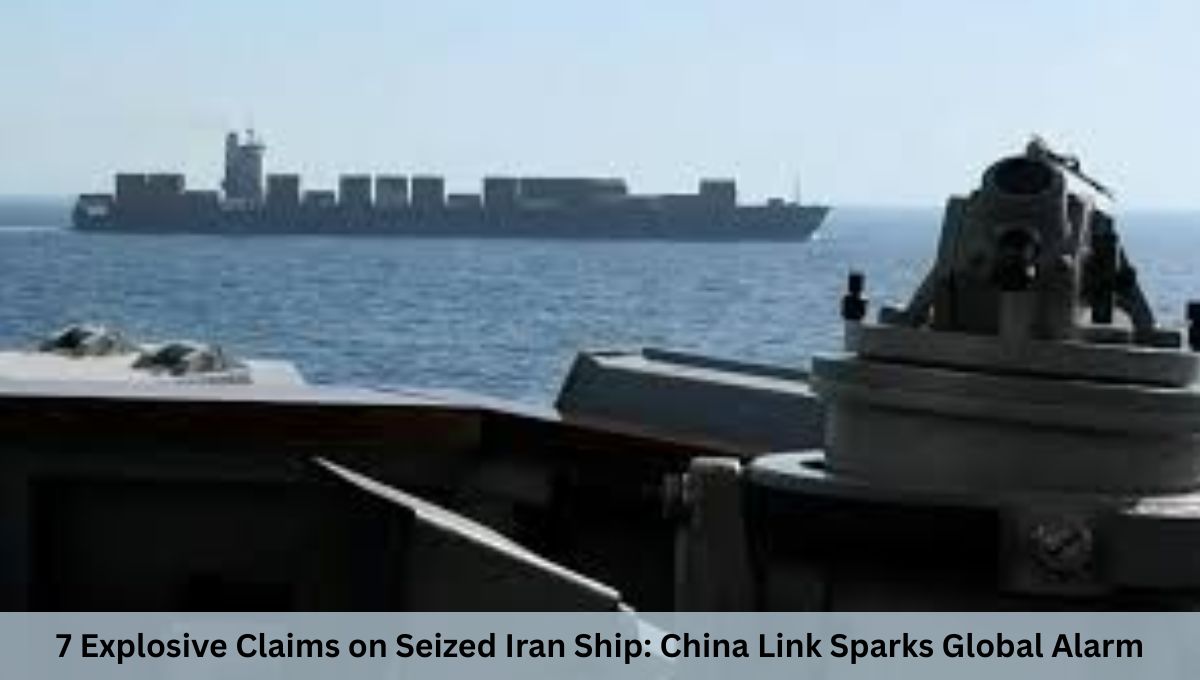
7 Explosive Claims on Seized Iran Ship: China Link Sparks Global Alarm and controversy. The seizure of an Iranian-flagged cargo vessel by United States forces has triggered a fresh wave of geopolitical tension, with new allegations adding another layer of complexity to an already volatile situation.
At the center of the controversy is a striking claim:
that the ship, intercepted near the Strait of Hormuz, was carrying chemicals linked to missile development—and that it originated from China.
This development comes at a time when global markets, diplomatic relations, and military strategies are all being shaped by the ongoing standoff between Washington and Tehran.
The implications extend far beyond the region, touching on global energy supply chains, international law, and great power rivalry.
7 Explosive Claims on Seized Iran Ship: China Link Sparks Global Alarm
What Happened: The Seizure of the Touska
The Iranian-flagged container vessel Touska was intercepted and seized by US forces in the Gulf of Oman after allegedly attempting to bypass a naval blockade.
According to US Central Command (CENTCOM), the ship ignored repeated warnings over several hours, prompting military action.
Footage released by the US military shows a coordinated operation involving a guided-missile destroyer and helicopters, with Marines boarding the vessel after disabling its engine.
The dramatic visuals underscore the seriousness of enforcement measures currently in place in the region.
Iran, however, has strongly condemned the incident, calling it an act of “armed piracy” and a violation of international law.
Tehran has demanded the immediate release of the vessel, its crew, and their families.
Nikki Haley’s Claim: China Link Raises Stakes
Adding fuel to the fire, former US diplomat Nikki Haley made a significant allegation: that the seized ship had traveled from China and was carrying chemicals intended for missile use.
According to her statement, the cargo was linked to Iran’s military capabilities, suggesting a deeper level of cooperation between China and Iran than previously acknowledged.
She also warned that China’s role in supporting Iran could no longer be ignored, framing the issue as part of a broader strategic challenge.
While these claims have not been independently verified, they have intensified scrutiny on China’s involvement in the region and raised concerns about the proliferation of dual-use materials.
What Are “Dual-Use” Materials?
US officials have been more cautious in their public statements, describing the cargo as “dual-use” items. These are materials that can serve both civilian and military purposes.
Examples include:
- Industrial metals
- Electronic components
- Specialized pipes and equipment
Such items are commonly used in infrastructure and manufacturing but can also be repurposed for weapons development, including missile systems.
This ambiguity makes enforcement particularly challenging, as distinguishing between legitimate trade and military supply lines is not always straightforward.
Iran’s Response: Accusations and Threats
Iran has reacted strongly to the seizure, accusing the US of escalating tensions and violating the ceasefire agreement currently in place.
Officials have stated that:
- The ship was on a legitimate commercial route
- The seizure endangered civilian lives
- Retaliation remains an option
Iran’s military command has warned that it will respond to what it calls “blatant aggression,” raising fears of further escalation.
At the same time, Tehran has indicated that it may withdraw from upcoming diplomatic talks unless the US lifts its maritime blockade.
The Strategic Importance of the Strait of Hormuz
The incident has once again highlighted the critical importance of the Strait of Hormuz, one of the world’s most vital energy corridors.
Roughly 20% of global oil supply passes through this narrow waterway. Any disruption here has immediate consequences for global markets.
Recent developments include:
- Reduced shipping traffic
- Rising insurance costs for vessels
- Increased military presence
The seizure of the Touska is part of a broader effort by the US to enforce a blockade targeting Iranian ports, significantly impacting maritime trade in the region.
Maritime Blockade: A High-Stakes Strategy
The US naval blockade has become a central point of contention. Washington argues that it is necessary to prevent the flow of materials that could enhance Iran’s military capabilities.
Under international maritime law, certain conditions allow for the inspection and seizure of vessels suspected of carrying contraband.
However, these actions are often disputed, particularly in politically sensitive contexts.
US forces have reportedly:
- Ordered dozens of vessels to change course
- Conducted multiple inspections
- Expanded the definition of contraband
This aggressive enforcement strategy has increased tensions not only with Iran but also with other countries whose ships operate in the region.
China’s Position: Concern Without Commitment
China has expressed concern over the interception of the Iranian vessel, urging all parties to respect the ceasefire and avoid escalation.
However, Beijing has stopped short of directly addressing the allegations made about the ship’s cargo.
China remains a major buyer of Iranian oil and has longstanding economic ties with Tehran. Any suggestion of military cooperation, however, carries significant geopolitical implications.
If proven, such links could:
- Strain China-US relations further
- Trigger new sanctions
- Shift the balance of power in the region
Economic Impact: Oil Markets on Edge
The crisis has already had a noticeable impact on global oil markets. Prices have fluctuated sharply amid uncertainty over shipping routes and supply disruptions.
Key trends include:
- Oil price volatility
- Reduced tanker movement
- Increased risk premiums
Even temporary disruptions in the Strait of Hormuz can lead to significant economic ripple effects, affecting everything from fuel prices to inflation.
Experts warn that prolonged instability could have lasting consequences for the global economy.
Military Escalation: A Dangerous Cycle
The seizure of the Touska has contributed to a broader cycle of escalation.
Iran has reportedly launched drone strikes on US-linked vessels in response, though details remain unclear.
This tit-for-tat dynamic increases the risk of a larger conflict, particularly as both sides adopt increasingly aggressive postures.
Military analysts note that:
- Miscalculations could trigger wider war
- Civilian shipping remains at risk
- Diplomatic channels are under strain
The situation remains highly fluid, with each new development carrying the potential for rapid escalation.
Legal Questions: Can the Ship Be Kept?
Under the laws of naval warfare, a vessel that attempts to breach a blockade can be seized and potentially treated as a “prize.”
This means:
- The ship could become US property
- Cargo may be confiscated
- Crew members could face detention
However, such actions typically require legal review through a prize court, a process that is rarely used in modern conflicts.
The fate of the Touska will likely depend on what investigators find onboard.
What Happens Next?
The immediate future hinges on several key factors:
- Whether Iran participates in upcoming talks
- Findings from the ship’s inspection
- Reactions from global powers
Diplomatic efforts are ongoing, but trust between the parties remains low. Any breakthrough will require significant concessions.
At the same time, military readiness remains high, suggesting that both sides are preparing for multiple scenarios.
Conclusion: A Flashpoint With Global Consequences
The seizure of the Iranian vessel Touska is more than just a maritime incident—it is a flashpoint in a broader geopolitical struggle involving major global powers.
With claims of missile-related chemicals, alleged Chinese involvement, and rising military tensions, the situation has the potential to reshape regional dynamics and impact global stability.
As investigations continue and diplomatic efforts unfold, the world will be watching closely. The stakes are high, and the margin for error is dangerously thin.
What began as a single interception at sea could evolve into a defining moment in international relations.
Also Read: 7 Powerful Developments as Iran Allows Pakistani Ships Through Hormuz Amid War Tensions
Related Posts:
- 9 Explosive Claims as Trump Says US Winning Iran War

- 7 Big Takeaways: Macron’s High-Stakes China Visit…

- 7 Powerful Facts About Ayatollah Ali Khamenei’s…

- 5 Major Takeaways from the US Supreme Court's…

- 7 Key Highlights That Will Shape the High-Stakes G20…

- In 8 Moves, EU Targets China-Linked Refineries and…
