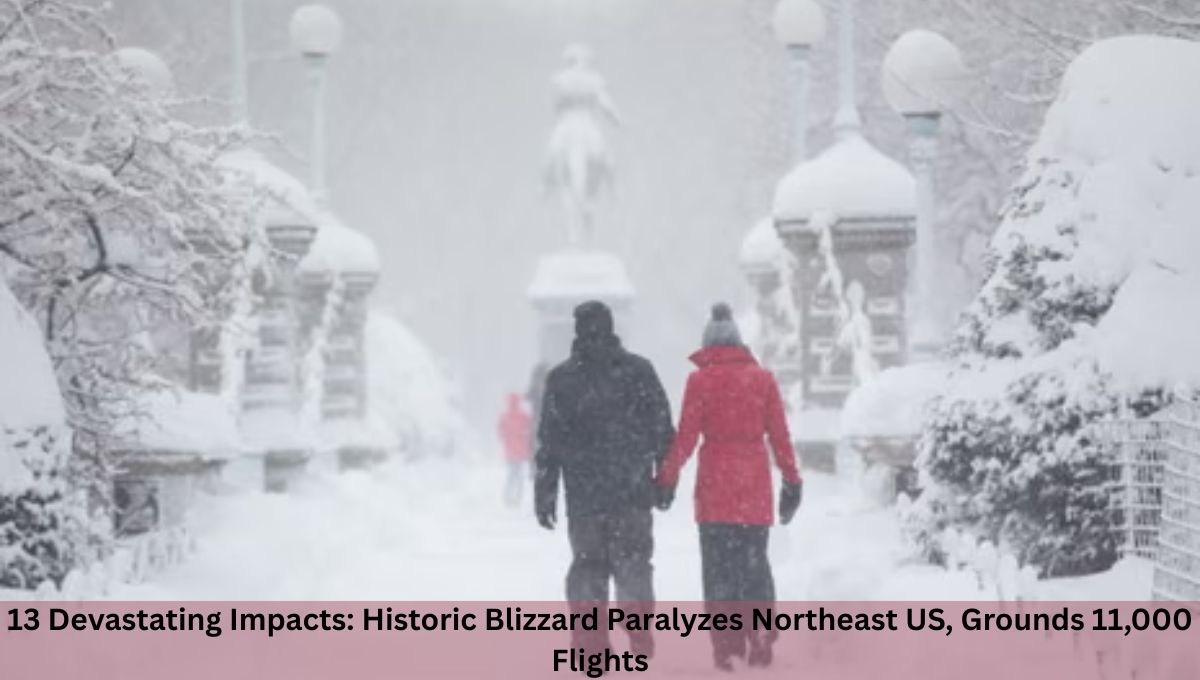
13 Devastating Impacts: Historic Blizzard Paralyzes Northeast US, Grounds 11,000 Flights, Triggers Travel Bans Amid Power Outages. A potentially historic winter storm brought the US Northeast to a near standstill, burying cities under feet of snow, grounding more than 11,000 flights, cutting electricity to over half a million homes, and forcing sweeping travel bans across some of the country’s most densely populated regions.
From New York City to Boston, from New Jersey to Rhode Island, daily life ground to a halt as whiteout conditions, hurricane-force wind gusts, and record-breaking snowfall combined into one of the most disruptive winter events the region has seen in years.
Meteorologists confirmed the storm intensified into a bomb cyclone, a rapidly strengthening system that dramatically worsens winds and snowfall.
Officials warned that while snowfall was easing in some areas by Monday evening, the impacts will linger for days.
13 Devastating Impacts: Historic Blizzard Paralyzes Northeast US, Grounds 11,000 Flights
1. Cities Fall Silent as Blizzard Tightens Grip
Usually packed streets across the Northeast emptied almost overnight.
In New York City, traffic vanished, public transport slowed or stopped, and entire neighborhoods were locked down under emergency orders.
Skyscrapers in Lower Manhattan disappeared behind curtains of snow, barely visible from Brooklyn as visibility dropped to near zero.
Similar scenes played out across Philadelphia, Boston, Providence, and dozens of smaller cities as snowfall rates reached two to three inches per hour at the storm’s peak.
Officials urged residents to stay indoors, warning that travel conditions were “nearly impossible.”
2. More Than 65 Million People Under Weather Alerts
According to national media reports, more than 65 million people—nearly one-fifth of the US population—were under winter storm alerts at the height of the blizzard.
Blizzard warnings stretched from Virginia to Maine, covering major population centres along the Interstate 95 corridor, one of the most economically vital and densely traveled regions in North America.
The National Weather Service (NWS) described the system as a “major and potentially destructive storm”, warning of dangerous wind chills, coastal flooding, and prolonged power outages.
3. Bomb Cyclone Explained: Why This Storm Was So Powerful
Meteorologists confirmed early Monday that the storm had intensified into a bomb cyclone, a phenomenon also known as bombogenesis.
This occurs when a storm’s central air pressure drops rapidly—by roughly 18 millibars in 24 hours at New York’s latitude—leading to:
- Explosive strengthening of winds
- Heavier precipitation
- Sharply reduced visibility
The clash of Arctic cold air with warmer Atlantic moisture created ideal conditions for rapid intensification, turning an already dangerous nor’easter into a high-impact blizzard.
4. Historic Snowfall Blankets Major Cities
Snow totals shattered records across multiple states.
New York
- Central Park: nearly 20 inches, ranking among the top 10 snowfall events in city history
- Staten Island: up to 24 inches
- Long Island (Islip): more than 22 inches, with Suffolk County approaching 30 inches
Rhode Island
- Providence: 32.8 inches, a new single-storm record
- Warwick: over 36 inches, among the state’s largest snowfalls ever
Massachusetts
- Boston: continued accumulating into Monday night
- Nantucket & Martha’s Vineyard: wind gusts exceeding 70 mph
Officials compared the storm to legendary events such as the Blizzard of 1978, underscoring its exceptional scale.
5. Travel Bans Shut Down Roads and Highways
With snow piling faster than plows could clear it, authorities imposed strict travel restrictions.
In New York City, Mayor Zohran Mamdani declared a local state of emergency, banning all non-essential travel until conditions improved.
“I’m urging every New Yorker to please stay home,” Mamdani said, warning that the city had not faced a storm of this scale in over a decade.
Similar travel bans were issued across:
- New York State
- New Jersey
- Rhode Island
- Parts of Massachusetts
Emergency crews reported abandoned vehicles, jackknifed trucks, and stranded motorists across highways.
6. Air Travel Crippled: Over 11,000 Flights Cancelled
Airports across the Northeast were among the hardest hit.
According to FlightAware, more than 11,000 US flights scheduled from Sunday through Tuesday were cancelled.
Worst-Affected Airports
- John F. Kennedy International Airport
- LaGuardia Airport
- Newark Liberty International Airport
- Boston Logan International Airport
- Philadelphia International Airport
At some airports, over 90% of flights were cancelled on Monday alone.
Airlines grounded planes pre-emptively to avoid aircraft and crew being stranded, a tactic increasingly common during extreme weather events.
7. Rail and Bus Networks Grind to a Halt
Beyond aviation, rail and road travel were also heavily disrupted.
Amtrak suspended service along the critical New York–Boston corridor, while commuter rail and intercity bus services were curtailed or halted across multiple states.
Normally crowded terminals fell eerily quiet, reflecting the scale of the shutdown across the region’s transport infrastructure.
8. Power Outages Leave Half a Million in the Dark
Heavy, wet snow combined with violent winds proved disastrous for power grids.
As of Monday evening:
- Over 500,000 homes and businesses were without electricity
- Massachusetts reported the highest number of outages
- New Jersey, Delaware, and Rhode Island also suffered widespread disruptions
According to PowerOutage.us, fallen trees and downed power lines stretched utility crews thin as they worked in hazardous conditions to restore service.
Officials warned outages could persist as additional snow and ice weighed down infrastructure.
9. States Activate Emergency Responses
Governors across the Northeast mobilised emergency resources.
- New York Governor Kathy Hochul deployed the National Guard to assist with rescues and logistics.
- Massachusetts Governor Maura Healey declared a state of emergency and ordered non-essential workers to stay home.
- New Jersey and Rhode Island issued similar emergency declarations.
Even the United Nations headquarters in New York closed for the day due to hazardous conditions.
10. Economic Shockwaves and Energy Market Impact
The storm’s effects rippled through financial and energy markets.
- US natural gas futures initially surged on expectations of higher heating demand
- Gains faded as power outages reduced actual consumption
- Wholesale electricity prices remained volatile across East Coast grids
With businesses and schools closed, electricity demand came in far below forecasts, highlighting how extreme weather can distort energy markets in unpredictable ways.
11. Schools, Broadway, and Daily Life Disrupted
Education systems across the region shut down or delayed reopening.
- New York City schools closed Monday but are set to reopen Tuesday
- Worcester, Massachusetts, and several other districts remained closed
- Broadway cancelled all Sunday night shows, a rare move reflecting safety concerns
Food-delivery platforms also felt the impact. DoorDash temporarily suspended operations in New York City, while other services continued on a limited basis.
12. Officials Warn: Impacts Will Linger
Although snowfall eased in parts of New York by Monday afternoon, officials cautioned that:
- Snow removal will take days
- Travel disruptions will persist
- Additional storms may arrive later in the week
Forecasters warned of another system potentially affecting the Mid-Atlantic and Northeast in the coming days, though its strength remains uncertain.
13. A Stark Reminder of Climate Extremes
Meteorologists noted that while nor’easters are not unusual, storms of this magnitude, geographic reach, and population impact are becoming more disruptive.
With:
- Record snowfall
- Explosive storm intensification
- Massive infrastructure strain
the blizzard stands as another reminder of how extreme weather events are testing even the most developed urban systems.
Conclusion: A Region Brought to a Standstill
The Northeast US blizzard of February has left a lasting mark—historic snowfall, crippled transport, widespread power outages, and millions confined indoors.
While recovery is underway, the storm’s scale and severity underscore a growing reality:
when extreme weather strikes densely populated regions, the consequences ripple far beyond snow-covered streets.
As cities dig out and flights slowly resume, officials and residents alike are left asking how prepared critical infrastructure truly is for the next storm of this magnitude.
Also Read: 9 Alarming Impacts of a Massive U.S. Winter Storm