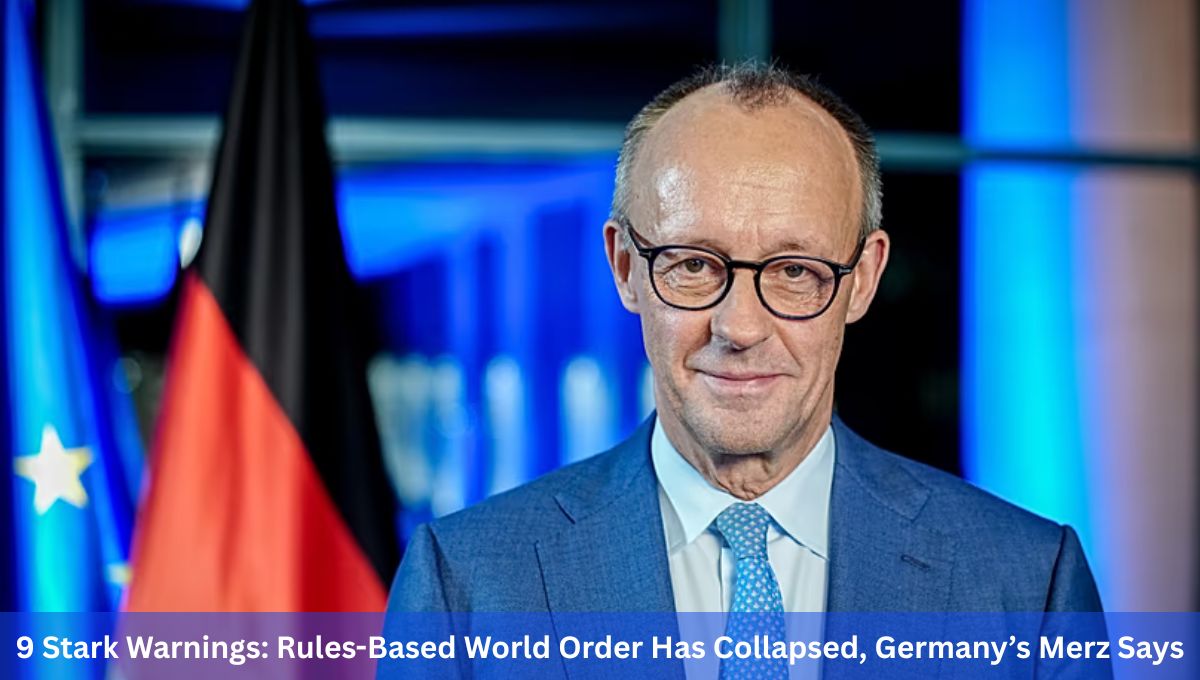
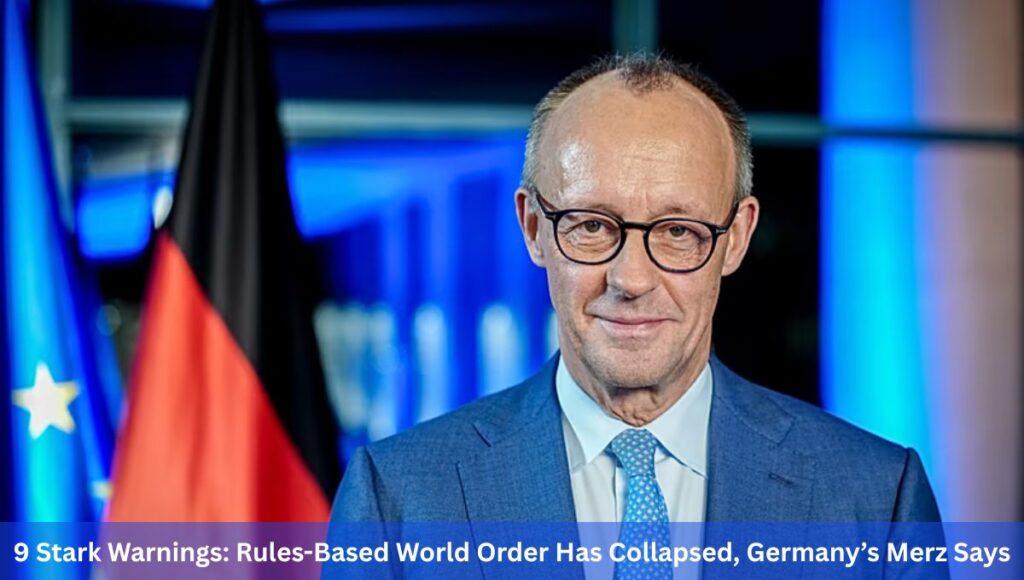
9 Stark Warnings: Rules-Based World Order Has Collapsed, Germany’s Merz Says at Munich security conference. The post-World War II global system built on shared rules, multilateral institutions, and predictable alliances is no longer functioning in its original form. That was the stark message delivered by Friedrich Merz, the German chancellor, as he opened the Munich Security Conference, one of the world’s most influential gatherings of political, military, and security leaders.
Speaking to an audience that included heads of state, defense ministers, diplomats, and security officials from across the globe, Merz warned that Europe and its allies have entered a fundamentally new geopolitical era — one defined less by international norms and more by raw power, strategic rivalry, and national self-interest.
“I fear we must put it even more bluntly:
this order, however imperfect it was even at its best, no longer exists in that form,” Merz said.
His remarks crystallized a growing consensus among Western leaders that the global architecture created after 1945 is eroding rapidly — and that Europe can no longer rely automatically on American leadership or inherited security guarantees.
9 Stark Warnings: Rules-Based World Order Has Collapsed, Germany’s Merz Says
The End of the Rules-Based World Order
For decades, the so-called “rules-based international order” rested on institutions, treaties, and alliances designed to prevent major wars, promote free trade, and manage disputes peacefully.
It was underwritten by US power and supported by European integration, NATO, and multilateral bodies. Merz argued that this framework has now fractured.
He pointed to a world increasingly shaped by “big-power politics,” where major states write their own rules, weaponize trade and technology, and use energy, resources, and supply chains as geopolitical leverage.
In such an environment, assumptions about stability, prosperity, and collective security no longer hold. Europe, Merz warned, must abandon the belief that peace and freedom are permanent conditions.
‘Our Freedom Is Not Guaranteed’
One of the most resonant lines of Merz’s speech was also one of its most sobering.
“Our freedom is not guaranteed,” he told delegates.
He argued that Europeans must be prepared to make sacrifices — economically, politically, and militarily — to defend democratic values in a world defined by rivalry between major powers.
This marked a sharp departure from decades of European strategic culture, which largely assumed that economic interdependence and diplomacy could tame geopolitical conflict. According to Merz, that era has ended.
The continent, he said, is facing a “defining moment” comparable to the post-1945 or post-Cold War transitions.
Transatlantic Rift Laid Bare
Merz did not shy away from addressing tensions between Europe and the United States.
“A rift, a deep divide has opened between Europe and the United States,” he said.
The comment reflected growing European unease over recent US policies, including tariffs, unilateral security decisions, and domestic political debates spilling into transatlantic relations.
Merz explicitly rejected the idea that Europe should mirror American political culture wars.
“The culture war of the MAGA movement is not ours,” he said, drawing a clear distinction between European constitutional values and US domestic ideological battles.
He emphasized that in Germany and much of Europe, freedom of expression is bounded by constitutional protections for human dignity — a principle that shapes European legal and political norms.
Criticism of Protectionism and Unilateralism
Merz also criticized economic nationalism and protectionism, arguing that Europe remains committed to free trade and multilateral cooperation.
He reaffirmed support for international frameworks such as climate agreements and the World Health Organization, stressing that global challenges cannot be solved by nations acting alone.
This stance stood in contrast to recent US policy shifts, including tariff threats against European imports and the weaponization of trade disputes for strategic leverage.
‘Even the United States Cannot Go It Alone’
In one of the most pointed sections of his speech, Merz challenged the idea of American unilateral dominance.
“In the era of great-power rivalry, even the United States will not be powerful enough to go it alone,” he said.
Switching to English for emphasis, Merz urged Washington to recognize that alliances remain strategic assets rather than constraints.
“Being a part of NATO is not only Europe’s competitive advantage. It’s also the United States’ competitive advantage.”
The message was both a warning and an olive branch:
Europe is ready to assume greater responsibility, but not at the cost of abandoning the transatlantic alliance.
Europe’s Over-Reliance on Washington
Merz acknowledged that Europe’s security dependence on the United States was, in part, self-inflicted.
For decades, many European countries underinvested in defense, relying on US military power to underwrite continental security. That era, Merz argued, must now end.
However, he was careful to stress that Europe’s response should not weaken NATO.
“We won’t do this by writing off NATO,” he said. “We will do it by building a strong, self-supporting European pillar in the alliance.”
This vision reflects a push for strategic autonomy within NATO rather than separation from it.
Europe as a Geopolitical Power
Merz’s call was echoed by French President Emmanuel Macron, who argued that Europe must accelerate its transformation into a full-fledged geopolitical power.
Macron stressed that Europe must be capable of defending itself, shaping global rules, and negotiating from a position of strength — particularly in defense and advanced technologies.
“This is the right time for a strong Europe,” Macron said. “This Europe will be a good ally — but a respected one.”
According to Macron, burden-sharing is not only about fairness, but credibility.
NATO’s Shifting Balance
NATO Secretary-General Mark Rutte reinforced the message that Europe is already stepping up.
He described a “shift in mindset,” with European allies taking on more leadership roles and increasing defense spending in response to a more dangerous security environment.
The alliance, long dominated by American military power, is gradually evolving into a more balanced partnership — a trend accelerated by Russia’s war in Ukraine.
Ukraine at the Center of the Crisis
The war in Ukraine loomed large over the conference.
Merz, Macron, British Prime Minister Keir Starmer, and other European leaders met with Ukrainian President Volodymyr Zelenskyy on the sidelines of the summit, underscoring Europe’s continued political and military support.
Merz argued that Russia can still be exhausted economically and militarily — and that sustained pressure remains essential to bringing Moscow to meaningful negotiations.
The conflict, he said, has forced Europe to “return from a vacation from world history.”
Talks on a European Nuclear Deterrent
One of the most strategically significant revelations from Merz’s speech was his disclosure that Germany has begun discussions with France about a potential European nuclear deterrent.
France is the European Union’s only nuclear-armed state, and any such arrangement would be firmly embedded within NATO’s nuclear framework.
Merz emphasized that this would not create unequal security zones within Europe, nor signal a departure from NATO commitments.
Rather, it reflects Europe’s search for credible deterrence in a more dangerous world.
The Shadow of US Domestic Politics
The conference also revisited tensions sparked the previous year by remarks from US Vice President JD Vance, who criticized Europe on democracy, immigration, and free speech.
Merz directly pushed back against those criticisms, arguing that democratic legitimacy in Europe is rooted in constitutional law, not populist rhetoric.
His message was clear:
Europe will not import American culture wars, even as it seeks to preserve the transatlantic partnership.
Rubio: ‘The Old World Is Gone’
US Secretary of State Marco Rubio struck a similar tone ahead of the conference, acknowledging that the global landscape is changing rapidly.
“The old world is gone,” Rubio said. “We live in a new era in geopolitics.”
Despite policy differences, Rubio signaled that Washington recognizes Europe’s importance — and that both sides must reassess their roles in a transformed global order.
From Rules to Power Politics
A recurring theme across speeches was the return of power politics.
Merz described a world where major powers increasingly ignore international rules, exploit dependencies, and act unpredictably.
Natural resources, technology, and supply chains are no longer purely economic assets — they are strategic weapons.
In such a world, Merz argued, democratic states must rely on partnerships, not illusions of neutrality or disengagement.
“Autocracies may have followers,” he said. “Democracies have partners and allies.”
Europe’s Moment of Choice
The Munich Security Conference made clear that Europe stands at a crossroads.
It can either cling to an international order that no longer functions as designed — or adapt, invest, and assert itself as a serious geopolitical actor.
Merz rejected any notion of European hegemony, emphasizing “partnership-based leadership” instead. Germany, he said, seeks to contribute to a sovereign Europe without dominating it.
What Comes After the Old Order?
If the rules-based order is truly gone, the question is what replaces it.
European leaders offered a partial answer:
stronger alliances, credible deterrence, strategic autonomy, and renewed commitment to democratic cooperation.
Macron argued that Europe must be present at the table when new arms-control and security frameworks are negotiated — not merely observe decisions made by others.
The message from Munich was unmistakable:
the age of complacency is over.
Conclusion: A World Reset Is Underway
Friedrich Merz’s warning was not merely rhetorical. It reflected a deep reassessment underway across Europe and the broader West.
The assumptions that shaped global politics for nearly eight decades are eroding. Power is fragmenting. Alliances are being tested. And freedom, as Merz warned, can no longer be taken for granted.
For Europe — and for the global community — the challenge now is not to mourn the old order, but to build something resilient enough to survive what comes next.
Also Read: Germany Welcomes Indian STEM & Management Talent Amid US H-1B Visa Fee Hike
Also Read: ‘The end of the world as we know it’: Is the rules-based order finished?
Related Posts:
- 7 Powerful Facts About Ayatollah Ali Khamenei’s…
- 5 Major Takeaways from the US Supreme Court's…

- 3 Explosive Conditions Iran Sets to End War with US…
- 7 Heartbreaking Facts About Venezuela's Earthquake Disaster
- In 8 Moves, EU Targets China-Linked Refineries and…

- 9 Explosive Claims as Trump Says US Winning Iran War