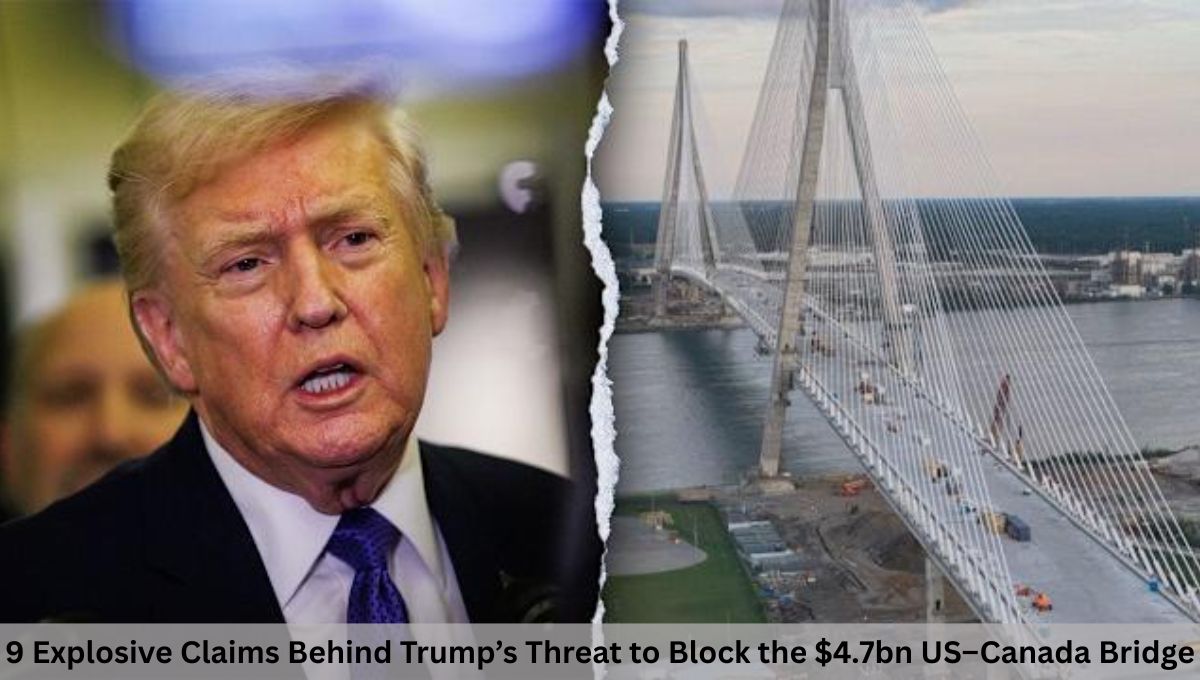
9 Explosive Claims Behind Trump’s Threat to Block the $4.7bn US–Canada Bridge, demanding compensation and ownership. US President Donald Trump has threatened to block the opening of the Gordie Howe International Bridge, a major cross-border infrastructure project linking Detroit, Michigan, with Windsor, Ontario, demanding what he called “full compensation” from Canada and insisting the United States should own at least half of the asset.
Thank you for reading this post, don't forget to subscribe!The warning marks a fresh escalation in Trump’s increasingly confrontational posture toward America’s northern neighbour — a country he has repeatedly accused of unfair trade practices and, at times, provocatively suggested should become the 51st US state.
The $4.7 billion bridge, financed entirely by Canada and nearing completion after years of delays, is designed to ease congestion at one of the world’s busiest trade corridors.
Trump’s intervention now raises questions not only about the project’s future but also about the broader trajectory of US–Canada relations, North American trade, and the looming renegotiation of the United States–Mexico–Canada Agreement (USMCA).
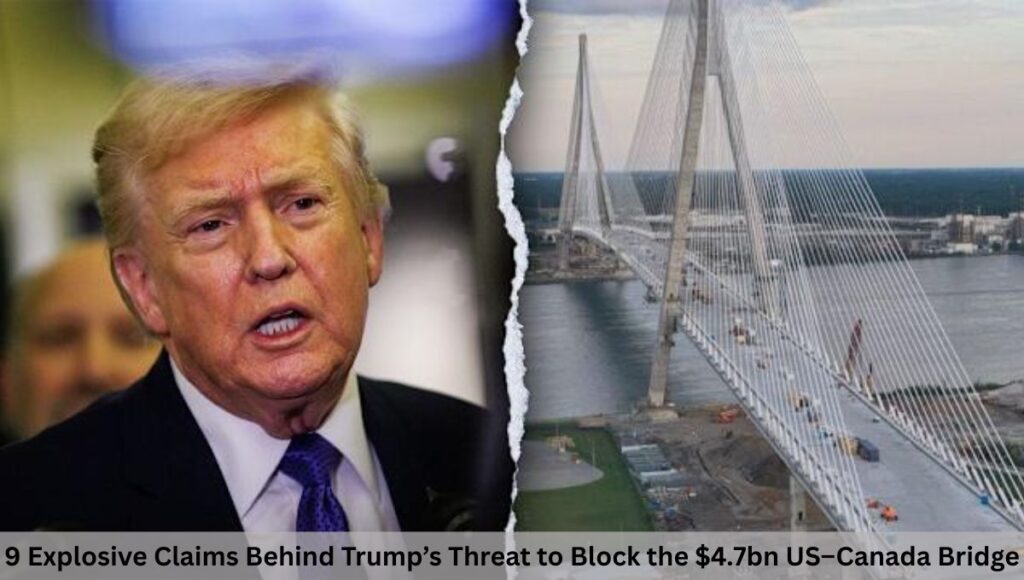
9 Explosive Claims Behind Trump’s Threat to Block the $4.7bn US–Canada Bridge
What Trump Said: ‘I Will Not Allow This Bridge to Open’
In a lengthy post on his Truth Social platform, Trump accused Canada of exploiting the United States for decades and singled out the Gordie Howe Bridge as emblematic of that imbalance.
“I will not allow this bridge to open until the United States is fully compensated for everything we have given them, and also, importantly, Canada treats the United States with the Fairness and Respect that we deserve,” Trump wrote.
He added that negotiations would begin “IMMEDIATELY”, reiterating his demand that Washington should own “perhaps, at least one half of this asset.”
Trump’s post included an image of the bridge and repeated several key complaints:
- Canada owns both sides of the bridge
- The project used “virtually no US content”
- The US market would generate “astronomical” revenues
Why the Gordie Howe Bridge Matters
A Critical Trade Artery
The Gordie Howe International Bridge is one of the most important infrastructure projects in North America.
- It spans the Detroit River
- Connects Interstate 75 (US) to Highway 401 (Canada)
- Designed as a six-lane crossing
- Built to relieve pressure on the privately owned Ambassador Bridge
Detroit–Windsor is the busiest commercial border crossing between the US and Canada. In 2023 alone, Detroit ranked as the second-largest US freight port by value, handling $126 billion in goods moved by commercial trucks.
According to a University of Windsor study, the bridge could:
- Cut up to 20 minutes off crossing times
- Save truckers $2.3 billion over 30 years
Who Built and Paid for the Bridge
The project’s origins date back more than a decade.
Canada Footed the Bill
- Negotiated in 2012 under former Michigan Governor Rick Snyder
- Canada agreed to finance the entire project
- Construction began in 2018
- Expected to open in early 2026
The unusual funding arrangement came after the United States declined to pay for the bridge. Canada stepped in to protect trade flows critical to both economies.
According to official documents:
- The bridge will be jointly owned by Canada and the State of Michigan
- Costs are expected to be recouped through tolls over 30 years
Trump’s Core Complaints Explained
1. Ownership and Control
Trump argues that Canada owning both sides of the bridge — despite its location on US soil — is unacceptable.
“With all that we have given them, we should own, perhaps, at least one half of this asset,” he wrote.
Canadian authorities counter that ownership is already joint, with oversight mechanisms agreed years ago.
2. ‘Virtually No US Content’
Trump claims the bridge was built using little American steel or materials, alleging that former president Barack Obama issued waivers from the Buy American Act.
While union workers from both countries have been involved, Trump has framed the issue as symbolic of broader US manufacturing losses.
3. Compensation for ‘Everything We’ve Given Them’
Trump did not specify what compensation Canada allegedly owes but referenced:
- Market access to the US
- Trade imbalances
- Long-standing disputes over dairy and alcohol
Trade Tensions Beyond the Bridge
Dairy, Alcohol and Tariffs
Trump revived familiar grievances:
- Canada’s dairy tariffs, which he says harm US farmers
- Provincial liquor rules that restrict US alcohol sales
- Non-tariff barriers affecting American products
These issues have surfaced repeatedly during USMCA disputes and now form part of Trump’s broader pressure campaign.
The China Factor: A Geopolitical Warning
One of the most explosive elements of Trump’s post was his criticism of Canada’s engagement with China.
“Prime Minister Mark Carney wants to make a deal with China — which will eat Canada alive,” Trump wrote. “We’ll just get the leftovers.”
Why China Is Central to the Dispute
- Carney visited Beijing in January
- Canada announced a preliminary trade agreement with China
- The US threatened 100% tariffs in response
Trump has repeatedly warned allies against deepening economic ties with Beijing, framing China as a strategic rival undermining Western economies.
He even repeated a widely ridiculed claim that China would “terminate ALL ice hockey being played in Canada”, a statement critics dismissed as baseless.
Political Reactions in the United States
Michigan Lawmakers Push Back
Trump’s threat triggered swift backlash from US officials — particularly in Michigan.
Senator Elissa Slotkin
“Canceling this project will have serious repercussions — higher costs for Michigan businesses, less secure supply chains and, ultimately, fewer jobs.”
Governor Gretchen Whitmer’s Office
“Canada financed the construction of the bridge… It’s going to open one way or another.”
Representative Debbie Dingell
“We cannot forget Canada is our friend and ally. These cheap shots help no one and hurt our economy.”
Economic Stakes for the US and Canada
For the United States
- Reduced congestion for exporters
- Lower logistics costs
- More resilient supply chains
- Faster freight movement from Montreal to Miami
For Canada
- Secure access to US markets
- Protection of manufacturing supply lines
- Long-term toll revenue
Blocking or delaying the bridge could ripple across automotive, manufacturing, agriculture, and energy sectors.
USMCA Renegotiation Looms Large
Trump’s threat comes as the USMCA trade pact approaches a critical review phase later this year.
Key concerns include:
- Tariffs and quotas
- Industrial subsidies
- China’s indirect access to North American markets
- Rules of origin
The bridge dispute risks becoming a bargaining chip in broader negotiations.
Trump’s Second-Term Canada Strategy
Since returning to office in January 2025, Trump has:
- Threatened steep tariffs on Canadian goods
- Floated annexation rhetoric
- Targeted Canadian aerospace firms like Bombardier
- Warned against China-Canada cooperation
Although some threats have not materialised, the pattern has injected volatility into bilateral relations.
Canada’s Response: Caution and Defiance
Canadian officials have largely avoided direct confrontation.
Prime Minister Mark Carney, speaking earlier at the World Economic Forum in Davos, warned that the US-led global system was undergoing a “rupture”, comments widely interpreted as a response to Trump’s disruptive trade policies.
Carney has insisted:
- Canada is not pursuing a full free-trade agreement with China
- Engagement with Beijing remains limited and pragmatic
Can Trump Actually Block the Bridge?
Legally, Trump’s ability to stop the opening remains uncertain.
- The US Department of Homeland Security has already designated the bridge as an official port of entry
- Ownership agreements were finalised years ago
- Cancelling the project could trigger legal and diplomatic fallout
Experts say any delay would likely face court challenges and fierce opposition from state authorities.
Global Implications: Infrastructure as a Trade Weapon
Trump’s bridge threat underscores a growing global trend:
- Infrastructure becoming a tool of geopolitical leverage
- Trade disputes spilling into transport and logistics
- Bilateral pressure replacing multilateral norms
For global investors and supply-chain planners, the episode highlights the political risk embedded even in long-planned infrastructure projects.
Final Analysis: Symbolism, Power and Pressure
The Gordie Howe Bridge dispute is about more than steel and concrete.
It reflects:
- Trump’s transactional view of alliances
- His insistence on reciprocity and leverage
- Rising US anxiety over China’s influence
- The fragility of North American economic integration
Whether or not the bridge ultimately opens on schedule, the episode has already sent a clear message:
in Trump’s second term, even shared infrastructure is negotiable.
Also Read: 10 Explosive Fallout Points as US Warns Canada Over Chinese EVs