10 Explosive Fallout Points as US Warns Canada Over Chinese EVs, raising fears over auto jobs, security, and trade ties. The United States has delivered a blunt warning to one of its closest allies: Canada will regret allowing Chinese electric vehicles into its market.
The remark, made publicly by senior officials in President Donald Trump’s administration, underscores the growing strain between Washington and Ottawa after Canadian Prime Minister Mark Carney struck a landmark trade deal with Beijing that slashes tariffs on Chinese EVs and restores access for Canadian agricultural exports into China.
At stake are far more than cars. The dispute touches on national security, auto jobs, supply chains, cybersecurity, geopolitics, and the future of North American trade alignment, at a time when Trump has imposed tariffs on Canadian goods and openly questioned the country’s sovereignty.
What follows is a comprehensive breakdown of the economic logic, political motivations, and strategic risks behind Canada’s China reset — and why it has triggered alarm bells in Washington.
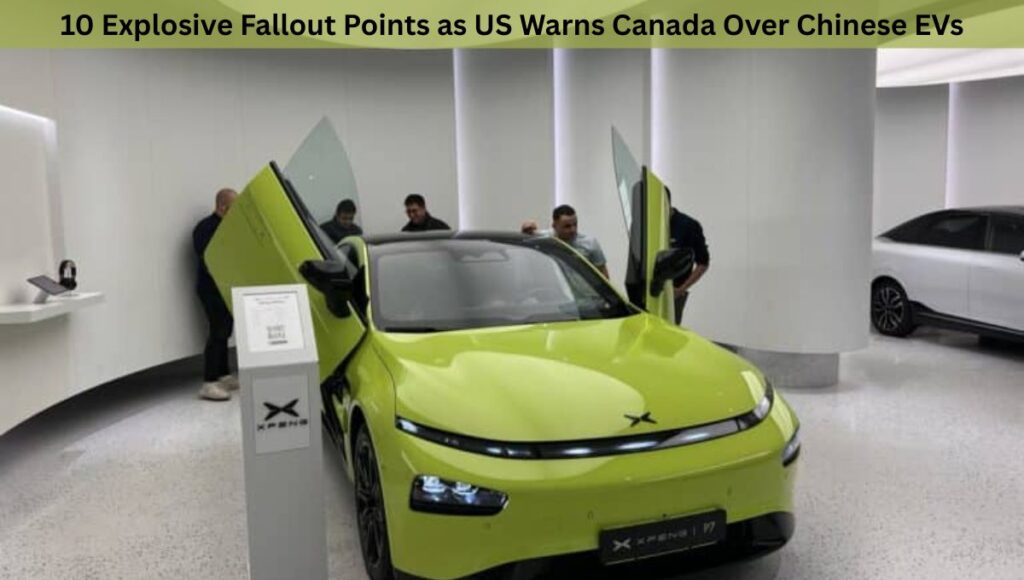
10 Explosive Fallout Points as US Warns Canada Over Chinese EVs
The US Warning — “They Will Regret It”
The message from Washington was unmistakable.
“I think they’ll look back at this decision and surely regret it to bring Chinese cars into their market,”
said US Transportation Secretary Sean Duffy, speaking at a Ford factory in Ohio alongside other administration officials.
Duffy’s comments were aimed squarely at Canada’s decision to allow up to 49,000 Chinese electric vehicles into the country annually, at a sharply reduced tariff.
He added that Chinese vehicles would not be allowed into the United States, reinforcing Washington’s position that Canada’s move would not serve as a back door into the US market.
The remarks reflect a hardening US stance against Chinese automakers, even as Canada breaks ranks with Washington on EV trade policy.
What Canada Agreed to With China
During his high-profile visit to Beijing — the first by a Canadian prime minister since 2017 — Mark Carney announced a sweeping trade reset with China.
Key Elements of the Deal
- Canada will allow 49,000 Chinese EVs per year
- Tariff rate reduced to 6.1% (most-favoured-nation terms)
- Quota expected to rise to 70,000 vehicles within five years
- China to cut tariffs on Canadian canola seed from ~85% to ~15% by March 1
- Removal of tariffs on canola meal, lobsters, crabs, peas
- Commitment to restart high-level economic and financial dialogue
Carney said the deal would unlock nearly $3 billion in export orders for Canadian farmers and fish harvesters.
“This is a return to levels prior to recent trade frictions,” Carney said, “but under an agreement that promises much more for Canadians.”
Why the US Is Alarmed
The United States sees Canada’s move as problematic on multiple fronts.
Fear of a Chinese Foothold in North America
US officials worry that allowing Chinese EVs into Canada:
- Normalizes Chinese automotive presence in North America
- Strengthens Chinese supply chains on the continent
- Undermines coordinated Western trade pressure on Beijing
US Trade Representative Jamieson Greer warned that even a limited quota could have long-term consequences.
“I think in the long run, they’re not going to like having made that deal,” Greer said.
Divergence From US Trade Strategy
Canada had previously aligned closely with the US:
- 100% tariffs on Chinese EVs
- 25% tariffs on Chinese steel and aluminum
The new deal breaks that alignment, complicating upcoming reviews of the US–Canada–Mexico Agreement (USMCA).
Will Chinese EVs Reach the US? Washington Says No
Despite concerns, US officials insist Chinese EVs entering Canada will not spill over into the US market.
“They’re going to Canada — they’re not coming here,” Greer said.
He stressed that:
- US border controls remain strict
- Existing tariffs block Chinese EV imports
- Supply chains are closely monitored
Still, critics argue that manufacturing partnerships or future assembly in Canada could complicate enforcement.
Cybersecurity and Surveillance Fears
One of Washington’s strongest arguments against Chinese vehicles centers on cybersecurity.
Connected Cars as National Security Risks
Modern EVs rely on:
- Internet connectivity
- Navigation systems
- Data collection and transmission
Greer said US regulations adopted in January 2025 create a major barrier for Chinese automakers.
“There are rules and regulations in place in America about the cybersecurity of our vehicles,” he said.
“I think it might be hard for the Chinese to comply.”
Lawmakers from both parties have echoed concerns that Chinese vehicles could:
- Collect sensitive location data
- Transmit information back to China
- Be remotely controlled or disabled
Canada’s looser framework raises fears of asymmetric security standards across North America.
Trump’s Mixed Signals on Chinese Automakers
Despite his administration’s hard line, President Trump himself has struck a different tone.
Trump has said he would like Chinese automakers to build vehicles in the United States, arguing domestic production could:
- Create American jobs
- Lower vehicle prices
- Increase competition
When asked about Canada’s deal, Trump responded:
“That’s what he should be doing. It’s a good thing for him to sign a trade deal.”
The contrast highlights internal contradictions within US policy, where economic pragmatism collides with political and security anxieties.
Bipartisan US Opposition to Chinese EVs
Despite Trump’s remarks, Congress remains deeply skeptical.
Ohio Senator Bernie Moreno, speaking at the same Ford event, drew loud applause when he declared:
“As long as I have air in my body, there will not be Chinese vehicles sold [in] the United States of America — period.”
Both Democratic and Republican lawmakers have:
- Warned Chinese EVs threaten US auto jobs
- Backed tariffs as worker protection
- Framed the issue as economic security
This bipartisan consensus limits Washington’s flexibility — and amplifies frustration with Canada’s divergence.
Canada’s Economic Calculation
For Ottawa, the deal with China reflects economic necessity rather than ideology.
Canola Crisis
China is a $4 billion market for Canadian canola.
After Canada imposed EV tariffs in 2024:
- China slapped duties on canola oil and meal
- Added steep tariffs on canola seed
- Shut Canadian farmers out of their second-largest market
China’s imports from Canada fell 10.4% in 2025.
Carney framed the new deal as a lifeline for rural Canada.
Affordable Cars for Canadians
Carney also emphasized affordability:
- Average car price in Canada ~ $40,000
- Chinese EVs priced around $33,000
- EV mandate increasing demand
He argued that limited imports — roughly 3% of annual vehicle sales — would not destabilize the auto sector.
Ontario Pushback — Auto Jobs at Risk
The fiercest opposition came from Ontario, Canada’s auto manufacturing heartland.
Premier Doug Ford denounced the deal as “lopsided.”
“China now has a foothold in the Canadian market,” Ford said, “and will use it to their full advantage at the expense of Canadian workers.”
Union Concerns
Auto unions echoed the alarm:
- Chinese EVs heavily subsidized
- Risk of job losses in Ontario plants
- Fear of hollowed-out supply chains
Unifor leaders said the sector felt “compromised” by Ottawa’s decision.
Experts Split on Impact
Not all experts agree the impact will be severe.
Professor Peter Frise of the University of Windsor noted:
- 49,000 vehicles equal one month of output at a major plant
- Covered vehicles are mostly low-cost imports already built offshore
- Minimal direct competition with Canadian EV production
Still, uncertainty remains over future quotas and investments.
China Sees an Opening
Beijing appears to view the deal as a strategic breakthrough.
Chinese state media hailed:
- A “new strategic partnership”
- Progress in resolving trade disputes
- Renewed high-level dialogue
Analysts say China is eager to:
- Drive wedges between the US and allies
- Reassert itself in global trade governance
- Position itself as a predictable partner amid Trump’s tariffs
Is Canada Pivoting Away From the US?
Despite rhetoric, experts caution against overstating the shift.
“Canada is a core US ally,” said Sun Chenghao of Tsinghua University. “It is therefore very unlikely to realign strategically away from Washington.”
Carney himself stressed:
- Differences with China on human rights remain
- Security cooperation with the US is unchanged
- Engagement with Beijing is selective and pragmatic
The Greenland Factor and Global Context
Carney confirmed he discussed Greenland with Chinese President Xi Jinping, noting “alignment of views.”
The comment comes as Trump revives claims over the Danish territory — adding to broader NATO unease.
Analysts say the Canada–China rapprochement must be viewed within:
- Trump’s “America First” trade disruption
- Fragmentation of global trade rules
- Rise of bilateral and regional deals
What Comes Next
Several fault lines remain unresolved:
- US review of USMCA
- Cybersecurity harmonization
- Chinese investment guarantees
- Protection of North American auto jobs
Canada insists Chinese EV imports will be:
- Limited
- Managed
- Linked to future domestic investment
The US remains unconvinced.
Conclusion: A Risky Reset in a Fractured World
Canada’s decision to cut tariffs on Chinese EVs marks one of the most consequential trade shifts in years.
For Ottawa, it is a calculated gamble to:
- Protect farmers
- Lower consumer costs
- Diversify economic partners
For Washington, it is a warning sign that allies under pressure may break ranks.
Whether Canada “regrets” the decision — as US officials predict — will depend on:
- Investment follow-through
- Job impacts
- Security safeguards
- The trajectory of US–Canada relations under Trump
What is certain is that electric vehicles have become a frontline issue in global power politics, where trade, technology, and trust increasingly collide.
Also Read: 7 Historic Shifts Powering Canada–China’s New Strategic Reset
Also Read: Trump calls Canada-China deal ‘good thing’ as U.S. officials voice concern