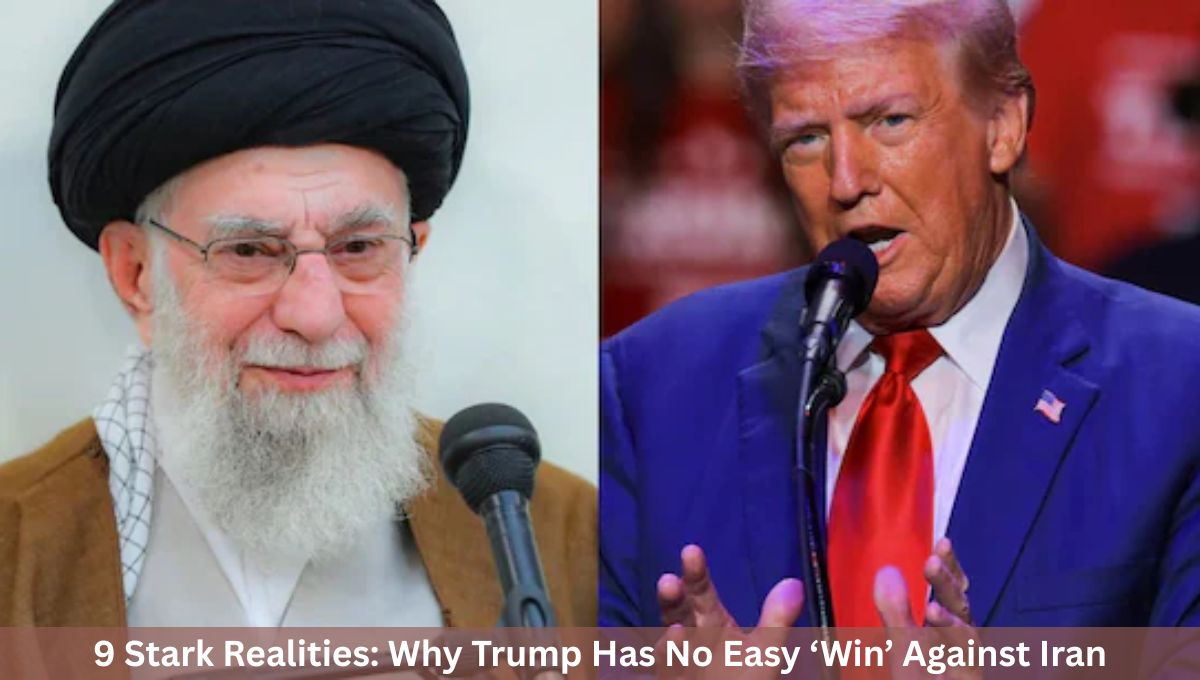
9 Stark Realities: Why Trump Has No Easy ‘Win’ Against Iran amid risks of retaliation and regional war. President Donald Trump has made clear that his goal in Iran is to “win.”
But analysts, diplomats and regional experts say the United States president faces no easy path to victory against an entrenched ideological system that is fighting for its survival — even as Iran reels from protests, economic collapse, and regional setbacks.
Iran’s governing structure has endured war, sanctions, assassinations and internal unrest for more than four decades. While the country is experiencing what many analysts describe as the most severe crisis in its post-1979 history, experts caution that US military action could trigger retaliation, regional escalation, and long-term instability, rather than a clean or decisive outcome.
“All the options are pretty terrible,” said Barbara Slavin, a distinguished fellow at the Stimson Center.
“It’s very hard to know what will take place if you do ‘A’ or ‘B’… particularly if the regime feels that its back is up against the wall.”
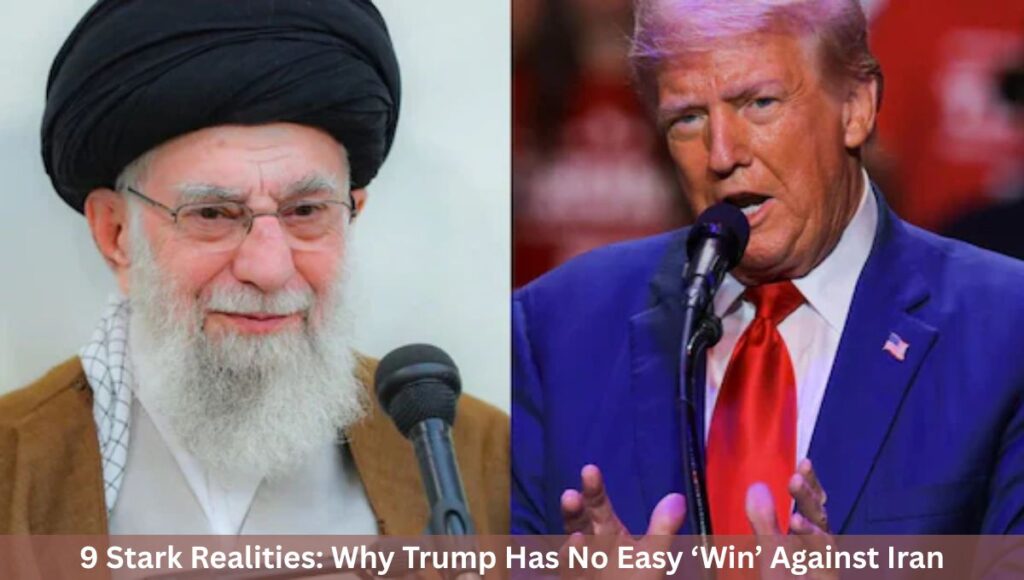
9 Stark Realities: Why Trump Has No Easy ‘Win’ Against Iran
1. Trump’s ‘Win’ Narrative Meets a Complex Reality
Trump has framed Iran through the lens of decisive victory — a theme consistent with his past actions, including:
- The assassination of Iranian general Qassem Soleimani in 2020
- US air strikes on Iran’s nuclear facilities in June
- Recent intervention against Venezuela’s Nicolas Maduro
But analysts stress that Iran is not Venezuela.
“This is not one and done,” Slavin said. “It would require a tremendous amount of military force.”
Unlike weaker or isolated regimes, Iran maintains:
- A large, battle-hardened security apparatus
- Regional influence networks
- A proven capacity for asymmetric retaliation
Any US attack on Iran’s central leadership would likely provoke a meaningful and sustained response, not symbolic retaliation.
2. Protests Shake Iran — But Do Not Guarantee Collapse
Since late December, Iran has witnessed widespread antigovernment protests, initially sparked by economic hardship and escalating into calls for an end to clerical rule.
According to opposition groups and Iranian officials:
- More than 2,000 people have been killed
- Thousands more detained
- A near-total internet blackout imposed
Trump initially responded with threats of intervention, declaring the US was “locked and loaded” if protesters were killed.
But as the crackdown intensified, his tone shifted.
“They said people were shooting at them with guns, and they were shooting back,” Trump said, recounting Iran’s version of events. “They told me there will be no executions, and so I hope that’s true.”
Analysts say the regime views protests as an existential threat, making it more likely to respond forcefully to any external pressure.
3. Iran’s Retaliation Calculus Has Changed
Iran’s response to earlier US attacks was relatively restrained.
After the June bombing of its nuclear facilities, Tehran fired missiles at Al Udeid Air Base in Qatar, causing no casualties.
But experts believe that restraint may no longer apply.
“They have come to the conclusion that they will no longer tolerate attacks,” said Trita Parsi of the Quincy Institute.
Iran does not need to “win” a war outright, analysts argue.
It only needs to:
- Drive up global oil prices
- Trigger inflation
- Prolong instability
“Destroying Trump’s presidency could be enough,” Parsi said.
4. Military Escalation Risks a Wider Regional War
US military assets are being surged to the Middle East, including:
- An aircraft carrier strike group
- Additional offensive and defensive capabilities
Recent US intelligence indicates Iran is preparing options to target American bases in Iraq and Syria if strikes occur.
Even limited US action could set off:
- Iranian missile strikes
- Attacks by regional allies
- Escalation involving Israel and Gulf states
Naysan Rafati of the International Crisis Group warned that desperation could lead Tehran to “reckless decisions.”
“What happens if you end up in a scenario of US action, Iranian retaliation, and then further US response?” he asked. “Then broadening of the campaign?”
5. Iran Is Weakened — But Still Dangerous
Iran is undeniably struggling.
Its regional alliance network — the so-called “axis of resistance” — has largely collapsed:
- Hamas and Hezbollah weakened by Israel’s wars
- Bashar al-Assad ousted in Syria
- Loss of ally Nicolas Maduro in Venezuela
Militarily:
- Israel dismantled Iran’s air defences
- Tehran’s nuclear program was severely damaged
- Uranium enrichment has halted
Economically:
- The rial has lost over 90 percent of its value
- Sanctions have devastated living standards
Yet analysts caution that weak regimes can be the most dangerous, especially when survival is at stake.
6. Decapitation Strikes May Backfire
Some US hawks have floated the idea of a decapitation strike, targeting Supreme Leader Ali Khamenei and top officials.
Experts warn such a move could:
- Fail to collapse the regime
- Fragment power among hardliners
- Trigger prolonged internal conflict
Iran’s system is not dependent on a single figure alone. It has institutional depth — the Revolutionary Guards, judiciary, and clerical networks — capable of sustaining control even after leadership losses.
7. Trump’s Domestic Political Constraints
Trump must also weigh domestic fallout.
The 2026 midterm elections loom, and large parts of his “America First” base remain deeply skeptical of foreign wars.
Polls suggest:
- Limited enthusiasm for intervention in Iran
- Growing frustration over foreign policy distractions
“I don’t think his base is excited about this at all,” Parsi said. “They wonder why he’s still so focused on foreign policy instead of domestic issues.”
Even the intervention in Venezuela, while operationally successful, failed to generate public approval.
8. Diplomacy Remains Narrow — But Not Impossible
Trump’s special envoy Steve Witkoff said Washington prefers diplomacy, outlining US demands:
- End uranium enrichment
- Hand over enriched stockpiles
- Curb missile development
- Cut ties with regional proxies
Critics argue these demands amount to capitulation.
“I don’t see a likelihood of diplomacy succeeding unless there is a profound recalibration,” Parsi said.
Still, analysts believe Iran might compromise on nuclear enrichment in exchange for sanctions relief — a move that could allow Trump to claim a victory without war.
“That would be controversial,” Slavin said. “But I could imagine that he might take such a deal and call it a big victory.”
9. A Crisis on Pause — Not Resolved
After intense behind-the-scenes diplomacy by Gulf allies, Israel, and European partners, Trump pulled back from imminent strikes following Iran’s reported decision to halt mass executions.
“I greatly respect the fact that all scheduled hangings… have been cancelled,” Trump wrote on social media.
But Iran has not confirmed such a halt publicly.
US officials say:
- Military planning continues
- Assets remain in motion
- All options remain on the table
Protests have subsided for now, but security forces remain heavily deployed across Iran.
Conclusion: No Clean Victory in Sight
Iran is weakened, divided, and under unprecedented pressure. Yet analysts agree that there is no clean, quick, or low-cost ‘win’ for the United States.
Military action risks:
- Retaliation
- Regional war
- Global economic shock
Diplomacy, meanwhile, demands compromises neither side is eager to make.
Trump may still seek a moment he can brand as victory — but in Iran, that moment is far harder to engineer than rhetoric suggests.
As one analyst put it:
“All the options are terrible — and none guarantee the outcome Trump wants.”
Also Read: 7 Explosive Impacts of Trump’s 25% Iran Tariff on Global Trade
Also Read: Analysis: Why a ‘quick and clean’ US attack on Iran won’t be easy
Related Posts:
- 11 Explosive Warnings as Trump Vows to ‘Knock the…

- 3 Explosive Conditions Iran Sets to End War with US…

- 9 Explosive Claims as Trump Says US Winning Iran War

- 10 Explosive Warnings as Donald Trump Calls Iran…
- 12 Explosive Claims as Donald Trump Says Iran War…
- 10 Explosive Signals: Trump Rates Iran War “15/10”…