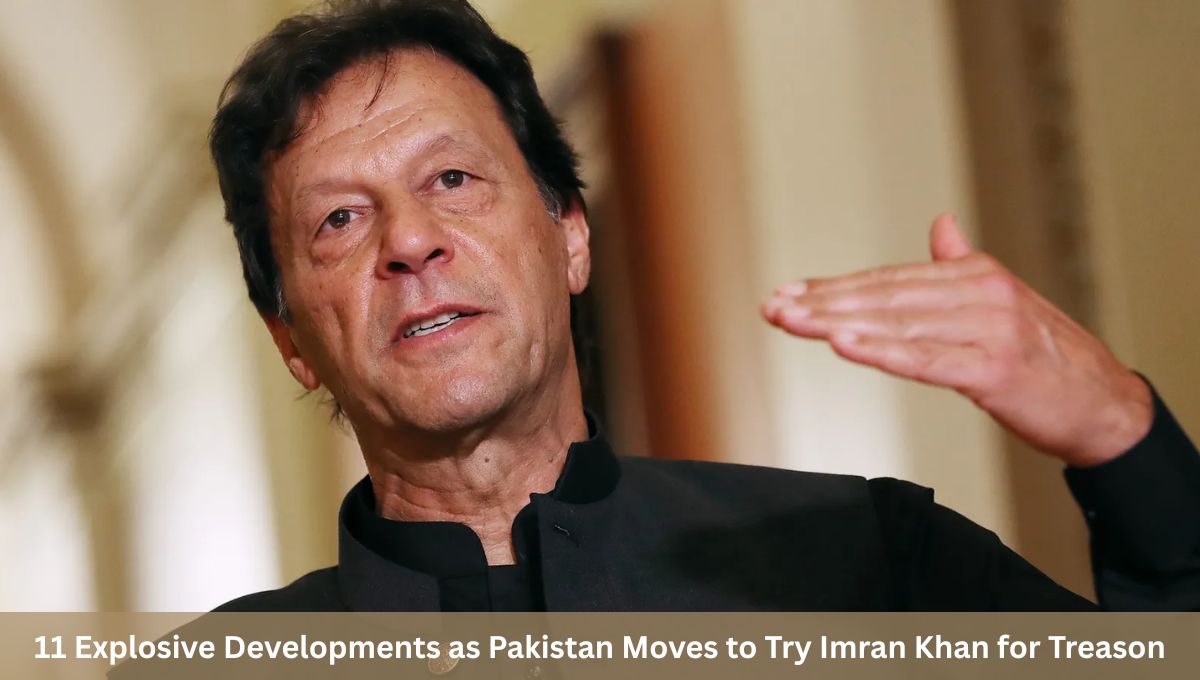
11 Explosive Developments as Pakistan Moves to Try Imran Khan for Treason, ex-ISI Chief Faiz Hamid to testify. Pakistan’s long-simmering civil–military confrontation has entered a decisive and potentially irreversible phase.
With former prime minister Imran Khan already behind bars on multiple convictions, the country’s powerful military establishment is now laying the groundwork for what could be the most serious charge yet: treason.
At the centre of this escalation is Lt Gen (retd.) Faiz Hamid, the former chief of Pakistan’s powerful Inter-Services Intelligence (ISI), who was sentenced this week to 14 years in prison by a Field General Court Martial.
According to senior politicians and security sources, Hamid is now expected to testify against Imran Khan, potentially providing the military with the legal ammunition it needs to try the former premier under the Official Secrets Act and military laws.
If pursued and proven, treason charges would expose Khan to either life imprisonment or the death penalty — a move that would permanently alter Pakistan’s political landscape.
11 Explosive Developments as Pakistan Moves to Try Imran Khan for Treason
Asim Munir Tightens His Grip on Power
Army chief and self-declared Field Marshal Asim Munir has emerged as the most powerful figure in Pakistan today. Since assuming office, Munir has overseen a systematic dismantling of Imran Khan’s political influence, from engineering his removal as prime minister in 2022 to backing a sweeping crackdown on the Pakistan Tehreek-e-Insaf (PTI).
Political observers say the use of Faiz Hamid as a prosecution witness fits squarely into Munir’s broader strategy:
neutralise Imran Khan completely and send an unmistakable message to both civilian politicians and the military ranks about who holds ultimate authority.
By pushing a former ISI chief to testify against a former prime minister, the establishment is signalling that no position — civilian or military — is beyond reach.
Faiz Hamid’s Conviction: A Turning Point
Faiz Hamid was sentenced on Thursday to 14 years in jail after a military court found him guilty on four charges, including violating the Pakistan Army Act and engaging in political activities while in service.
In addition to the sentence, Hamid faces a separate investigation into his alleged role in the May 9, 2023 attacks on military installations across Pakistan. Those attacks erupted after Imran Khan was arrested from court premises, triggering violent protests by PTI supporters.
Military statements following Hamid’s conviction were notable for their wording. The Inter-Services Public Relations (ISPR) said his involvement in “fomenting vested political agitation and instability in cahoots with political elements” was being addressed separately — language widely interpreted as pointing directly at Imran Khan and the PTI leadership.
Claims That Hamid Will Testify Against Imran
Senator Faisal Vawda, a former PTI leader who has since become one of Imran Khan’s fiercest critics, claimed on a Geo News programme that Faiz Hamid is prepared to testify against the jailed former prime minister.
According to Vawda, the ex-ISI chief has been “caught in a legal squeeze” and is likely to present evidence implicating Imran Khan in conspiracy against the military.
While there has been no official confirmation of such testimony, multiple sources within Pakistan’s security establishment have indicated that evidence emerging during Hamid’s trial has strengthened the case for pursuing Imran Khan in military courts.
May 9 Violence at the Heart of the Case
The violence of May 9, 2023 has become the central pillar of the establishment’s case against Imran Khan.
That day, PTI supporters attacked and vandalised military installations, including the Corps Commander’s House in Lahore and the General Headquarters in Rawalpindi — sites long regarded as untouchable symbols of military authority.
Defence Minister Khawaja Asif has described the unrest as a “joint plan” orchestrated by Imran Khan and Faiz Hamid. Speaking on television, Asif alleged that the attacks were designed to undermine and overturn the appointment of Asim Munir as Army chief.
According to Asif, Imran Khan could not have executed the May 9 unrest without strategic guidance and support from a figure like Hamid, who he says retained influence even after retirement.
The Munir–Imran Rift Goes Back Years
The bitter rivalry between Asim Munir and Imran Khan predates the current crisis.
Munir was appointed ISI chief in 2018 by then-army chief Qamar Javed Bajwa but served only eight months. In 2019, he was abruptly removed from the post while Imran Khan was prime minister.
Multiple reports suggest Munir’s removal followed his decision to pursue corruption allegations involving Imran Khan’s wife, Bushra Bibi — a move that reportedly angered the prime minister.
That episode is widely seen as the origin of the deep animosity between the two men.
Path to a Treason Trial
Pakistan’s federal Law Ministry has reportedly begun consultations to draft a comprehensive lawsuit against Imran Khan.
According to senior officials, the civilian government will be made a formal party to the proceedings, lending political cover to what would otherwise be seen as a purely military initiative.
The charges under consideration include treason, instigating mutiny, and encouraging or orchestrating attacks on military installations.
The case would be pursued under the Official Secrets Act and relevant military statutes — laws that allow civilians to be tried in military courts under specific circumstances.
Supreme Court Opens the Door
A key legal hurdle was cleared earlier this year when Pakistan’s Supreme Court ruled that civilians involved in the May 9 riots could be tried in military courts.
That landmark judgment has since been used to justify dozens of military trials against PTI supporters and activists. Legal experts say it also provides the foundation for trying Imran Khan himself in a military forum.
Critics argue that such trials lack transparency and violate basic principles of due process.
Mounting Political Pressure
Beyond the courts, political pressure on Imran Khan continues to build. The Punjab Assembly has passed a resolution calling for his trial on treason charges and seeking a ban on the PTI.
Government officials have openly discussed the possibility of outlawing the party, which still commands significant popular support despite the crackdown. The establishment appears determined to dismantle PTI’s organisational structure and permanently weaken Imran Khan’s appeal.
Imran Khan’s Existing Convictions
Imran Khan is already serving sentences in multiple cases:
• 14 years in the Toshakhana corruption case
• 7 years in the Iddat case
• 14 years in the Al-Qadir Trust case
He also faces numerous FIRs linked to the May 9 violence. A treason conviction would eclipse all previous cases, effectively ending his political career and ensuring his long-term incarceration.
‘The Hameed Precedent’
Analysts describe Faiz Hamid’s conviction as a template for what lies ahead.
By prosecuting a former ISI chief, the military has established a precedent for internal accountability — or, critics argue, selective accountability aimed at consolidating power.
Security officials say Hamid’s testimony and the evidence gathered during his trial will be central to building a narrative that portrays Imran Khan as anti-state.
Risks of Backlash
Despite the establishment’s confidence, the strategy carries risks.
Imran Khan remains one of Pakistan’s most popular politicians, and efforts to brand him a traitor could deepen public resentment and political polarisation.
Human rights groups and international observers have already expressed concern over the use of military courts to try civilians.
What Comes Next
Once investigations conclude, formal charges against Imran Khan are expected to be framed. Military trials could begin soon after.
For Pakistan, the stakes could not be higher. A treason trial against a former prime minister would mark an unprecedented assertion of military dominance over civilian politics.
Whether it brings stability or further turmoil remains an open question — but one thing is clear:
the power struggle between Asim Munir and Imran Khan is entering its most dangerous phase yet.
Also Read: 7 Shocking Revelations as Imran Khan’s Sister Confirms He Is Alive Amid Death Rumours
Related Posts:
- 17-Year Shock Verdict: Imran Khan Jailed as Protests Loom

- 7 Shocking Twists in Imran Khan Death Rumours and Jail Chaos

- 7 Urgent Revelations as Imran Khan’s Isolation…

- 7 Shocking Revelations as Imran Khan’s Sister…

- South Korea Heads to Snap Presidential Election…

- 10 Explosive Updates: US Destroys 16 Iranian…