
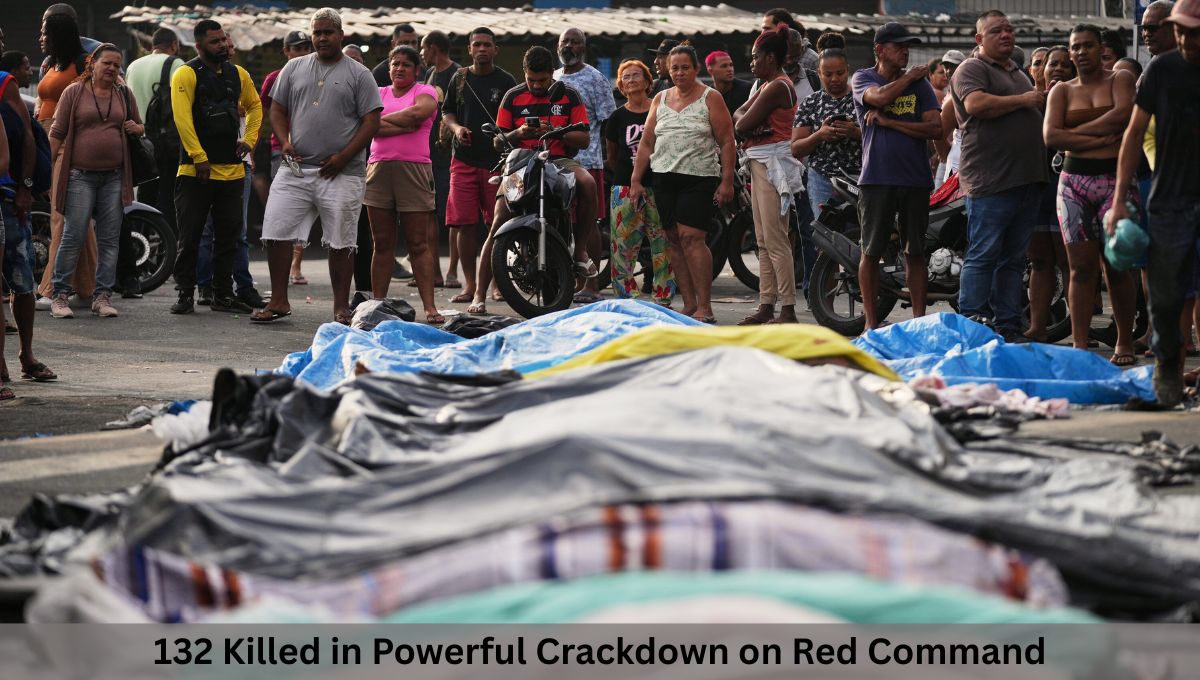
132 Killed in Powerful Crackdown on Red Command in Brazil’s Deadliest Police Raid. At least 132 people have been killed in what officials are calling the deadliest police operation in Brazil’s history, intensifying global scrutiny just days before Rio de Janeiro hosts major climate events linked to the United Nations COP30 summit. The sweeping crackdown on the powerful Red Command gang has reignited debate over policing, human rights, and security in Latin America’s largest democracy.
132 Killed in Powerful Crackdown on Red Command
What Happened in Rio: The Deadliest Operation Yet
The updated death toll — confirmed by the Rio public defender’s office — is more than double the initial figure of 64 reported by state authorities on Tuesday.
The operation targeted the Comando Vermelho (Red Command), one of Brazil’s most notorious criminal gangs, which dominates drug trafficking across multiple Rio favelas.
The raid, involving 2,500 heavily armed police officers and soldiers, deployed armored vehicles, helicopters, and drones. Officials say gun battles erupted in the forested outskirts of the Penha and Alemão complexes, northern Rio districts long under gang control.
Governor Cláudio Castro described the offensive as the state’s largest-ever operation against organized crime, calling it a “historic day” for law enforcement. “The only real victims were the police officers,” Castro said, defending the use of force.
Bodies in the Streets: Residents Accuse Police of a Massacre
As the operation ended, grim scenes emerged. Residents retrieved bodies from wooded areas and lined them on the streets of Penha favela, demanding justice.
More than 70 corpses were laid in a row by grieving families, some identifying relatives by the light of mobile phones.
“I just want to take my son out of here and bury him,” said Taua Brito, one of many mourning parents. Activists and community leaders described the incident as a “massacre.”
Rights groups say many victims bore execution-style wounds, including shots to the head and back, and alleged that some bodies showed signs of stabbing or restraint.
The UN Human Rights Office urged Brazil to launch “prompt and independent investigations,” warning that the scale of killings may amount to extrajudicial executions.
The Numbers: Scope of the Raid
- Death toll: 132 (including 4 police officers)
- Operation name: “Operação Contenção” (Operation Containment)
- Forces involved: 2,500 police & soldiers
- Arrests: 81 suspects
- Seizures: 93 rifles, over 500 kg of drugs
- Areas affected: Penha & Alemão complexes, Rio de Janeiro
- Context: One week before C40 Climate Summit & Earthshot Prize events
Authorities claim those killed were gang members who “resisted arrest,” but critics question whether such lethal force was necessary in densely populated urban zones.
Global Reactions: Shock and Condemnation
The operation has drawn sharp criticism both within Brazil and abroad. President Luiz Inácio Lula da Silva expressed horror at the scale of fatalities.
According to Justice Minister Ricardo Lewandowski, Lula was “astonished” that the federal government was not informed in advance of the raid. He said, “Confrontation must be carried out with intelligence and coordination, not brute force.”
United Nations Secretary-General António Guterres voiced concern, urging Brazilian authorities to respect human rights standards and conduct an impartial investigation. “The use of force must adhere to international law,” his spokesperson said in New York.
Amnesty International and Human Rights Watch also condemned the violence, describing it as a “pattern of deadly policing” that disproportionately affects Rio’s poorest communities.
Rio’s Governor Defends Police Actions
Governor Castro rejected accusations of a massacre, saying those killed were part of “narco-terrorist” networks.
“To be honest, the conflict wasn’t in built-up areas but in the woods,” he said. “I don’t believe anyone was just strolling in the forest on a day of conflict. That’s why we can easily classify them.”
He also claimed that criminal groups used weaponized drones, explosives, and burning buses to block police advances. “This is not ordinary crime, but narcoterrorism,” he said.
Still, critics argue the remarks further dehumanize favela residents and reinforce the narrative of impunity for state violence. Congressman Henrique Vieira, an evangelical pastor, accused the state of treating favelas as “enemy territory with a license to kill.”
War-Like Scenes Across Rio
The raid paralyzed parts of northern Rio. Gunfire echoed across the Complexo do Alemão, while buses and cars were set ablaze to form barricades.
Schools and universities shut down, flights were delayed, and businesses closed early as panic spread through neighborhoods near the Galeão International Airport.
Police footage showed officers advancing through narrow alleys and steep hillsides, exchanging fire with heavily armed suspects. A police source described “war-like conditions.”
“This is how the Rio police are treated by criminals: with bombs dropped by drones,” Governor Castro wrote on X (formerly Twitter). “This is the scale of the challenge we face.”
Political Fallout Between Rio and Brasília
The raid has sparked political tension between the state and federal governments. Governor Castro accused Brasília of “leaving Rio alone in this war,” implying a lack of national support against organized crime.
The Justice Ministry countered, saying federal forces have been deployed several times to assist in Rio’s security crises.
A high-level meeting between Lula’s ministers and Rio’s governor has been scheduled to review the operation’s legality and proportionality.
President Lula later posted on X:
“We cannot allow organized crime to destroy families and oppress communities. We must strike at drug trafficking’s roots without putting innocent lives at risk.”
Human Rights Concerns Mount
The UN Human Rights Office called the raid “horrifying,” demanding accountability. Spokesperson Marta Hurtado urged Brazil to uphold its obligations under international human rights law, emphasizing that “lethal force must be a last resort.”
Brazil’s Public Defender’s Office said evidence pointed to excessive use of force and potential summary executions. Photos and videos from Penha appeared to show residents carrying bodies wrapped in sheets while shouting “justice.”
Local NGOs such as FAFERJ (Federation of Favelas of Rio) say mass killings do not reduce gang power.
“In 30 days, organized crime will reorganize,” said Filipe dos Anjos, FAFERJ’s director. “For society, this achieves practically nothing.”
Timeline of the Raid
- Day 1 (Tuesday): Police launch coordinated raids in Penha and Alemão. Heavy gunfire erupts; buses are set ablaze.
- Day 2 (Wednesday): Residents retrieve dozens of bodies; public defender confirms 132 deaths. UN, NGOs issue statements.
- Day 3 (Thursday): President Lula calls emergency meeting. Federal Justice Ministry orders review of Rio’s use-of-force protocols.
The Broader Security Crisis in Brazil
Brazil’s security forces have long battled criminal networks entrenched in favelas. In 2024 alone, nearly 700 people died during police operations in Rio — almost two per day — according to state data.
Analysts say such raids do little to dismantle organized crime but worsen relations between communities and police.
“Decades of inaction have allowed crime to expand,” said Rio’s Security Secretary Victor Santos. “This is a war we are witnessing.”
Experts warn that militarized policing — often politically motivated ahead of elections — fuels a cycle of violence that criminal gangs exploit to justify retaliation.
International Spotlight: COP30 and Global Image Risks
The timing of the bloodshed has amplified scrutiny as Rio prepares for major international gatherings, including:
- C40 World Mayors Summit
- Prince William’s Earthshot Prize ceremony
- COP30 climate meetings in Brazil’s Amazon region next month
Diplomats and UN observers worry that the violence could overshadow Brazil’s environmental diplomacy and undermine efforts to showcase the country as a stable host.
“The world is watching Brazil not just for its forests, but for how it treats its people,” said a European envoy in Brasília.
Calls for Reform and Accountability
Rights advocates, community leaders, and politicians are urging a complete review of Brazil’s policing model.
“Force alone cannot resolve Rio’s security crisis,” said Justice Minister Lewandowski. “We need intelligence, coordination, and respect for the Constitution.”
Activist Raul Santiago, who documented the aftermath in Penha, described the scene as “a theatre of war and barbarism.”
He added: “People were executed — shot in the back, in the head, some tied up. This was not an operation; it was a massacre.”
What Lies Ahead
Federal investigators are expected to examine reports of execution-style killings and civilian deaths. The probe will likely determine whether the operation violated Brazil’s 2021 Supreme Court restrictions on police raids in favelas during peacetime.
Observers say the outcome could shape Brazil’s national security strategy, influence Lula’s political standing, and test the country’s human rights credibility ahead of the COP30 summit.
Conclusion
The 132 deaths mark a grim chapter in Brazil’s struggle against organized crime — one that exposes deep divisions over how to balance law enforcement, justice, and human rights. While officials defend the operation as a blow to “narcoterrorism,” rights groups call it a massacre emblematic of systemic failure.
As Rio’s residents bury their dead, the world’s gaze turns toward Brazil’s leaders — to see whether the tragedy triggers reform or becomes yet another forgotten episode in the nation’s long war within its own borders.
Also Read: Is Trump pushing for regime change in Venezuela; where else is he meddling?
Also Read: Insights from Pakistan Navy’s $1 Billion Arabian Sea Drug Seizure
Related Posts:
- 7 Alarming Forces Driving the COP30 Climate Summit…

- 7 Shocking Moments from the COP30 Brazil Fire Chaos
- 7 Powerful Shifts at COP30 as 80 Nations Demand a…

- 7 Key Developments as China Steps In and Trump Skips COP30

- BRICS Denounces Trump Tariffs, Condemns Iran Strikes…
- 32 Dead: Cuba’s Fierce Fighters Killed in Shocking…
