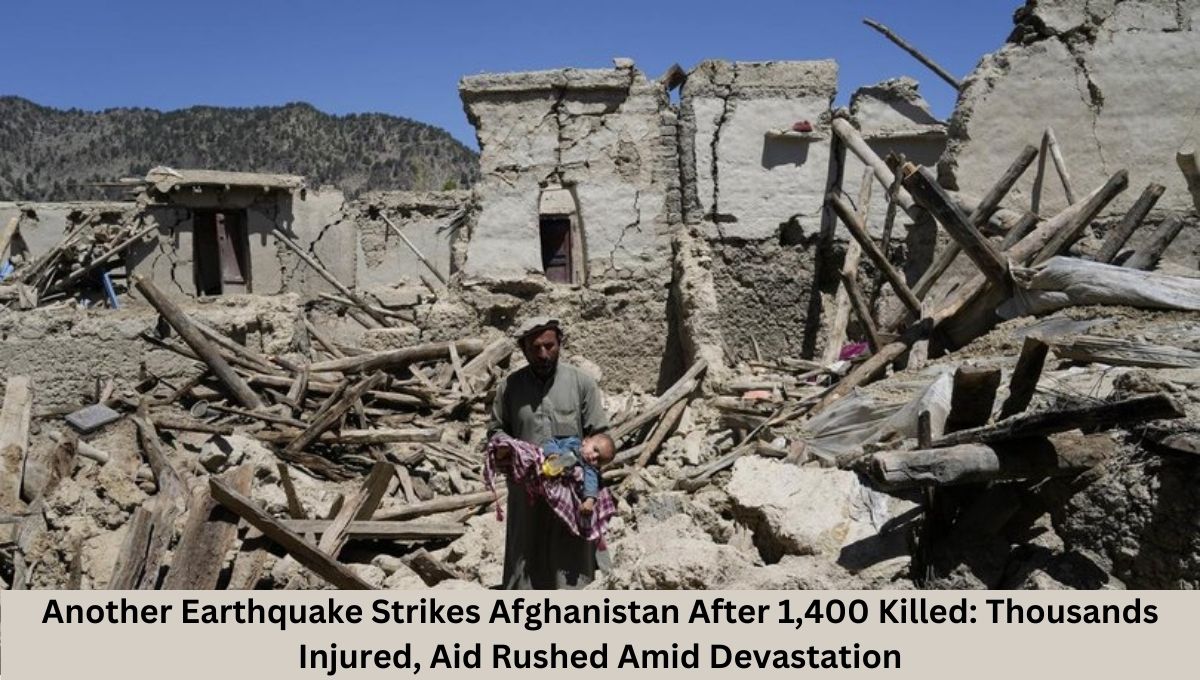
A nation shaken again as Another Earthquake Strikes Afghanistan After 1,400 Killed: Thousands Injured, Aid Rushed Amid Devastation. Afghanistan has been struck by yet another earthquake, compounding an already devastating humanitarian disaster. Just two days after a 6.0-magnitude quake flattened villages in the eastern provinces of Kunar and Nangarhar, killing at least 1,411 people and injuring more than 3,100, a second earthquake measuring 5.2–5.5 magnitude shook the same region on Tuesday.
The fresh tremor, reported by the US Geological Survey (USGS), occurred northeast of Jalalabad city in Nangarhar province at a shallow depth of around 10 kilometers (6 miles). Shallow earthquakes are particularly destructive because they release energy close to the Earth’s surface, and the shockwaves ripple directly through fragile villages constructed largely of mud brick and timber.
This second quake triggered fresh panic, halted rescue operations, and caused already fragile homes to collapse. For thousands of Afghans, it was another cruel reminder of the country’s vulnerability.
Another Earthquake Strikes Afghanistan After 1,400 Killed: Thousands Injured, Aid Rushed Amid Devastation
Scale of Devastation
Casualties and Damage
According to Taliban government spokesman Zabihullah Mujahid, at least 1,411 people have died so far, with 3,124 others injured. In Kunar province alone, over 5,400 houses were destroyed.
Neighboring Nangarhar province also reported dozens of deaths and hundreds of injuries, while other provinces like Laghman, Nuristan, and Panjshir have recorded significant damage.
The latest tremor has worsened the already critical situation. Partially damaged homes collapsed completely, while rockslides and landslides cut off vital roads, isolating entire communities.
Aid groups warned that more people are likely trapped under rubble, and the death toll is expected to rise.
Rescue Operations
Efforts to save survivors remain extremely challenging. Helicopters were unable to land in some areas, forcing rescue teams to air-drop Taliban commando units who pulled injured villagers from the rubble.
In places where roads are blocked, survivors are being evacuated on foot or carried to makeshift aid stations.
A Reuters journalist who reached the affected areas described villages reduced to piles of mud and stone.
Locals dug with bare hands and shovels, desperate to find loved ones. Many were still trapped under debris when the second quake struck.
The Human Cost
Stories of Survival and Loss
Personal stories emerging from the rubble reveal unimaginable suffering.
- Sadiqullah, a resident of Nurgal in Kunar province, told the Associated Press that he was half-buried under his collapsed home. He survived, but his wife and two sons were killed.
- Obaidullah Stoman, 26, searched for his missing friend in the destroyed village of Wadir. “There is only rubble left,” he said in despair.
- Hospitals in Jalalabad city have been overwhelmed, receiving hundreds of injured patients. Doctors reported severe trauma injuries, particularly to the head, back, and legs. One emergency ward cleared beds for unidentified patients, waiting for relatives to recognize them.
Villages Wiped Out
Entire villages in Kunar have been reduced to dust. Survivors described digging through mud and stone with no machinery, while bodies wrapped in white shrouds were buried quickly to prevent disease.
The destruction is eerily reminiscent of past disasters. In October 2023, a 6.3-magnitude earthquake in Herat province killed more than 1,500 people.
In June 2022, another quake in Paktika killed over 1,000. Afghanistan is caught in a tragic cycle of seismic disasters that overwhelm its limited resources.
Afghanistan’s Vulnerability
Afghanistan is one of the world’s most earthquake-prone countries, sitting at the intersection of the Indian and Eurasian tectonic plates in the Hindu Kush Mountain range.
Most rural homes are constructed with mud bricks and timber, materials that crumble easily when shaken.
The Sunday quake struck 27 kilometers northeast of Jalalabad at a shallow depth of 8 kilometers. Such shallow quakes cause maximum destruction.
Nearly half a million people felt strong to very strong shaking, according to USGS estimates. Compounding the disaster, the region has endured decades of conflict, poverty, and displacement.
More than 4 million Afghans have been forced back from Pakistan and Iran in recent years, many settling in vulnerable border provinces like Nangarhar.
Also Read: Why is Afghanistan so prone to earthquakes?
A Race Against Time
Rescue Challenges
Rescue teams face a daunting landscape of blocked roads, falling rocks, and heavy rains. Aftershocks continue, destabilizing slopes and threatening both survivors and rescuers.
Aid group Save the Children warned:
“This is now a race against time to save lives to get injured people out of remote villages cut off by massive rock falls and to get clean water, food, and shelter in.”
Disease and Scarcity
Clean water sources have been disrupted, raising fears of cholera and other waterborne diseases. Food is scarce, and families sleep in the open amid cold nights, lacking blankets and tents.
Humanitarian experts warn that hundreds of thousands could be affected if aid does not scale up quickly.
Global Response
United Nations
The UN Humanitarian Coordinator for Afghanistan, Indrika Ratwatte, has called for urgent international support. “The resilience of Afghan communities has been saturated,” he warned, noting the crisis could impact hundreds of thousands.
Regional and Global Aid
Despite strained relations with the Taliban government, several countries and organizations have stepped forward:
- India airlifted 21 tonnes of relief supplies to Kabul, including tents, blankets, medicines, and hygiene kits.
- The European Union announced €1 million ($1.16 million) in emergency funding and sent 130 tonnes of aid supplies.
- The United Arab Emirates dispatched food, tents, medical supplies, and a search-and-rescue team.
- The UK pledged £1 million ($1.3 million) in aid through the UN Population Fund and the International Red Cross.
- China expressed readiness to provide relief assistance, while Pakistan and Iran pledged support despite their own challenges.
The United States offered condolences but has not announced significant aid, reflecting tensions with the Taliban regime.
Aid Cuts and Humanitarian Crisis
Afghanistan’s disaster response has been crippled by shrinking international aid. Since the Taliban takeover in 2021, global donors reduced funding, citing concerns over women’s rights, governance, and security.
- Humanitarian aid fell from $3.8 billion in 2022 to just $767 million in 2025, according to Reuters.
- The US cut $1.7 billion in contracts earlier this year.
- Humanitarian air services have been curtailed, limiting access to remote communities.
Organizations like the International Federation of Red Cross and Red Crescent Societies warn:
“The scale of need far exceeds current resources.”
Regional Tremors and Fear
The National Centre for Seismology (India) reported that tremors were felt across eastern Afghanistan and into Pakistan, sparking widespread fear.
Families rushed into streets at night, fearing their homes would collapse.
Aftershocks ranging from magnitude 4 to 5 continued to rattle the region, further complicating relief operations.
Historical Context: Deadly Afghan Earthquakes
Afghanistan has suffered several catastrophic quakes in recent years:
- October 2023, Herat Province: 6.3-magnitude quake killed 1,500+ people.
- June 2022, Paktika Province: 5.9-magnitude quake killed 1,000+ and left tens of thousands homeless.
- 2015, Hindu Kush: 7.5-magnitude quake killed 380 people across Afghanistan and Pakistan.
The current quake ranks among the deadliest in decades, underscoring the urgent need for better preparedness.
Taliban’s Appeal for Help
The Taliban have made rare appeals for international aid, acknowledging the scale of the disaster.
Health ministry spokesperson Sharafat Zaman said:
“We need it because here lots of people lost their lives and houses.”
Despite political tensions, aid is slowly arriving. But analysts warn that without consistent funding and coordination, Afghanistan’s cycle of crisis will continue.
Outlook
The coming days are critical. With thousands injured, villages flattened, and survivors left without shelter or food, the humanitarian crisis is deepening. Aid agencies stress the need for:
- Emergency shelters, blankets, and warm clothing.
- Medical supplies, including trauma kits and body bags.
- Clean water systems to prevent disease outbreaks.
- Long-term reconstruction assistance for destroyed villages.
For now, Afghans continue to dig through rubble with their bare hands, searching for loved ones, even as the ground beneath them refuses to stay still.
Also Read: Drake Passage Earthquake: 7.5-Magnitude Quake Rattles Antarctic Waters, No Tsunami Threat
Related Posts:
- Afghanistan Earthquake 2025: Over 800 Dead as…
- Afghanistan Earthquake 2025: Over 600 Killed, 1,500…
- 6.3-Magnitude Earthquake Devastates Northern Afghanistan
- Third Earthquake Strikes Afghanistan: Death Toll…
- Drake Passage Earthquake: 7.5-Magnitude Quake…
- 6.1 Magnitude Earthquake Strikes Turkey’s Balikesir…