
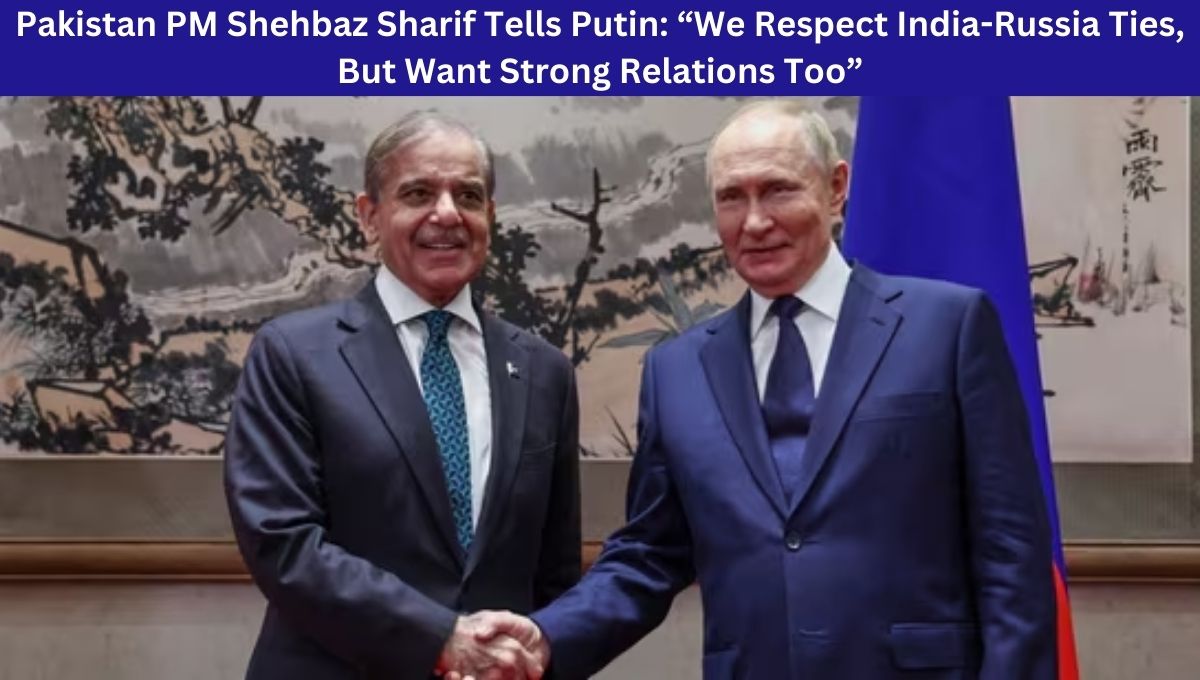
During a meeting in Beijing, Pakistan PM Shehbaz Sharif Tells Putin: “We Respect India-Russia Ties, But Want Strong Relations Too.” Pakistan Prime Minister Shehbaz Sharif met Russian President Vladimir Putin on the sidelines of the Shanghai Cooperation Organisation (SCO) summit and commemorative events in China. During their interaction, Sharif made a diplomatic balancing statement, saying that Islamabad “respects Russia’s relations with India” but is equally eager to strengthen its own strategic partnership with Moscow.
“Our relations have only improved over the past many years. Thanks to your commitment and interest in many areas. I must say that we respect your relations with India. That is perfectly fine. But we also want to build very strong relations with Russia. And these relations will be supplementary and complementary for the progress and prosperity of the region,” Shehbaz Sharif told Putin.
The meeting took place in Beijing, where both leaders were attending the 80th anniversary celebrations of the Chinese People’s Victory in the Second World War.
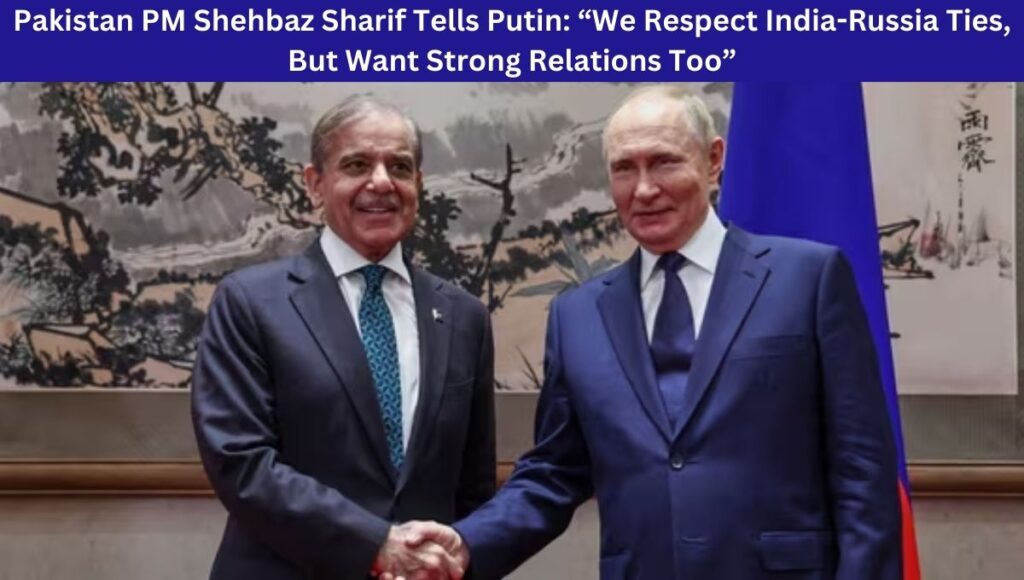
Pakistan PM Shehbaz Sharif Tells Putin: “We Respect India-Russia Ties, But Want Strong Relations Too”
Shehbaz Sharif Highlights Pakistan-Russia Cooperation
Shehbaz Sharif emphasized that Pakistan was keen to deepen cooperation with Russia in several vital sectors, including:
- Trade and connectivity
- Energy and agriculture
- Defence and investment
- Artificial intelligence and education
- Cultural and people-to-people exchanges
According to Radio Pakistan, Sharif also praised Putin’s leadership style, calling him a “very dynamic leader” and thanking him for what he described as Moscow’s “balancing act” in South Asia.
The Pakistani leader noted that ties with Russia had consistently grown stronger over the years, describing them as moving “in the right direction.”
Putin Acknowledges Growth in Ties
President Putin reportedly welcomed Pakistan’s outreach and reaffirmed Russia’s willingness to expand cooperation. He emphasized the role of platforms like the SCO in ensuring regional stability and global security.
Both leaders exchanged views on a wide range of issues, including:
- The security situation in South Asia
- Developments in Afghanistan
- Ongoing conflicts in the Middle East
- The Ukraine war
- Global disputes, including Palestine and Kashmir
Sharif also accepted Putin’s invitation to visit Russia in November 2025, where he will participate in the SCO Heads of Government meeting.
SCO Summit in Tianjin: Regional and Global Dimensions
This year’s SCO summit in Tianjin was the largest since the grouping was founded in 2001. China, as host and chair, invited:
- 20 foreign leaders
- 10 heads of international organisations, including UN Secretary-General Antonio Guterres
Chinese President Xi Jinping, in his banquet speech, underscored the SCO’s responsibilities in safeguarding regional peace and stability.
He urged member states to strengthen the voice of the Global South and work collectively toward the progress of human civilisation.
Modi-Putin Meeting Overshadows Sharif
During the SCO summit, a video clip went viral on social media showing Indian Prime Minister Narendra Modi and Vladimir Putin walking together in an animated conversation.
Standing nearby, Shehbaz Sharif appeared sidelined, watching the exchange.
The brief moment sparked online commentary, with many contrasting the warm optics of the Modi-Putin engagement with Sharif’s relatively muted presence.
India’s Diplomatic Gain at SCO
Sharif’s remarks about respecting India-Russia relations came just a day after India secured a diplomatic win at the SCO.
In the joint declaration, the grouping’s 10 member states strongly condemned the terrorist attack in Jammu and Kashmir’s Pahalgam, which India blamed on Pakistan-based groups.
While Pakistan was not explicitly named, the inclusion of the condemnation and Sharif’s signature on it was viewed as a marked shift from the June SCO summit, where the incident had gone unmentioned.
Indian Prime Minister Narendra Modi used the platform to reiterate that terrorism is a threat to humanity as a whole. He urged member nations to adopt a zero-tolerance policy and avoid double standards in addressing terrorism.
Pakistan Seeks New Avenues in Foreign Policy
The meeting with Putin signals Pakistan’s intent to diversify its foreign policy at a time of shifting global alliances.
While India continues to highlight its decades-old strategic partnership with Moscow, Pakistan is positioning itself as a willing partner to Russia, particularly in energy and defence cooperation.
Pakistan already enjoys close ties with China, and its outreach to Moscow could be seen as part of a larger strategy to deepen integration into the SCO bloc.
Observers note that Sharif’s remarks reflected Islamabad’s attempt to strike a careful balance acknowledging India-Russia friendship while advocating for Pakistan-Russia cooperation as complementary, not conflicting.
Pakistan PM Meets Tajikistan President
On the sidelines of the summit, Shehbaz Sharif also met with Tajikistan’s President Emomali Rahmon.
Both leaders expressed satisfaction with the continued growth of bilateral relations across multiple domains of shared interest.
The Sharif-Rahmon meeting reinforced Pakistan’s commitment to engaging Central Asian partners under the SCO framework.
Shehbaz Sharif Accepts Invitation to Visit Russia
In one of the most significant outcomes of his Beijing engagements, Shehbaz Sharif accepted President Putin’s invitation to visit Russia in November 2025.
The trip will coincide with the SCO Heads of Government summit, offering another platform for Pakistan to deepen cooperation with Moscow.
The visit is expected to focus on:
- Energy deals, including oil and gas supply frameworks
- Defence collaboration, particularly in training and joint exercises
- Educational and cultural exchanges
- Enhanced trade routes linking Pakistan with Central Asia and Russia
Looking Ahead: Complementary, Not Competing
By openly stating that Pakistan respects India-Russia relations, Shehbaz Sharif positioned Islamabad’s outreach as non-threatening and complementary.
His remarks align with Pakistan’s broader foreign policy goal of projecting itself as a constructive regional player.
For Moscow, the engagement with Islamabad provides additional diplomatic leverage in South Asia while maintaining its traditional partnership with New Delhi.
As geopolitical alignments evolve, the Pakistan-Russia relationship may not rival that of India-Russia, but it could emerge as an important secondary partnership one that Islamabad hopes will bring trade, technology, and strategic benefits.
Conclusion
The Sharif-Putin meeting in Beijing underscored Pakistan’s diplomatic strategy of balancing relations while expanding its outreach. By respecting India-Russia ties yet pushing for a stronger Pakistan-Russia partnership, Sharif signaled Islamabad’s desire to be part of the multipolar world order championed by Moscow and Beijing.
The upcoming November visit to Russia could mark a turning point for Pakistan-Russia cooperation, with potential agreements in energy, defence, and education. At the same time, Sharif’s words and the optics of the SCO summit highlight the complex triangle of India, Pakistan, and Russia, where history, alliances, and emerging realities continue to shape the future of South Asia.
Also Read: Silent Standoff at SCO: Modi, Shehbaz Keep Distance as Xi and Putin Show Camaraderie
Related Posts:
- China Hosts SCO Summit 2025 and Military Parade as…
- The Hongqi L5: State Car in Which PM Modi Travelled…

- 7 Alarming Facts About Super Typhoon Fung-wong

- Putin’s Shocking Risks Ahead of Trump–Hungary Summit 2025

- Trump’s 20-Point Gaza Peace Plan Gains Urgent Global…

- US Strike on Venezuelan Boat Kills 6 in Fifth…
