

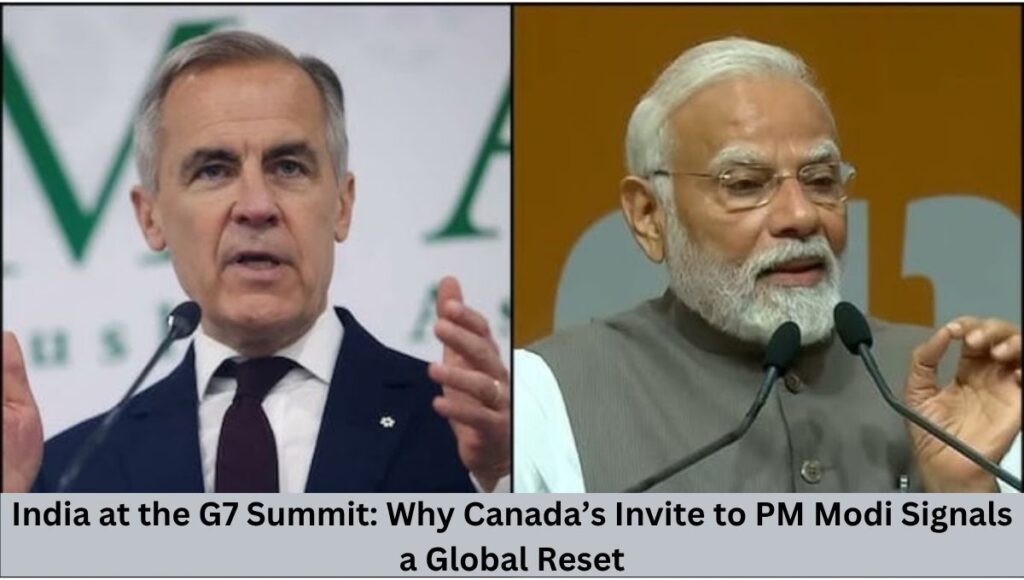
G7 Summit, to take place in Canada and India at the G7 Summit: Why Canada’s Invite to PM Modi Signals a Global Reset. Canada’s new Prime Minister Mark Carney made waves by officially inviting Indian Prime Minister Narendra Modi to attend the 2025 G7 Summit, set to take place in Canada. The move not only signals a diplomatic thaw after years of strained India-Canada relations but also underscores India’s growing importance on the world stage. With India recently surpassing Japan to become the world’s fourth-largest economy, its inclusion in top global policy discussions is no longer optional, it’s essential.
India at the G7 Summit: Why Canada’s Invite to PM Modi Signals a Global Reset
Mark Carney: “India Belongs at the Table”
During a press interaction on Friday, PM Carney clarified his rationale behind inviting PM Modi. “India is the fifth-largest economy, effectively the most populous country in the world, and central to a number of supply chains,” he noted.
His comments echo the global sentiment that New Delhi can no longer be excluded from critical geopolitical conversations especially when it comes to trade, defense, and climate policy. Carney’s statement comes after Canada found itself isolated within the G7 bloc over its hesitant stance toward India in past years.
According to experts like Vina Nadjibulla from the Asia Pacific Foundation of Canada, “Canada was the outlier” while the rest of the G7 was eager to strengthen ties with India. Carney’s course correction now aligns Canada with other G7 countries like the US, UK, and France all of which are enhancing strategic cooperation with India.
India’s Global Economic Weight
India’s invitation to the G7 is rooted in economic reality. In May 2025, India overtook Japan to become the world’s fourth-largest economy. Its GDP is now only behind that of the US, China, and Germany, and its role in global supply chains from semiconductors to pharmaceuticals is expanding rapidly.
According to Carney, inviting PM Modi “made sense” because of India’s increasing role in shaping international trade, climate change strategies, and digital governance.
Canadian opposition leader Pierre Poilievre echoed this view, emphasizing that “India has been at the last six G7 conferences. We need to work with India on trade and security.”
India-Italy and India-UK: Strengthening Global Ties
India’s rising influence isn’t limited to North America. Its ties with Italy and the UK have also deepened in recent years. Italian PM Giorgia Meloni’s two visits to India helped reinvigorate bilateral relations, with trade between the two nations reaching $14.56 billion in 2023–24.
On the UK front, Foreign Secretary David Lammy’s upcoming visit aims to push forward the historic India-UK Free Trade Agreement.
Once implemented, the deal is expected to boost bilateral trade by over £25 billion and increase UK GDP by £4.8 billion annually. PM Modi’s continued engagement with G7 leaders like Rishi Sunak and Emmanuel Macron reflects India’s growing weight in global negotiations.
India-Canada Relations: A Diplomatic Reset?
The decision to invite PM Modi has sparked speculation about whether this marks a true thaw in India-Canada relations, which soured dramatically under former Prime Minister Justin Trudeau.
Accusations by Trudeau’s government including unsubstantiated claims linking India to the killing of Khalistani separatist Hardeep Singh Nijjar led to a diplomatic standoff, visa suspensions, and the withdrawal of ambassadors.
While Carney has avoided direct references to Khalistani figures, his tone has been markedly different from his predecessor. “We are a country of the rule of law, and the rule of law is proceeding as it should,” he said when asked about the controversy.
Indian officials remain cautiously optimistic but emphasize that trust must be rebuilt through decisive actions particularly against Khalistani extremist groups operating with impunity in Canada.
Khalistani Threat Still Looms Large
Indian diplomats in Canada remain under threat from Khalistani extremists, who continue to use Canada as a haven under the pretext of “freedom of expression.”
The Khalistani political front the New Democratic Party (NDP) led by Jagmeet Singh suffered a crushing defeat in Canada’s recent elections, possibly signaling a shift in public sentiment.
Despite this, India insists that any improvement in bilateral ties hinges on Canadian authorities cracking down on anti-India elements and ensuring real-time intelligence sharing. PM Modi’s visit to Canada his first since 2015 will likely serve as a litmus test for Carney’s intentions.
Carney’s First Major Foreign Policy Test
The G7 Summit will be Carney’s debut on the world stage as Canada’s Prime Minister. His invitation to Modi offers a chance to demonstrate a break from Trudeau-era policies that alienated key global partners. While the gesture is significant, India’s expectations are clear: end the political sheltering of extremist groups, restart meaningful security cooperation, and build mutual trust based on action, not just words.
India’s Expanding Global Footprint
PM Modi’s participation in G7 Summits since 2019 has reflected India’s transformation from a regional power to a pivotal global player. From economic resilience during the COVID-19 pandemic to leadership in digital infrastructure and green energy, India’s policy contributions have been widely recognized.
The 2025 G7 Summit in Canada will further affirm this shift not only symbolically through Modi’s presence, but substantively through discussions on economic resilience, Indo-Pacific security, and climate cooperation.
Conclusion: India Can’t Be Ignored Anymore
The message from this year’s G7 host is clear: India is indispensable to the future of global governance. Whether it’s combating climate change, securing supply chains, or countering authoritarian threats, New Delhi is now part of the solution.
Canada’s invitation to PM Modi may be driven by economic logic, geopolitical necessity, or diplomatic pragmatism but whatever the reason, it confirms what the world has known for years: India deserves a seat at the table. For India, the focus now is on ensuring that Canada walks the talk and that this G7 Summit is not just a photo-op, but the start of a more mature, respectful partnership.
Also Read: India-Canada Diplomatic Reset at G7 Summit Marks New Era of Cooperation
Also Read: PM Modi Lands In Canada For G7 Summit. Why This Visit Is Important
Related Posts:
- Modi to Attend G7 Summit in Canada: A Diplomatic…
- 7 Critical Twists in the US–South Africa G20 Showdown

- 5 Key Signals from PM Modi’s Virtual ASEAN Summit Appearance
- 5 Key Takeaways from Trump–Carney Meet: Trade,…
- 7 Powerful Signals as India Joins G7 Critical…

- 7 Key Highlights That Will Shape the High-Stakes G20…
