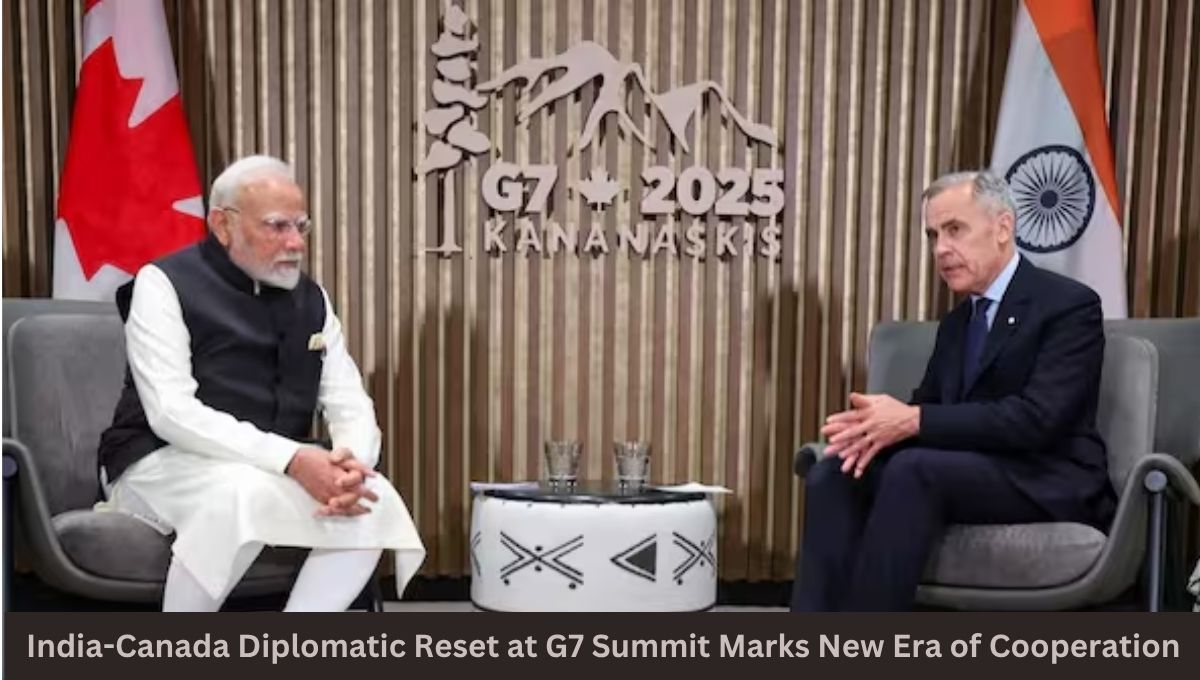
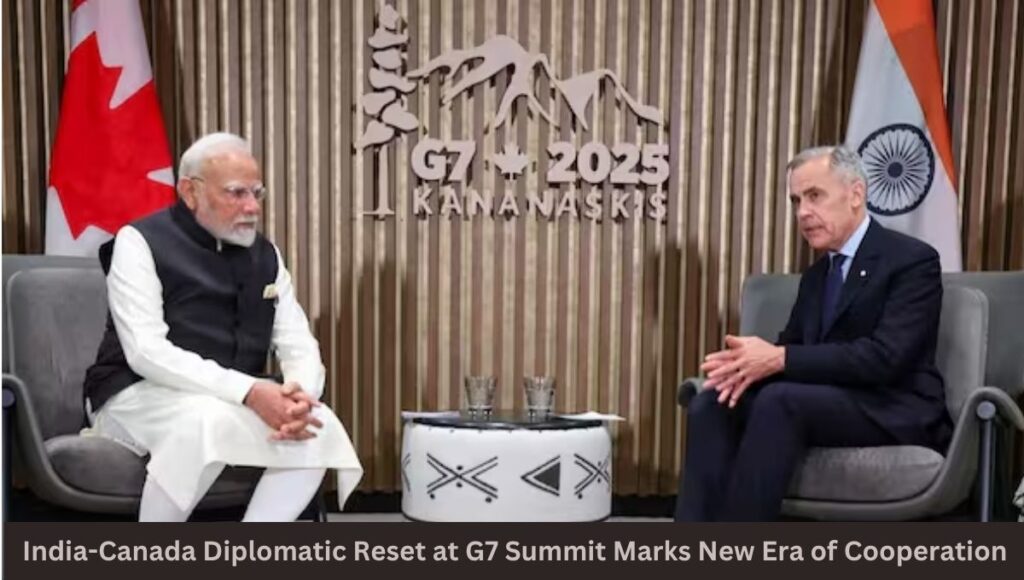
In a major breakthrough India-Canada Diplomatic Reset at G7 Summit Marks New Era of Cooperation. At the G7 Summit 2025 in Kananaskis, Alberta, India and Canada have agreed to reinstate their ambassadors High Commissioners under Commonwealth norms marking a new chapter in their once-frosty bilateral relationship.
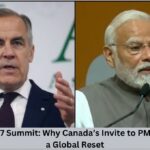
Prime Minister Narendra Modi and newly elected Canadian Prime Minister Mark Carney met on the sidelines of the summit and committed to restoring full diplomatic services between the two countries.
The decision comes nearly two years after relations hit a low point following the assassination of Khalistani separatist Hardeep Singh Nijjar in British Columbia and former Canadian PM Justin Trudeau’s public allegations implicating Indian officials.
India-Canada Diplomatic Reset at G7 Summit Marks New Era of Cooperation
Why India-Canada Relations Had Soured
Tensions escalated sharply in 2023 when Trudeau accused India of orchestrating Nijjar’s killing a charge India vehemently denied. The Indian government dismissed the claims as baseless and criticized Canada for failing to provide credible evidence or initiate formal diplomatic dialogue.
The diplomatic standoff led to both countries expelling top diplomats and suspending key consular services. Trade, student visas, and people-to-people exchanges suffered as a result. Nijjar, who had long been on India’s list of wanted terrorists, was a prominent pro-Khalistan activist and Canadian citizen.
Modi and Carney’s Meeting: A Turning Point
The meeting between PM Modi and PM Carney during the G7 Summit 2025 marks a symbolic and practical reset. Both leaders agreed to appoint new High Commissioners and emphasized a commitment to cooperation in security, law enforcement, energy, technology, and counterterrorism.
“This meeting is foundational,” Carney stated at a joint press event, calling it a “necessary first step toward rebuilding mutual trust and sovereignty.” Modi reciprocated the sentiment, congratulating Carney on his election and reaffirming India’s commitment to democratic values and shared global responsibilities.
A Fresh Approach Under Mark Carney
Unlike his predecessor, Carney opted for a more measured tone regarding the Nijjar case, acknowledging the ongoing judicial process while also emphasizing forward-looking cooperation. His willingness to move ahead diplomatically has been welcomed in New Delhi, signaling a shift in tone and approach.
Indian Foreign Secretary Vikram Misri confirmed that both nations would resume key institutional mechanisms on trade, security, and diaspora issues. “This is a calibrated first step to bring stability back to a very important relationship,” Misri said.
Bilateral Trade and Diaspora Dynamics
Restoring India-Canada diplomatic ties is expected to rejuvenate trade and cultural connections. In 2023, bilateral trade stood at over $9 billion. Canada also hosts one of the largest Indian diasporas globally, including the highest Sikh population outside India.
Several Canadian firms operate in India across sectors such as education, energy, and mining, while Indian businesses and professionals continue to expand their footprint in Canada. Reinstating consular and visa services will likely revitalize business and academic engagement between the two countries.
Modi’s Message on Terrorism at G7
During the Outreach Session on Energy Security at the G7, PM Modi issued a powerful statement against terrorism, indirectly referencing Pakistan’s role in regional instability.
He referred to the recent Pahalgam terror attack, which killed 26 tourists, and vowed: “If any country supports terrorism, it will have to pay the price for it.”
This marks Modi’s first major international statement following Operation Sindoor, India’s targeted strike against terror camps across the border.
His remarks were echoed by G7 leaders who condemned the attack and backed India’s right to defend its sovereignty.
Energy Security, Sustainability, and AI Governance
PM Modi also used the summit to champion India’s green energy agenda. Highlighting India’s leadership in initiatives like the International Solar Alliance, Global Biofuels Alliance, and Coalition for Disaster Resilient Infrastructure, Modi stressed the need for inclusive and equitable energy transitions.
He further emphasized the ethical regulation of Artificial Intelligence (AI), advocating for technology that serves humanity rather than exploiting it. “Innovation must uplift, not divide,” he told fellow G7 leaders, calling for global cooperation on AI governance.
India’s Voice for the Global South
A recurring theme in Modi’s address was India’s role as a bridge between developed and developing nations.
Speaking as the former G20 chair, he reiterated India’s responsibility to raise the concerns of the Global South, particularly around food security, fuel access, and financing challenges.
“The Global South countries are the first to suffer in global crises. India considers it its duty to amplify their voice.”
This aligns with India’s long-standing foreign policy goal of representing emerging economies on major global platforms like the G7.
Modi’s Busy G7 Schedule: 9 Leaders in 10 Hours
PM Modi’s itinerary was packed, reflecting India’s rising diplomatic stature. In just 10 hours, he met with nine world leaders:
- Mark Carney (Canada)
- Emmanuel Macron (France)
- Keir Starmer (UK)
- Giorgia Meloni (Italy)
- Lee Jae-myung (South Korea)
- Claudia Sheinbaum (Mexico)
- Friedrich Merz (Germany)
- Anthony Albanese (Australia)
- Cyril Ramaphosa (South Africa)
These meetings focused on expanding bilateral trade, investment, green energy, semiconductor partnerships, and security cooperation.
India’s Global Leadership on Full Display
As he concluded his visit, Modi posted on X:
“Concluding a productive Canada visit. Thankful to the Canadian people and Government for hosting a successful G7 Summit. We remain committed to global peace, prosperity, and sustainability.”
India’s consistent participation in the G7 since 2018, despite not being a formal member, underscores its growing relevance in global governance.
Conclusion: From Conflict to Collaboration
The diplomatic reset between India and Canada represents more than just restored ambassadors. It signals a broader geopolitical shift toward resolution through dialogue, mutual respect, and strategic cooperation. With High Commissioners set to be reinstated and consular services back on track, both countries are poised to unlock new opportunities in trade, technology, and global governance. The G7 Summit 2025 may well be remembered as the moment India and Canada turned the page toward a stronger, more collaborative future.
Also Read: Modi to Attend G7 Summit in Canada: A Diplomatic Reset with PM Mark Carney
Also Read: India and Canada to restore high commissioners in diplomatic reset
Related Posts:
- 7 Explosive Revelations from UK Intel Linking India…

- Modi to Attend G7 Summit in Canada: A Diplomatic…
- Columbia University Settles Antisemitism Claims for…

- Columbia University Faces Loss of Accreditation Over…

- India at the G7 Summit: Why Canada’s Invite to PM…
- 7 Historic Shifts Powering Canada–China’s New…