

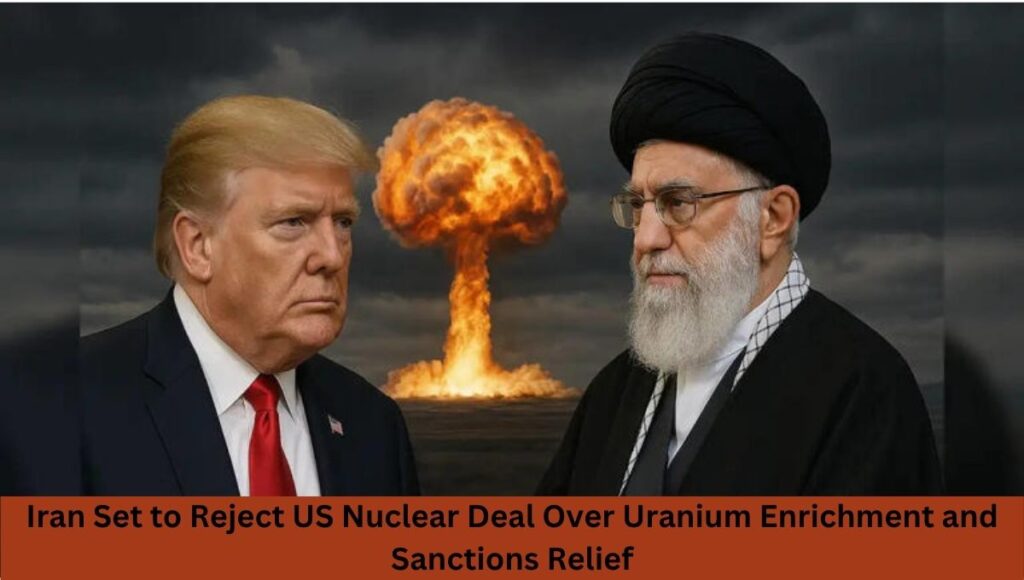
Despite five rounds of indirect talks, Iran Set to Reject US Nuclear Deal Over Uranium Enrichment and Sanctions Relief. Iran appears poised to reject the latest US nuclear deal proposal over what officials describe as “excessive demands” and a lack of clarity surrounding sanctions relief and uranium enrichment rights. In spite of indirect talks and a proposal that the White House has called “acceptable,” Iranian officials have labeled it a “non-starter,” casting doubt over the future of nuclear negotiations.
Iran Set to Reject US Nuclear Deal Over Uranium Enrichment and Sanctions Relief
Trump Reasserts “No Enrichment” Policy
US President Donald Trump reaffirmed his hardline stance on the Iran nuclear deal in a post on social media Monday, stating unequivocally, “WE WILL NOT ALLOW ANY ENRICHMENT OF URANIUM” under any agreement with Tehran.
This declaration came hours after media reports suggested that the US, under Special Envoy Steve Witkoff, had presented Iran with a proposal permitting low-level uranium enrichment for peaceful uses such as medical isotopes and nuclear power if Tehran agreed to close its underground enrichment facilities.
However, Trump’s public statement appears to contradict elements of the US proposal reportedly delivered via Omani mediation, reigniting tensions over a key sticking point in the stalled talks.
Mixed Messages Undermine Negotiations
The latest US proposal has sparked confusion and frustration in Tehran. A senior Iranian diplomat told Reuters that the offer lacks “concessions on key issues,” describing it as “incoherent and disjointed.”
Iranian officials also criticized Washington for shifting positions too frequently, accusing the US of undermining trust and making progress nearly impossible. “This proposal is a non-starter,” the diplomat said. “It fails to address Tehran’s interests and tries to impose a bad deal on Iran through excessive demands.”
While some US officials floated the idea of a regional enrichment consortium involving the IAEA and Middle Eastern nations to oversee civilian-grade enrichment, Iran insists on retaining control over its own facilities. Tehran sees full ownership of uranium enrichment as a sovereign right and a crucial component of its peaceful nuclear program.
Iran Demands Clear Sanctions Relief Mechanism
Another major point of contention remains sanctions relief. Iranian Foreign Ministry Spokesman Esmail Baghaei emphasized Monday that Iran needs “clear assurances” that US-imposed sanctions will be lifted under any new deal.
Speaking at a press conference in Tehran, Baghaei said, “So far, the American side has not wanted to clarify this issue.”
Without guarantees or a defined timeline for lifting economic restrictions, Iranian negotiators have warned that they cannot accept the current proposal. The sanctions have devastated Iran’s economy, especially its oil sector, leading to widespread public dissatisfaction.
IAEA Reports Increasing Uranium Stockpile
Tensions have also been exacerbated by a leaked report from the International Atomic Energy Agency (IAEA), which revealed that Iran has increased its stockpile of uranium enriched up to 60% purity just short of the 90% required for nuclear weapons.
The report has fueled concerns in Washington and among US allies, especially Israel, that Iran may be edging closer to developing a nuclear bomb.
Iran, however, has dismissed the IAEA report as biased and politically motivated. Foreign Minister Abbas Araghchi warned that “some countries are trying to abuse this agency to pave the way for escalation with Iran.” He stressed that Iran’s nuclear activities are for peaceful purposes and that “Iran has nothing to hide.”
Trump Warns of Military Strike Option
Despite claims that a deal is near, President Trump has also made thinly veiled threats of military action. According to Bloomberg, Trump told Israeli Prime Minister Benjamin Netanyahu last week that a military strike on Iran was “inappropriate right now” but remained a possibility if talks fail.
“President Trump has made it clear that Iran can never obtain a nuclear bomb,” said White House spokeswoman Karoline Leavitt. “Special Envoy Witkoff has sent a detailed and acceptable proposal to the Iranian regime, and it’s in their best interest to accept it.”
Nonetheless, the Iranian side remains skeptical. One senior official involved in the negotiations told CNN that the US proposal contradicts earlier agreements and shows signs of being “very unrealistic” and overly demanding.
Negotiations Lose Momentum
Diplomatic sources now say the momentum behind negotiations is collapsing, and the next round of talks, which was expected following a fifth session in Rome on May 23, is currently uncertain. While both sides had expressed cautious optimism earlier this spring, positions have hardened in recent weeks.
The Iranian nuclear negotiating team, reportedly under the supervision of Supreme Leader Ayatollah Ali Khamenei, is said to have reviewed the latest US proposal and concluded that it “could not serve Tehran’s interests.”
“Iran’s position on enrichment is firm and steadfast,” one Iranian official stated. “We will continue enriching uranium with or without a deal.”
The Road Ahead
With no clear agreement in sight, the possibility of a return to the 2015 Joint Comprehensive Plan of Action (JCPOA) seems increasingly remote. That deal, which Trump withdrew from in 2018, allowed Iran to enrich uranium under strict limits and international oversight.
Since then, Iran has significantly expanded its nuclear activities, citing the US’s failure to uphold its end of the bargain. As both sides dig in, observers warn that the chances of renewed confrontation are rising.
While the US insists Iran must abandon its enrichment program entirely, Tehran demands its right to nuclear energy and the lifting of crippling sanctions. Unless one side softens its stance, the talks risk collapsing entirely, reigniting one of the world’s most volatile nuclear flashpoints.
Conclusion
The ongoing standoff over uranium enrichment and sanctions relief continues to stall hopes for a breakthrough nuclear agreement between the US and Iran. With both governments sticking to “red lines,” and mutual mistrust growing, the likelihood of a renewed nuclear deal remains slim. As diplomatic channels falter and rhetoric hardens, the possibility of escalation looms large over the region and the world.
Also Read: Trump Declares ‘No Uranium Enrichment’ as Iran Nuclear Talks Falter
Also Read: Report: US nuclear deal proposal would let Iran enrich uranium at limited level
Related Posts:
- 7 Powerful Facts About Ayatollah Ali Khamenei’s…
- 5 Major Takeaways from the US Supreme Court's…

- 9 Explosive Claims as Trump Says US Winning Iran War

- 3 Explosive Conditions Iran Sets to End War with US…
- 7 Heartbreaking Facts About Venezuela's Earthquake Disaster
- 7 Powerful Measures: Trump Sanctions Russian Oil…
