
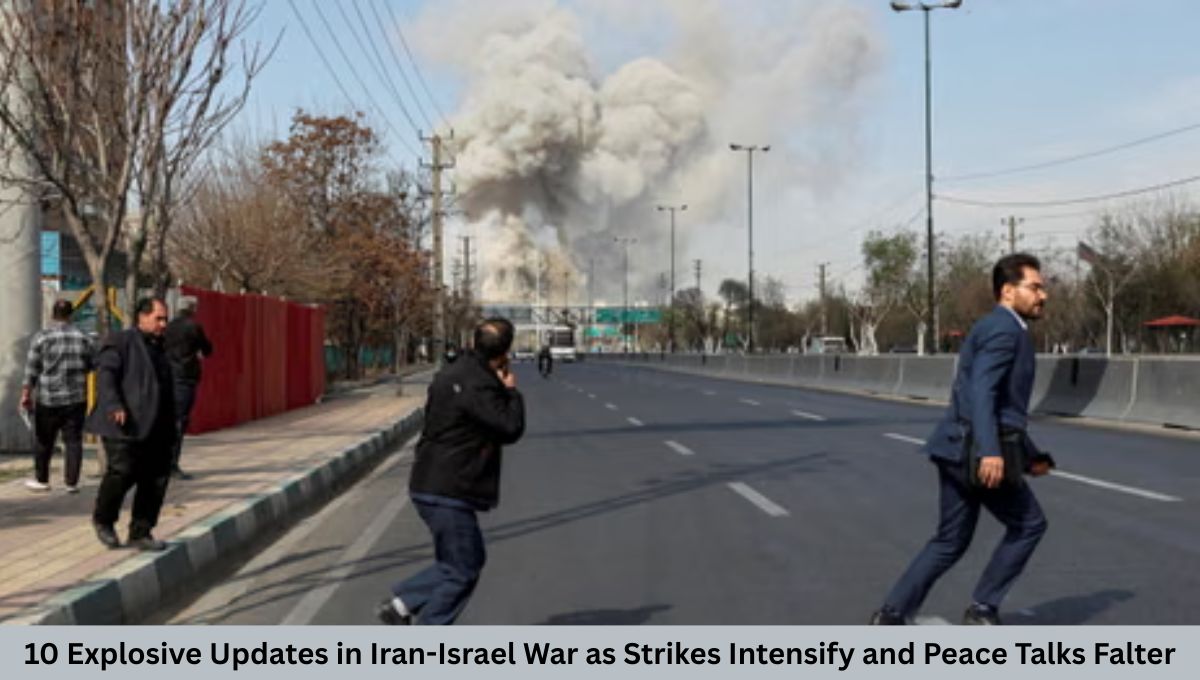
10 Explosive Updates in Iran-Israel War as Strikes Intensify and Peace Talks Falter amid rising global economic concerns. The Iran-Israel war entered a dangerous new phase on March 24, 2026, as airstrikes pounded Tehran while Iranian missiles and drones struck Israel and multiple Gulf states.
Thank you for reading this post, don't forget to subscribe!At the same time, conflicting claims about possible negotiations between the United States and Iran added uncertainty to an already volatile situation. While Washington signaled that talks to end the war may be underway, Tehran strongly denied any formal negotiations.
This disconnect has fueled skepticism globally, especially as military escalation continues across multiple fronts. The war is no longer confined to two nations. It has expanded into a regional crisis affecting the Gulf, Lebanon, Iraq, and global energy markets.
The stakes are rising rapidly, with economic, military, and diplomatic consequences spreading worldwide.
10 Explosive Updates in Iran-Israel War as Strikes Intensify and Peace Talks Falter
1. Tehran Under Heavy Airstrikes
Iran’s capital faced intense bombardment as multiple waves of airstrikes targeted infrastructure and strategic facilities.
Explosions were reported across several cities, including key industrial and energy hubs.
Reports indicate that gas facilities and pipelines suffered partial damage, raising concerns about energy supply disruptions within Iran.
The attacks also extended to intelligence headquarters and military storage sites, signaling a strategy aimed at weakening Iran’s operational capabilities.
Civilian casualties continue to mount, with hundreds of children reported among the dead since the conflict began.
The scale of destruction has intensified international calls for restraint.
2. Iran’s Missile Barrage on Israel
In response, Iran launched multiple waves of missiles targeting Israel, including Tel Aviv.
Some missiles reportedly penetrated advanced defense systems, striking urban areas and causing injuries.
The attacks included a mix of ballistic missiles and drones, highlighting Iran’s evolving strike capabilities.
Military and commercial centers were among the targets, indicating a broader operational scope beyond purely military objectives.
Residents described the psychological toll of constant missile alerts, with many spending extended periods in shelters amid fears of further escalation.
3. Gulf States Drawn Into the Conflict
The war has increasingly spilled into the Gulf region. Countries such as Saudi Arabia, Kuwait, and Bahrain reported missile and drone interceptions.
Air defense systems were activated repeatedly, and critical infrastructure, including power lines and oil facilities, faced threats.
These developments underscore the widening geographic scope of the conflict.
The Gulf’s involvement is particularly concerning due to its central role in global energy supply. Any sustained disruption could have severe consequences for the world economy.
4. Strait of Hormuz Crisis and Global Impact
One of the most significant flashpoints remains the Strait of Hormuz, a critical chokepoint for global oil shipments.
Iran’s actions to restrict or control access have already disrupted shipping and driven oil prices above $100 per barrel.
This represents a sharp increase since the war began, reflecting growing fears of a prolonged energy crisis.
Although Iran has indicated that “non-hostile” vessels may pass through under certain conditions, uncertainty remains high.
Many shipping companies are reluctant to risk transit, exacerbating supply concerns.
5. Conflicting Signals on Peace Talks
A major point of confusion is the status of potential negotiations between the United States and Iran.
US officials have suggested that talks are underway and that a peace plan has been proposed.
However, Iranian leaders have dismissed these claims as false, accusing Washington of attempting to manipulate global perception and buy time for military deployments.
This divergence highlights deep mistrust between the two sides, making any diplomatic breakthrough highly uncertain.
6. Military Build-Up and Strategic Moves
The United States is reportedly deploying thousands of additional Marines to the Gulf region.
This move has sparked speculation about possible ground operations, including the seizure of key Iranian assets.
Iran has warned that it could mine the Persian Gulf if it perceives an imminent invasion. Such a move would dramatically escalate the conflict and severely disrupt global shipping.
Military analysts suggest that both sides may be positioning themselves for either a major escalation or leverage in negotiations.
7. Leadership Uncertainty Inside Iran
Internal dynamics within Iran add another layer of complexity. Questions remain about who holds ultimate authority over military decisions.
Reports indicate that some strikes have been carried out by local commanders rather than centralized leadership.
Additionally, the country’s leadership structure appears strained following recent high-profile losses.
This uncertainty complicates diplomatic efforts, as it is unclear who could effectively negotiate or enforce any agreement.
8. Escalation in Lebanon and Iraq
The conflict has extended beyond Iran and Israel into neighboring regions.
In Lebanon, airstrikes targeted areas associated with armed groups, resulting in civilian casualties and widespread displacement.
The situation has prompted political tensions, including diplomatic actions against Iranian representatives.
In Iraq, strikes on armed groups have turned the country into a secondary battleground.
These developments highlight the regional nature of the conflict and the difficulty of containing it.
9. Economic Shockwaves Across the World
The war’s impact on global markets has been immediate and severe.
Oil prices have surged, stock markets have shown volatility, and countries dependent on Middle Eastern energy supplies are facing growing uncertainty.
Nations in Asia, in particular, are experiencing significant economic strain due to disrupted supply chains.
The possibility of prolonged conflict raises concerns about inflation, energy shortages, and broader economic instability.
10. A War With No Clear End in Sight
Despite talk of negotiations, there is little evidence of de-escalation on the ground. Both sides continue to exchange strikes, and military operations are expanding rather than contracting.
Statements from key leaders suggest conflicting priorities. While some emphasize diplomacy, others signal readiness for continued or even intensified military action.
This disconnect raises the risk of miscalculation, which could lead to an even larger and more destructive phase of the conflict.
Diplomatic Efforts and Global Pressure
Several countries have urged both sides to pursue dialogue and avoid further escalation.
Offers to mediate talks have emerged, reflecting widespread concern about the conflict’s trajectory.
International organizations are also stepping in, calling for adherence to international law and protection of civilians.
However, the effectiveness of these efforts remains uncertain given the deep mistrust and ongoing hostilities.
Humanitarian Crisis Deepens
The human cost of the war continues to rise. Thousands have been killed, and millions have been displaced across multiple countries.
Infrastructure damage has disrupted essential services, including healthcare and electricity.
Humanitarian agencies warn that the situation could worsen significantly if the conflict persists.
The targeting of civilian areas has drawn particular criticism and calls for investigations into potential violations of international law.
Energy Security at Risk
The war has exposed vulnerabilities in global energy systems. Heavy reliance on the Middle East for oil and gas has left many countries exposed to supply disruptions.
Efforts to diversify energy sources may accelerate as nations seek to reduce dependence on volatile regions.
However, such transitions take time, leaving the world vulnerable in the short term.
Conclusion: A Critical Turning Point
The Iran-Israel war has reached a critical juncture.
With escalating military actions, expanding regional involvement, and uncertain diplomatic prospects, the situation remains highly volatile.
The coming days will be crucial in determining whether the conflict moves toward de-escalation or further intensification.
For now, the world watches closely as one of the most dangerous geopolitical crises in recent years continues to unfold.
Also Read: 7 Critical Impacts of the Strait of Hormuz Crisis as U.S.–Iran War Disrupts Global Oil Markets
Also Read: Iran Rejects Trump’s Peace Claim As Strikes Intensify
Related Posts:
- 3 Explosive Conditions Iran Sets to End War with US…

- 5 Major Takeaways from the US Supreme Court's…

- 7 Powerful Measures: Trump Sanctions Russian Oil…

- Trump’s 20-Point Gaza Peace Plan Gains Urgent Global…

- 9 Explosive Claims as Trump Says US Winning Iran War

- In 8 Moves, EU Targets China-Linked Refineries and…
