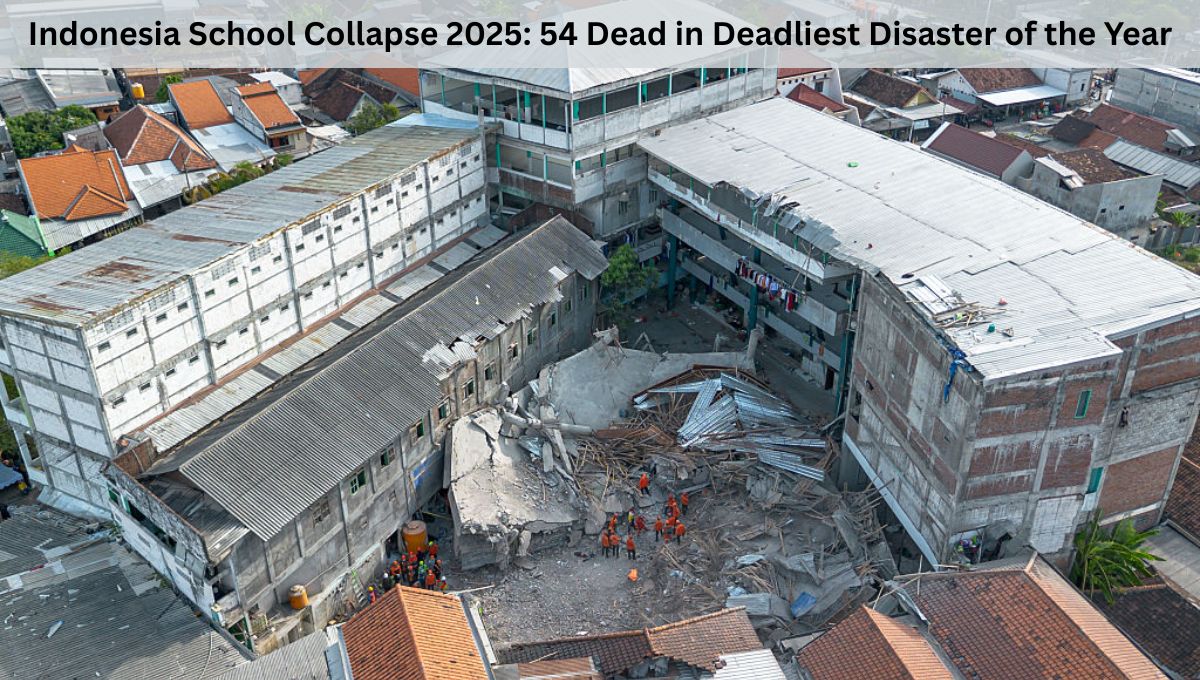
Sidoarjo, East Java | October 6, 2025 — Indonesia School Collapse 2025: 54 Dead in Deadliest Disaster of the Year, 13 still missing. The death toll from the collapse of the Al Khoziny Islamic boarding school in East Java, Indonesia, has risen to 54, officials said on Monday, marking the country’s deadliest disaster of the year.
Rescuers were continuing their search for more than a dozen students still missing, nearly a week after the multi-storey school caved in while undergoing construction. The incident has raised urgent questions about building safety standards in Indonesia, where thousands of informal religious schools operate with limited oversight.
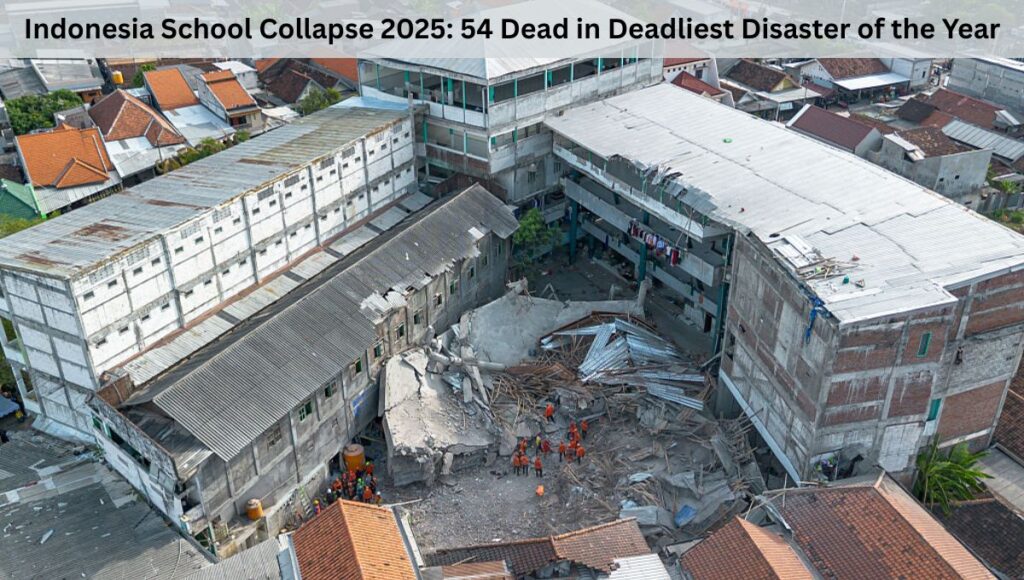
Indonesia School Collapse 2025: 54 Dead in Deadliest Disaster of the Year
Rescue Efforts Enter Final Phase
The school, located in the town of Sidoarjo, collapsed suddenly last Monday (September 29) while hundreds of students, most of them teenage boys, were gathered for afternoon prayers.
As of Monday morning, rescuers had retrieved 54 bodies, including five body parts, from the ruins, said Yudhi Bramantyo, Operations Director at the National Search and Rescue Agency (Basarnas).
“We hope to conclude recovery efforts today and return the bodies to their families,” Bramantyo said at a press briefing.
At least 13 people remain unaccounted for, and officials said rescue teams were racing against time as hopes of finding survivors faded after the critical 72-hour period had passed. Families of the missing gave permission on Thursday for heavy machinery to be used to clear the remaining debris.
“This has become Indonesia’s deadliest disaster of 2025,” confirmed Budi Irawan, Deputy Head of the National Disaster Mitigation Agency (BNPB). “Out of all the disasters this year — natural or otherwise — none have claimed as many lives as the tragedy in Sidoarjo.”
A Scene of Chaos and Desperation
When the upper floors of the Al Khoziny Islamic boarding school began to give way, students ran for their lives. Survivors described a terrifying few seconds as the ceiling cracked and concrete slabs began to fall like “layers of a pancake.”
“I thought it was an earthquake,” said Muhammad Royhan Firdaus, 16, who had just finished prayers on the first floor. “We all started to run. I fell several times and was hit by pieces of cement, but somehow I managed to escape.”
Another student, 13-year-old Muhammad Rijalul Qoib, said he first heard “the sound of falling rocks” that grew louder before the building collapsed. He suffered leg and shoulder fractures after being hit by debris.
Rescuers described the site as difficult and dangerous, with narrow gaps in the rubble making access challenging. “The way the structure collapsed left only thin voids,” a Basarnas spokesperson said. “We are working carefully to avoid further collapses.”
Also Read: Indonesia Islamic School Collapse: 65 Students Feared Trapped, 1 Dead, 99 Injured
Families Waiting for Closure
For dozens of families, the wait has been agonizing. Some have camped at the site for days, hoping for news of their children.
Muhammad Ali, whose 14-year-old son Fajri remains missing, said he is clinging to hope. “I am hoping for a miracle,” he told reporters. “The school leaders met with us and apologised, and we have chosen not to blame anyone. It was the will of God.”
Many parents echoed similar sentiments. Despite the tragedy, most said they did not hold the school responsible and wanted their children to return to the rebuilt institution once it reopens.
“I am not scared to send my son back,” said Yuni, mother of survivor Royhan. “We consider this a tragic accident. We leave everything to God.”
Investigators Probe Structural Weakness
Investigators believe the collapse was caused by ongoing construction work on the school’s upper floors that the building’s foundation could not support.
“Builders were pouring concrete on the top levels while students were still inside,” said Mohammad Abduh, a civil engineering lecturer at Muhammadiyah University. “The weight of wet cement and vibration from construction equipment can cause extreme stress on weak structures.”
Abduh added that the support pillars were likely undersized, making the building unable to bear the additional load. “This is a classic case of what we call ‘living structures,’ where floors are added over time without proper planning,” he said. “Such expansions are dangerous unless the original design anticipates them.”
Authorities have not confirmed whether the Al Khoziny school had a building permit for the additional floors.
According to Indonesia’s Ministry of Religious Affairs, the country has around 42,000 Islamic boarding schools, known as pesantren. However, only 50 are officially registered with valid construction permits, Public Works Minister Dody Hanggodo said on Sunday.
“This lack of regulation is a huge problem,” said Hanggodo. “Many pesantren expand their facilities informally, which increases the risk of accidents.”
Also Read: Parents see tragedy, not fault, in Indonesia school collapse
A Long History and Deep Influence
Founded in 1927, the Al Khoziny Islamic Boarding School holds a revered place in East Java’s religious landscape. Several of the founding figures of Nahdlatul Ulama, the world’s largest Muslim organization, once studied or taught there.
Religious sociologist Syamsul Arifin of Muhammadiyah University in Malang said pesantren like Al Khoziny command enormous respect in conservative regions.
“These schools provide not only education but also spiritual authority,” he explained. “Parents entrust their children’s moral and religious development entirely to the school’s leaders, known as kyai or ustadz.”
Because of that deep trust, Arifin said, parents are reluctant to assign blame, even in the wake of tragedy. “The kyai are seen as close to God, and their authority is rarely questioned. For many families, this disaster is seen through a theological lens — as destiny rather than negligence.”
A Systemic Problem of Building Safety
Experts say the tragedy exposes a broader structural problem: weak enforcement of building codes and inadequate monitoring of private institutions.
In many cases, small religious schools and community buildings are erected using local contractors and low-cost materials, often without formal approval or inspection.
“Construction standards in Indonesia remain uneven, especially in rural or semi-urban areas,” said Abduh. “When religious or community groups manage projects independently, engineering oversight is minimal.”
A similar incident occurred just last month in West Java, when a building hosting a prayer recital collapsed, killing three people and injuring dozens.
Public works officials have pledged a review of safety standards at all registered pesantren, but implementation may prove challenging. “We are dealing with tens of thousands of structures,” said a spokesperson for the Ministry of Public Works and Housing. “Many are informal and built incrementally over decades.”
Rescuers Battle Time and Terrain
Search and rescue operations have involved more than 400 personnel, including Basarnas, BNPB, police, and military units, supported by thermal drones and excavators.
Officials said rescuers had cleared nearly 80% of the debris by Sunday night. Video from the scene showed workers carrying orange body bags from the rubble under floodlights.
“Our teams have been working day and night,” Bramantyo said. “Conditions are difficult, but we are doing everything possible to ensure that all victims are recovered and their families can have closure.”
The rescue mission has been hampered by unstable debris and narrow access points, forcing rescuers to manually sift through sections of rubble. Authorities said safety protocols have been tightened to prevent secondary collapses.
Voices of Survivors and Faith
For the students who escaped, survival has brought both relief and trauma.
“I still hear the sound of falling concrete when I try to sleep,” said Rijalul Qoib, now recovering in hospital. “I lost many of my friends that day.”
His mother, Nur Aini, said she was grateful but also fearful. “When I saw the news, I thought my son was gone,” she said. “Now I pray for the others who are still missing.”
Despite the heartbreak, many families have expressed faith over anger, calling the tragedy a test of belief.
“Everything that happens is part of God’s plan,” said Ali, father of missing student Fajri. “We accept it with sincerity. What matters now is rebuilding the school and our faith.”
Government Response and Calls for Reform
President Joko Widodo has ordered a full investigation into the collapse and promised assistance to victims’ families. He has also directed the Ministry of Religious Affairs to conduct an urgent audit of pesantren buildings across Indonesia.
“The safety of our children is non-negotiable,” the President said in a statement on Sunday. “We must ensure that every learning institution, religious or otherwise, adheres to proper construction standards.”
However, enforcement remains a daunting task. Indonesia’s rapid urbanization, combined with a vast number of informal schools and religious centers, has created a complex regulatory gap.
“We need stronger coordination between local governments, the public works ministry, and religious institutions,” said urban planner Anita Sari. “Otherwise, tragedies like the Al Khoziny collapse will happen again.”
Looking Ahead: Lessons from Tragedy
As the search for the final missing students nears its conclusion, the Al Khoziny disaster has forced Indonesia to confront uncomfortable questions about safety, faith, and accountability.
For some, the collapse is a symbol of systemic neglect. For others, it is a moment of spiritual reflection and communal solidarity.
But across Sidoarjo, one sentiment prevails — grief.
In the courtyard near the ruins, rows of white shrouds now cover the bodies of students awaiting burial. Their classmates, many still in shock, recite prayers beside grieving parents. “Their prayers were interrupted that day,” said local resident Hassan Rofiq, tears in his eyes. “Now we continue them for them.”