As the clock ticks EU Races to Avert Trump’s Tariff Threat as July 9 Deadline Looms. European Union leaders are under mounting pressure to finalize a trade deal with the United States that could prevent a devastating wave of tariffs from President Donald Trump. Meeting in Brussels, leaders from all 27 EU countries are trying to navigate internal divisions, balance strategic priorities, and decide whether to compromise or confront the Trump administration.
Trump has warned that without a new agreement, he will slap tariffs of up to 50% on a wide range of EU exports, from automobiles to pharmaceuticals. The looming deadline has transformed the EU’s planned summit on security and Ukraine into an emergency session on transatlantic trade.
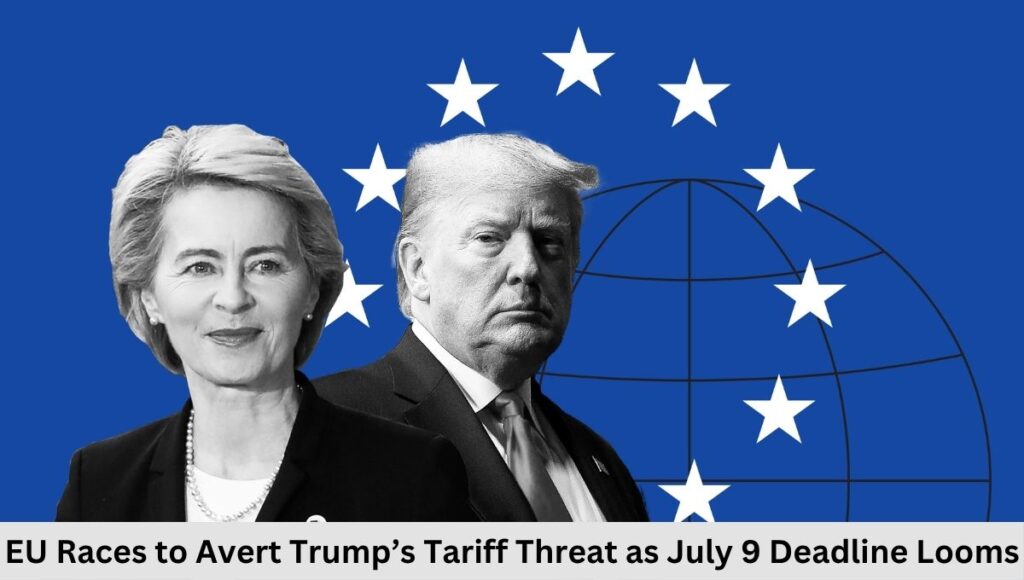
EU Races to Avert Trump’s Tariff Threat as July 9 Deadline Looms
Trump’s July 9 Deadline: Deal or Trade War
Trump’s tariff ultimatum is simple: strike a deal by July 9 or face the consequences. The U.S. has already imposed tariffs ranging from 25% to 50% on European steel and aluminium.
Most EU goods currently face a 10% import duty, but that could double or more overnight.
If no agreement is reached, the tariffs would deal a crushing blow to major European industries, including automobiles, steel, energy, and pharmaceuticals.
The prospect of such a trade war has sparked frantic efforts in Brussels to avert what would be one of the most serious ruptures in EU-US economic relations in recent history.
Brussels Receives US “Two-Pager” Trade Proposal
European Commission President Ursula von der Leyen presented EU heads of state with the latest U.S. trade counter-offer, described by diplomats as a “two-pager” a short, principle-based proposal that deliberately avoids detailed sector-by-sector negotiations.
According to Reuters, U.S. negotiators are pushing for a broad, flexible framework, similar to trade deals already concluded with Brazil and the UK.
One EU diplomat explained, “We only have two weeks left so we should go for something like that.” While the offer lacks specifics, it reflects Washington’s urgency to close a deal, as Trump seeks to tout trade victories ahead of the U.S. presidential election.
France and Germany Clash on Strategy
A major roadblock to a unified EU response is the growing strategic rift between France and Germany.
German Chancellor Friedrich Merz favors a swift, simplified agreement, even if it means conceding more to the U.S. He has warned that delay could severely damage key German exports, especially in autos and chemicals.
“It’s better to act quickly and simply than slowly and in a highly complicated way,” Merz told reporters.
In contrast, French President Emmanuel Macron insists that any agreement must be balanced and fair, rejecting the idea of speed at the expense of sovereignty.
“We want a deal, but not at any cost. Our goodwill should not be seen as weakness,” Macron stated during the summit.
France is particularly concerned about maintaining control over digital market regulations and preventing excessive U.S. access to EU services.
EU’s Zero-Tariff Proposal Hits a Wall
Since March, Brussels has been pushing for a zero-for-zero tariff agreement covering industrial goods, alongside commitments to buy U.S. LNG and soybeans.
But according to EU officials, Washington has little appetite for eliminating tariffs altogether.
“The U.S. now sees tariffs as a permanent revenue source,” one official told Euronews.
A more realistic fallback is a 10% tariff benchmark, already standard across many U.S. imports. While some sectors can absorb a 10% tariff, others especially aviation and high-tech could face severe disruption due to interdependent supply chains.
A “Swiss Cheese” Agreement?
To navigate these complexities, EU diplomats are floating the idea of a “Swiss cheese” deal a general agreement with strategic loopholes that protect sensitive European sectors like automobiles, aerospace, and pharmaceuticals.
This would allow Trump to claim a win while limiting collateral damage for Europe. A general principled framework would buy both sides time to iron out sector-specific details later, possibly averting a worst-case scenario.
“It would be less painful than the status quo,” one EU official remarked.
Ursula von der Leyen: “All Options Remain on the Table”
Commission President von der Leyen remains the central player in the EU’s trade chessboard. She confirmed the receipt of the U.S. offer but refused to divulge details.
“We are ready for a deal. But we are also prepared for the possibility that no agreement is reached,” she said, emphasizing that “all options remain on the table.”
So far, von der Leyen has avoided direct confrontation, preferring negotiation over retaliation, a strategy in contrast to earlier Trump trade disputes with China and Canada.
Retaliation Plans: €95 Billion in EU Tariffs on Standby
Should talks collapse, Brussels is ready to retaliate. The European Commission has already approved tariffs on €21 billion of U.S. goods, with a second package worth €95 billion under discussion.
Targets could include digital advertising, energy goods, and U.S. tech giants like Google, Apple, Microsoft, and Meta. There’s also talk of taxing digital services and artificial intelligence platforms, a move likely to escalate tensions.
“We need proportionate and targeted responses,” said Belgian Prime Minister Bart De Wever. “We don’t want a stupid trade war.”
Trump Touts Global Trade Wins Amid EU Talks
While Brussels deliberates, Trump has taken a victory lap, boasting of new trade agreements with China and possibly India.
On June 11, Trump announced a framework agreement with China that includes rare earth exports and continued access for Chinese students at U.S. universities.
Posting on Truth Social, he claimed “China will provide all the magnets and rare earths needed, in advance.”
No official details or confirmation have been released by Beijing or Washington. Nevertheless, Trump is using these announcements to project global deal-making prowess, further pressuring the EU to accept his terms.
NATO Unity Shifts to Economic Survival
The Brussels summit was originally meant to focus on defence spending, Ukraine, and EU-Russia relations, following a tense NATO summit where members pledged to increase military budgets. However, economic issues quickly overtook security concerns.
Countries like Spain have asked for opt-outs from increased military commitments, citing budgetary strain. Meanwhile, Ukraine’s President Volodymyr Zelenskyy urged EU leaders to stay firm against Russia.
“Any delay by Europe at this point could create a global precedent a reason to doubt Europe’s words and commitments,” Zelenskyy warned.
Yet Hungary and Slovakia continue to block new sanctions and demand energy concessions, illustrating the internal fragmentation complicating EU policy decisions.
Energy, Sanctions, and Side Deals
Beyond the U.S. trade issue, Slovakia and Hungary are also holding up the EU’s 18th sanctions package on Russia, demanding long-term guarantees for continued access to Russian gas.
In response, the Commission has proposed a gradual phase-out of Russian gas by 2027, hoping to win unanimous approval.
The Road Ahead: Risk, Retaliation, or Rushed Deal?
As the July 9 deadline nears, the EU faces three unenviable options:
- Accept a rushed U.S.-led trade deal, possibly filled with compromises.
- Hold firm and risk economic retaliation.
- Strike back with tariffs, escalating into a full-fledged trade war.
For now, Brussels appears to favor a tactical compromise, crafting a vague but palatable agreement to keep trade flowing and buy time for deeper talks. However, whether that will satisfy Trump or merely delay a new round of tariff threats remains uncertain.
Final Word: Transatlantic Relations at a Crossroads
The outcome of these negotiations will shape EU-US relations for years. With Trump campaigning on trade victories, and Europe trying to defend its economic model, the July 9 talks may either usher in a tense truce or a painful rupture. For European leaders, the task is to safeguard economic stability while projecting unity and resolve. The coming days will test both their diplomatic finesse and their political courage.
Also Read: UK and EU Reset Ties with Historic Post-Brexit Deal Covering Trade, Defence, and Youth Mobility
Also Read: EU Races to Avoid Trade War as Trump Threatens 30% Tariffs
Related Posts:
- Trump Urges EU to Slap 100% Tariffs on China and…

- 9 Explosive Revelations as Trump Declares His Health…
- Trump’s 2025 Gaza Peace Plan Signing and Historic…

- 7 Crucial Insights Into Trump and Xi’s High-Stakes…
- Trump to Host 2026 G20 Summit at His Florida Golf…

- What’s Next for Donald Trump After Court Rules His…