
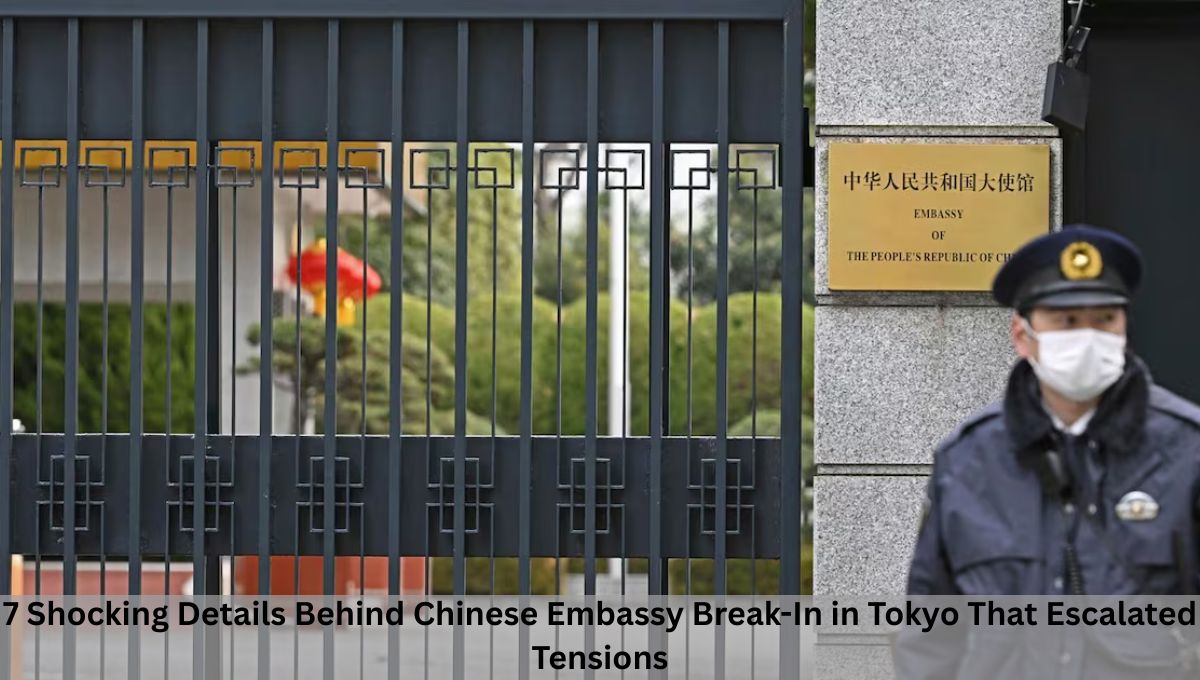
7 Shocking Details Behind Chinese Embassy Break-In in Tokyo That Escalated Tensions between China and Japan. A dramatic and highly unusual security breach at the Chinese embassy in Tokyo has triggered a fresh diplomatic crisis between China and Japan.
Thank you for reading this post, don't forget to subscribe!The incident, described by Beijing as a “forceful break-in,” has not only raised alarm over embassy security but has also intensified already fragile ties between the two Asian powers.
According to Chinese officials, an individual claiming to be an active-duty member of the Japan Self-Defense Forces (SDF) scaled the embassy wall and entered the premises illegally. The suspect reportedly admitted wrongdoing and made chilling threats against diplomatic personnel.
This event comes at a time when geopolitical tensions in East Asia are already running high, particularly over issues like Taiwan, military expansion, and historical disputes.
7 Shocking Details Behind Chinese Embassy Break-In in Tokyo That Escalated Tensions
What Exactly Happened?
A Breach of Diplomatic Security
Chinese Foreign Ministry spokesperson Lin Jian confirmed that the intruder forcibly entered the embassy compound on the morning of March 24, 2026.
The individual allegedly:
- Scaled the embassy wall
- Illegally entered restricted diplomatic grounds
- Admitted his actions were unlawful
- Threatened to kill Chinese diplomats “in the name of God”
Reports from Japanese authorities later identified the suspect as a 23-year-old member of the Ground Self-Defense Forces.
He was arrested by the Tokyo Metropolitan Police Department on suspicion of trespassing. A knife was reportedly recovered at the scene, though fortunately, no injuries were reported.
Why This Incident Is So Serious
Violation of International Law
China has strongly condemned the breach, calling it a “serious violation” of the Vienna Convention on Diplomatic Relations.
Under this convention:
- Embassy premises are inviolable
- Host nations must ensure the safety of diplomatic missions
- Unauthorized entry is strictly prohibited
The incident raises concerns about whether Japan fulfilled its legal obligation to protect foreign diplomatic facilities within its borders.
Threat to Diplomatic Personnel
The reported threats against embassy staff elevate the seriousness of the incident beyond simple trespassing.
From Beijing’s perspective, this constitutes a direct threat to the lives and safety of its diplomats.
China’s Strong Reaction
China responded swiftly and firmly. Officials stated they were “deeply shocked” and lodged a strong diplomatic protest with Tokyo.
Lin Jian emphasized that:
- Japan must conduct a thorough investigation
- Those responsible must be punished
- Measures must be taken to prevent recurrence
Beijing also urged Japan to:
- Guarantee embassy security
- Reflect on its China policy
- Address what it called “root causes” of such incidents
The Chinese embassy in Tokyo separately filed formal complaints, escalating the matter to a high diplomatic level.
Japan’s Response: Regret and Investigation
Japan’s government acknowledged the seriousness of the situation.
Chief Cabinet Secretary Minoru Kihara described the incident as “regrettable,” especially given that the suspect was a member of the Self-Defense Forces.
Authorities confirmed:
- The suspect has been arrested
- A police investigation is underway
- Security around the embassy has been increased
Japan has also promised to take steps to prevent similar incidents in the future.
However, Tokyo has so far avoided broader political commentary, focusing instead on law enforcement and procedural responses.
The Suspect’s Motive: Disturbing Details
Reports suggest the suspect claimed he wanted to meet the Chinese ambassador and persuade him to soften his stance on political issues.
More disturbingly:
- He allegedly threatened violence if his demands were not met
- Some reports indicate he intended self-harm if unsuccessful
These elements point toward a mix of political motivation and possible personal instability.
Nevertheless, the fact that the individual was linked to the military adds a layer of complexity and concern.
The Bigger Picture: Rising China-Japan Tensions
Taiwan at the Center
Relations between China and Japan have been deteriorating for months, particularly after comments by Japanese Prime Minister Sanae Takaichi regarding Taiwan.
Takaichi suggested that:
- A Chinese attack on Taiwan could trigger a Japanese military response
This statement angered Beijing, which considers Taiwan part of its territory.
Diplomatic Downgrades
Japan is reportedly planning to downgrade its description of ties with China in its annual diplomatic report.
Instead of calling China “one of its most important partners,” it may label it simply as an “important neighbor.”
This symbolic shift reflects deeper strategic mistrust.
Accusations of Rising Militarism
China has used the embassy incident to criticize broader trends in Japan.
Beijing claims the event highlights:
- The spread of far-right ideology
- Growing militarization
- Weak discipline within the Self-Defense Forces
Chinese officials have linked the incident to:
- Japan’s defense expansion
- Increased military activity
- Political rhetoric perceived as anti-China
Japan, however, has consistently rejected accusations of remilitarization.
Security Concerns for Foreign Missions
The breach raises serious questions about embassy security not just in Japan but globally.
Key concerns include:
- How an armed individual accessed a high-security diplomatic site
- Whether security protocols were sufficient
- The role of host governments in preventing such incidents
For the international community, this serves as a reminder of the vulnerabilities diplomatic missions can face—even in highly developed nations.
Impact on Global Geopolitics
Regional Stability at Risk
The incident could further destabilize East Asia, a region already facing:
- Military tensions
- Trade disputes
- Strategic rivalry
Even isolated incidents can escalate quickly when relations are strained.
Diplomatic Fallout
Potential consequences include:
- Reduced diplomatic engagement
- Increased rhetoric
- Stricter security measures
Countries observing the situation may also reassess their own diplomatic security protocols.
Media Narratives and Information Gaps
Interestingly, coverage of the incident has varied significantly.
- Chinese outlets emphasized ideological concerns and systemic issues
- Japanese media largely focused on the criminal aspect
This divergence reflects broader differences in political narratives and public discourse.
Historical Context: A Fragile Relationship
China-Japan relations have long been complicated by:
- Historical grievances
- Territorial disputes
- Competing regional ambitions
Recent developments have only intensified these tensions:
- Trade restrictions
- Military posturing
- Diplomatic disagreements
The embassy break-in is not an isolated event but part of a larger pattern of friction.
What Happens Next?
Investigation and Accountability
Japan’s next steps will be crucial. A transparent and thorough investigation could help ease tensions, while any perceived lack of accountability may worsen the situation.
Diplomatic Engagement
Backchannel diplomacy may play a key role in preventing escalation.
Countries like:
- Pakistan
- Oman
- Egypt
have previously acted as intermediaries in geopolitical conflicts and could potentially help if tensions rise further.
Key Takeaways
- A suspected Japanese military officer breached the Chinese embassy in Tokyo
- China has lodged a strong protest, calling it a violation of international law
- Japan has arrested the suspect and launched an investigation
- The incident highlights deeper geopolitical tensions, especially over Taiwan
- It raises global concerns about embassy security and diplomatic safety
Final Analysis
This incident is more than just a security breach—it is a reflection of growing geopolitical strain in East Asia. While no lives were lost, the symbolic and diplomatic damage is significant.
In an era where global tensions are already high, even a single incident like this can have ripple effects far beyond its immediate context.
Whether this becomes a turning point or just another flash point depends largely on how both nations choose to respond in the coming days.
Also Read: 7 Alarming Signals in the China–Japan Clash Over PM Takaichi’s Taiwan Remarks
Also Read: Beijing demands thorough probe into Tokyo embassy intrusion
Related Posts:
- 5 Major Takeaways from the US Supreme Court's…

- 7 Powerful Facts About Ayatollah Ali Khamenei’s…

- In 8 Moves, EU Targets China-Linked Refineries and…

- 9 Explosive Claims as Trump Says US Winning Iran War

- 7 Heartbreaking Facts About Venezuela's Earthquake Disaster

- Trump’s 20-Point Gaza Peace Plan Gains Urgent Global…
