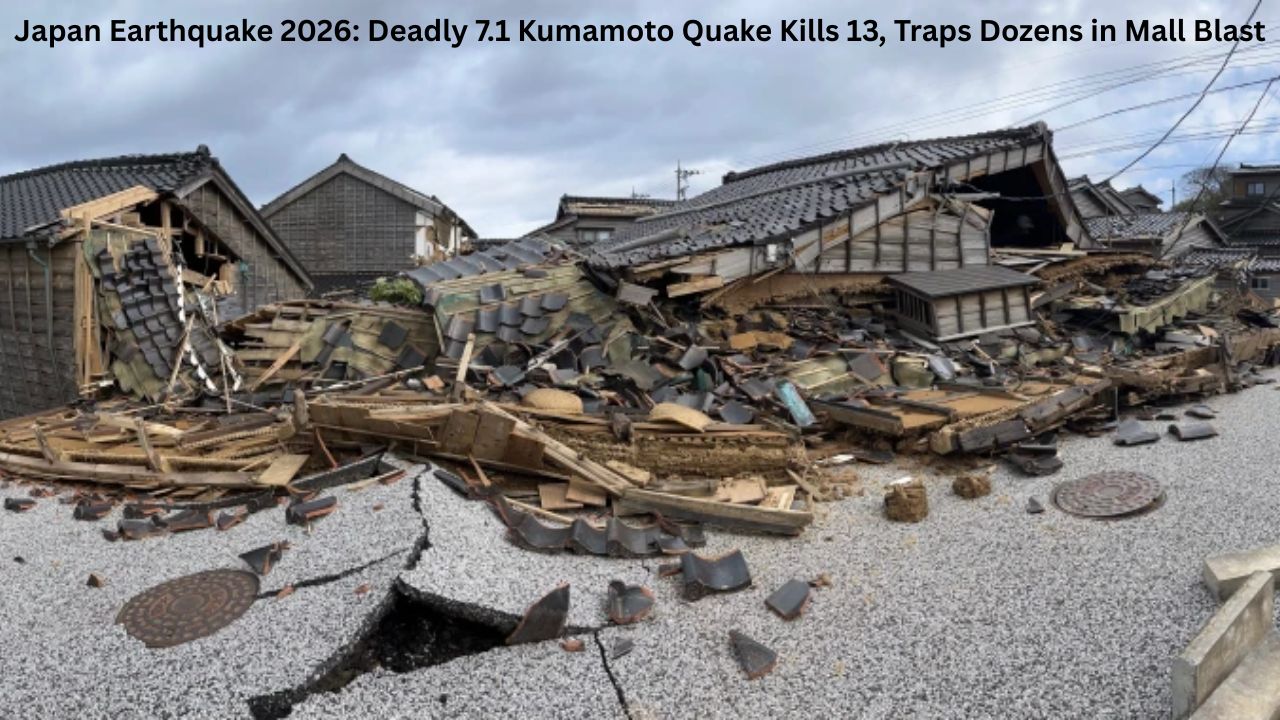
Japan Earthquake 2026: Deadly 7.1 Kumamoto Quake Kills 13, Traps Dozens in Mall Blast while disrupting operations at Global Chip Giants TSMC and Sony. A massive 7.1-magnitude earthquake tore through southern Japan on Tuesday, July 28, 2026, killing at least 13 people, injuring dozens, and triggering a terrifying explosion inside a shopping mall where shoppers had only just escaped the initial shaking.
A day later, rescue crews are still digging through rubble in Kumamoto Prefecture, racing against the clock to reach residents trapped under collapsed buildings, a shattered factory chimney, and mountains of debris.
The disaster has reopened old wounds for a region that endured one of Japan’s deadliest modern earthquakes almost exactly a decade earlier, and it has sent shockwaves — quite literally — through the global technology industry, since Kumamoto sits at the heart of the world’s semiconductor and camera-sensor supply chain.
Here is a complete, up-to-date breakdown of what happened, who has been affected, and why this earthquake matters far beyond Japan’s borders.
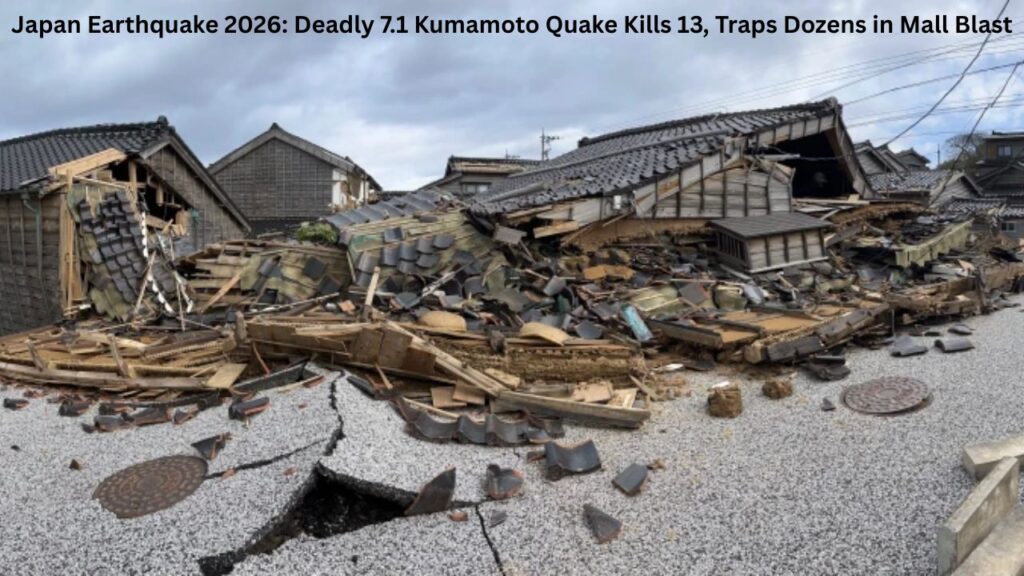
Japan Earthquake 2026: Deadly 7.1 Kumamoto Quake Kills 13, Traps Dozens in Mall Blast
Quick Facts: The Kumamoto Earthquake at a Glance
- When: Tuesday, July 28, 2026, at approximately 4:27 p.m. local time
- Magnitude: 7.1 (Japan Meteorological Agency preliminary reading); later revised to 6.8 by the US Geological Survey
- Epicenter: Near Uto City, Kumamoto Prefecture, on the southern island of Kyushu
- Depth: Roughly 10 kilometers (shallow, which intensified the shaking)
- Maximum intensity: Shindo 7 — the highest level on Japan’s seismic scale — recorded in Uki City and the town of Hikawa
- Deaths: At least 13 confirmed as of Wednesday morning
- Injuries: More than 50 people hospitalized
- Tsunami advisory: Issued for the Ariake and Yatsushiro seas, lifted within about two hours
- People evacuated: Well over 150,000 residents told to move to shelters
What Happened: A Timeline of the Kumamoto Earthquake
The quake struck at 4:27 p.m. local time, with its epicenter just a few kilometers east of Uto City and a depth of around 10 kilometers — shallow enough to unleash violent, ground-level shaking across a wide stretch of Kyushu.
The tremor registered the maximum shindo 7 on Japan’s intensity scale in Uki City and Hikawa, the first time anywhere in Japan had reached that top level since the Noto Peninsula earthquake in January 2024.
Neighboring areas, including Yatsushiro, Uto, Misato, Mashiki, and the Minami Ward of Kumamoto City, all recorded upper-6 intensity.
The shaking was strong enough to be felt as far away as Tokyo and across the sea in South Korea, where emergency services logged hundreds of reports of tremors, many from the port city of Busan.
Roughly an hour later, a second, smaller earthquake measuring magnitude 6.1 struck the same region, adding to the panic and complicating rescue efforts that were only just getting underway.
Seismologists say the quake was caused by movement along the Hinagu and Futagawa faults — the very same fault system responsible for the devastating 2016 Kumamoto earthquakes, which killed more than 270 people.
Officials have cautioned that it is still too early to say definitively whether the two events are directly linked, though the parallels have unsettled residents who lived through the earlier disaster.
Death Toll Climbs to 13 as Rescue Operations Continue
Japanese Prime Minister Sanae Takaichi confirmed on Wednesday that the death toll had risen to at least 13, warning that the figure is likely to climb further as search teams reach areas that remain cut off.
Addressing reporters, she said rescuers were working against the clock to reach those still trapped, stressing that “every second counts” for the people still waiting to be found.
More than 3,600 members of Japan’s Self-Defense Forces, backed by roughly 20 aircraft, have been deployed to assist local fire and police crews with search-and-rescue operations, aerial damage assessments, and emergency supply drops.
More than 150 public facilities in Kumamoto City alone — including libraries, sports centers, and community halls — have been shut down, with several converted into emergency shelters.
Gas Explosion Rips Through Aeon Mall in Kashima Town
One of the most harrowing scenes unfolded at the Aeon Mall in Kashima Town, where the building’s second floor partially collapsed during the initial quake.
Staff managed to evacuate around 200 shoppers before a powerful explosion — believed to have been triggered by a gas leak — tore through the structure roughly an hour later, blowing out walls and exposing steel framework.
The blast killed two women and left an unknown number of people trapped in the wreckage, with rescue crews and soldiers combing through the rubble into Wednesday.
The tragedy carries a bitter irony:
the mall had reopened only weeks earlier, in June 2026, after being fully rebuilt following the 2016 Kumamoto earthquake, when it became a symbol of the region’s recovery.
Workers Trapped After Factory Chimney Collapse in Yatsushiro
At the Nippon Paper Industries mill in Yatsushiro City, a large factory chimney collapsed, trapping multiple workers beneath the debris.
As of Wednesday, several employees remained missing, though rescue teams managed to pull two survivors from the wreckage.
Extreme summer heat and near-constant aftershocks have made the recovery operation both slow and dangerous for emergency crews.
Tsunami Advisory Issued, Then Lifted
Within minutes of the main shock, the Japan Meteorological Agency issued a tsunami advisory for the Ariake and Yatsushiro seas, warning of waves up to one meter high.
Coastal residents were urged to move to higher ground immediately. No waves were ultimately recorded, and the advisory was formally cancelled roughly two hours later.
Even so, the warning triggered a tense scramble along Japan’s southwestern coastline, a grim echo of the country’s long and painful history with tsunami disasters.
Widespread Damage: Roads, Rail, and Power Knocked Out
The earthquake left a trail of infrastructure damage across Kyushu. Kyushu Electric Power reported that nearly 48,000 households lost electricity in the immediate aftermath.
JR Kyushu suspended all of its rail services, including Shinkansen bullet trains running between Hakata and Kagoshima-Chuo, along with several local lines.
A freight train reportedly derailed during the shaking. Major expressways sustained large cracks, with 13 separate sections across two highways closed for safety inspections.
Kumamoto Airport briefly shut its runway before reopening later the same day, though several airlines diverted or cancelled flights.
Mobile network operators KDDI and Docomo also reported service disruptions caused by power outages and damaged transmission lines.
Authorities confirmed that Kyushu’s nuclear facilities, including the Sendai and Genkai plants, reported no abnormalities following the quake.
Kumamoto Castle Damaged Again, a Decade After 2016
In a painful reminder of the region’s seismic history, sections of the stone walls surrounding the historic Kumamoto Castle collapsed once again.
The centuries-old landmark, one of Japan’s most treasured cultural sites, had only recently completed years of painstaking restoration following extensive damage in the 2016 earthquakes.
Castle officials confirmed the fresh collapse but said a full damage assessment is still underway.
Global Tech Giants Hit: TSMC, Sony, and the Chip Supply Chain Scare
Kumamoto isn’t just a historic prefecture — it’s also one of the most important manufacturing hubs on the planet for semiconductors and camera sensors, home to a cluster of plants that supply components to smartphones, cars, and computers worldwide.
The quake registered an intensity of 5 in Kikuyo, the town hosting Taiwan Semiconductor Manufacturing Company’s (TSMC) Japan Advanced Semiconductor Manufacturing (JASM) plant — a facility central to Japan’s multibillion-dollar push to rebuild its domestic chip industry.
That intensity crossed the plant’s evacuation threshold, prompting TSMC to pull staff out as a precaution.
The company later said the site itself was largely unaffected and that operations were gradually resuming, though the initial uncertainty was enough to send TSMC’s American shares tumbling more than 2% in pre-market trading.
Sony Semiconductor Manufacturing, which produces roughly four million image sensors a day at its Kumamoto facility, also evacuated staff, as did camera and imaging giant Fujifilm.
Chipmaker Renesas Electronics went further, suspending operations entirely at two of its Kumamoto plants after inspectors found cracks, water leaks, and fallen ceiling panels.
Equipment maker Tokyo Electron halted two local factories through Wednesday, and Honda temporarily idled a motorcycle plant in the region as a safety measure.
Analysts say the episode is a stark reminder of how concentrated — and how exposed — the global electronics supply chain remains, with a single earthquake in one Japanese prefecture capable of rattling markets and production lines from Taiwan to Silicon Valley.
Why Japan Shakes So Often: Understanding the Ring of Fire
Japan sits atop the Pacific “Ring of Fire,” the horseshoe-shaped zone circling the Pacific Basin where several of the planet’s major tectonic plates — the Pacific, Philippine Sea, Eurasian, and North American plates — constantly grind against one another.
This makes Japan one of the most earthquake-prone nations on Earth, accounting for roughly a fifth of the world’s magnitude 6.0-plus earthquakes despite its relatively small landmass.
Kumamoto Prefecture sits at the southern tip of the Japan Median Tectonic Line, where the Hinagu and Futagawa faults intersect — the same fault network blamed for the deadly 2016 disaster.
Decades of strict building codes and nationwide earthquake drills have significantly reduced casualties compared with historical disasters, but as this week’s events show, powerful shallow quakes can still overwhelm even well-prepared infrastructure.
What Happens Next? Aftershocks and Recovery Efforts
The Japan Meteorological Agency has recorded more than 60 aftershocks since the main quake and is urging residents to remain on high alert for further strong tremors — potentially up to shindo 7 — for at least the next week, with the following two to three days considered the highest-risk window.
Officials have also flagged an elevated risk of landslides in hillside communities weakened by the shaking.
Prime Minister Takaichi has pledged that the national government will mobilize every available resource to support search-and-rescue teams and deliver food, water, and other essentials to hard-hit areas.
Hospitals in Uki City and elsewhere are reportedly operating under field-hospital conditions after losing power, while officials continue assessing the full scope of structural damage across the prefecture.
Conclusion
A day after the ground violently shook beneath Kumamoto, the true scale of the disaster is still coming into focus.
With the death toll at 13 and expected to rise, dozens of people still unaccounted for, a battered shopping mall, a collapsed factory chimney, and a damaged castle wall that has now fallen twice in a decade, the region faces a long and difficult recovery.
At the same time, the earthquake’s ripple effects — felt from Seoul to Wall Street — are a sobering reminder of just how tightly Kumamoto’s fate is woven into the modern world’s supply of chips, sensors, and technology.
As rescue teams continue their painstaking search through the rubble, the coming days will be critical both for the people of Kyushu and for an industry watching closely from afar.
Also Read: 7 Alarming Facts About Japan’s 7.5 Earthquake and Tsunami Threat
Also Read: Why does Japan experience so many large earthquakes?
Related Posts:
- 7 Heartbreaking Facts About Venezuela's Earthquake Disaster

- How US Shoppers Will Be Hit as De Minimis Tariff…

- 6.3-Magnitude Earthquake Devastates Northern Afghanistan

- Philippines Earthquake: 6.9 Magnitude Quake…

- US Ends Tariff Exemption on Small Packages Under…

- 7 Shocking Truths About Venezuela’s Earthquake…