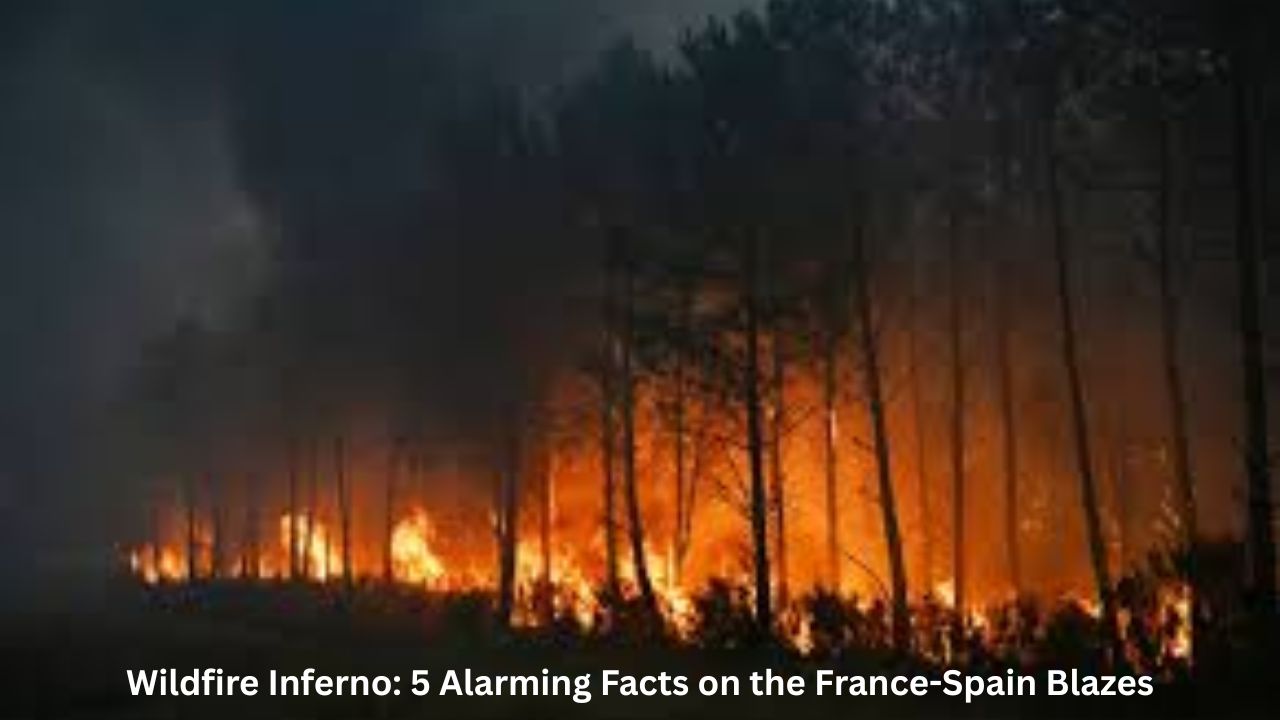
Wildfire Inferno: 5 Alarming Facts on the France-Spain Blazes that forced over 300,000 people to evacuate. A wildfire disaster of historic scale is unfolding across southwestern France and central Spain, where relentless flames have already forced more than 300,000 people from their homes and pushed emergency services to their absolute limit.
Fueled by back-to-back summer heatwaves, drought, and shifting winds, the fires have become one of the largest wildfire crises Europe has faced in decades — serious enough to draw an emergency cabinet meeting from French President Emmanuel Macron and a public prayer appeal from Pope Leo XIV.
Here’s a complete breakdown of what’s happening, how bad the damage really is, and what comes next as authorities brace for yet another heatwave this week.
Wildfire Inferno: 5 Alarming Facts on the France-Spain Blazes
The Scale of the Crisis: More Than 300,000 Displaced
The numbers behind this disaster are staggering. Since the fires broke out last Wednesday, authorities have evacuated more than 300,000 people across the two countries, with France’s Gironde region — home to the famous wine city of Bordeaux — bearing the brunt of the disaster.
Roughly 250,000 people have been evacuated from Gironde alone, including 55,000 people forced out overnight in a single evening as flames advanced.
In France’s southwest, the fire has already scorched around 42,000 hectares (about 104,000 acres) of land, in what French officials have described as one of the largest wildfires the country has endured since the Second World War.
Officials say roughly 240 homes have been destroyed since the blaze first ignited.
Meanwhile, France’s prime minister, Sébastien Lecornu, has called the broader situation “historic,” noting that nearly 100,000 hectares have burned nationwide since the start of the year — a level of destruction he described as unprecedented.
Spain Isn’t Far Behind
Spain has declared a national emergency of its own, with tens of thousands of people evacuated from wildfire zones west of Madrid and in the eastern region of Valencia.
Estimates of the total displaced in Spain have ranged from roughly 76,000 to well over 100,000 people as the situation has evolved day by day, with Spanish Prime Minister Pedro Sánchez confirming that around 130,000 hectares have burned across the country so far this year.
Tragically, firefighters in Spain found an elderly man dead inside his car during evacuation efforts, underscoring just how dangerous these conditions have become for residents caught off guard.
Bordeaux on Edge: How Close Did the Fire Get?
Few images have captured global attention quite like the sight of wildfire smoke creeping toward Bordeaux, a metropolitan area of roughly 850,000 people and one of France’s most iconic wine-producing regions.
At its closest point, the fire came within about 15 kilometers of the city, close enough that local officials described it as being “at the gates” of the metropolitan area, even as they maintained that a full evacuation of Bordeaux itself wasn’t on the table.
Bordeaux’s mayor, Thomas Cazenave, said the city stood ready to house any evacuees who had nowhere else to go.
Fire officials on the ground described the blaze in almost unpredictable terms — one regional fire service official said the fire “makes no sense” and “has no direction,” reflecting just how erratic the flames have behaved as they’ve shifted with the wind.
By Monday, there were early signs of hope: the Gironde prefecture described the situation as “broadly stable” after overnight drizzle helped slow the fire’s advance, though officials cautioned it remained active and far from fully contained.
Macron’s Emergency Response and Promise to Rebuild
The severity of the crisis prompted President Macron to chair an emergency cabinet meeting, bringing together his ministers of the interior, defense, health, transport, and environment to coordinate the national response.
France’s interior minister, Laurent Nunez, confirmed the fire had not spread further overnight but urged continued vigilance, stressing that authorities needed to remain fully prepared to respond at a moment’s notice.
Macron also visited the fire-ravaged region in person, vowing to rebuild the affected areas differently to better withstand future fires, and warning residents that the difficult conditions were far from over.
In a message posted online, he pledged long-term support for the affected communities, promising that the government would rebuild, repair, and remain present for as long as necessary.
To fight the blaze, French authorities have deployed roughly 2,500 firefighters, 1,500 military personnel, and nearly 1,200 police officers, alongside military aircraft dropping flame retardant over the affected areas.
The European Union has also stepped in to help, dispatching several firefighting aircraft and helicopters to support French crews on the ground — though EU officials have warned that resources are becoming increasingly stretched as extreme fire risk spreads to other countries, including Hungary, Slovakia, the Czech Republic, and Portugal.
What’s Actually Driving These Fires
Behind the immediate chaos lies a broader climate story. Europe has already endured three separate heatwaves this summer, and the World Meteorological Organization has confirmed that last month was the hottest June on record for western Europe, and the second-warmest globally.
Both Germany and the United Kingdom broke temperature records for three consecutive days, conditions that, combined with prolonged drought, have created what officials describe as close to ideal conditions for wildfires to spread rapidly and unpredictably.
A Rare and Dangerous Weather Phenomenon
The fires have grown so intense in parts of France that they’ve triggered pyrocumulonimbus clouds — massive, fire-generated storm clouds capable of producing their own thunderstorms and lifting smoke, heat, and moisture far into the upper atmosphere.
According to research from Harvard’s School of Engineering and Applied Sciences, the scale of smoke plumes reaching those upper atmospheric layers has, on occasion, rivaled or even exceeded the output of volcanic eruptions over the past decade — a striking illustration of just how extreme this wildfire season has become.
Adding a troubling twist, investigators in France believe the massive Gironde fire may have originated from a routine brush-clearing operation, while separately, police in Spain have accused a tractor driver of accidentally sparking another blaze, highlighting how ordinary agricultural activity can turn catastrophic under such dry, high-risk conditions.
A Global and Spiritual Response
The crisis has drawn attention well beyond Europe’s borders.
During his Sunday Angelus address, Pope Leo XIV expressed his closeness to those affected by the wildfires and called on the faithful worldwide to pray for victims and for the emergency responders working tirelessly to contain the flames.
His appeal reflected just how widely this disaster has resonated, touching not only the communities directly affected but audiences following the crisis around the world.
Economic officials in France have also warned about the disaster’s ripple effects.
France’s finance minister described the crisis as a serious blow to the local economy, particularly given that the affected Gironde region relies heavily on tourism and its prized wine industry — an especially painful timing given that France is entering its peak August travel season.
Local authorities have already taken steps to limit further risk, including banning children’s and disability camps in the region as a precaution.
Why This Matters for a Global Audience
For readers well beyond France and Spain, this wildfire crisis offers a sobering preview of what climate scientists have long warned about: hotter summers translating directly into longer, more destructive, and less predictable wildfire seasons.
The fact that European nations are now competing for the same limited pool of firefighting aircraft and emergency resources — with countries like Portugal, Hungary, Slovakia, and the Czech Republic all facing rising fire risk simultaneously — signals a strain that could become the new normal for fire-prone regions worldwide, not just in the Mediterranean.
Travelers with plans to visit southwestern France or central Spain this summer should also stay alert to evolving evacuation zones and travel advisories, particularly as forecasters warn of yet another heatwave arriving later this week, which could easily reignite or intensify the fires currently classified as “stable.”
How Evacuees Are Coping
Beyond the statistics, this crisis has upended daily life for hundreds of thousands of ordinary families.
Evacuees on both sides of the border have described chaotic, frightening escapes from their homes with little more than a few hours’ notice, followed by an anxious wait in emergency shelters, hotels, and with relatives, unsure of when — or whether — they’ll be able to return.
In France, cities like Bordeaux have opened their doors to displaced residents with no backup housing options, while Spanish authorities have similarly scrambled to set up temporary shelter for the tens of thousands confined to their homes or forced out entirely.
For many, the hardest part hasn’t been the evacuation itself, but the uncertainty that follows:
not knowing what condition their homes, farms, or vineyards will be in once it’s finally safe to go back.
Conclusion
The wildfires tearing through France and Spain represent one of the most severe fire crises Europe has seen in years, displacing hundreds of thousands of people, destroying homes, and straining emergency resources across multiple countries.
While early signs suggest the largest blaze near Bordeaux may be stabilizing, officials are cautious rather than celebratory, especially with another heatwave on the horizon.
As French and Spanish authorities work to contain the flames and begin the long process of rebuilding, the disaster stands as a stark reminder of how quickly climate-driven extreme weather can upend entire regions — and why coordinated, well-resourced emergency response has never mattered more.
Also Read: Wildfire Forces Evacuation of Thousands in Crete Amid European Heatwave
Also Read: French wildfire created country’s 1st recorded pyrocumulonimbus cloud, igniting more fires
Related Posts:
- Robert Francis Prevost Elected Pope Leo XIV: First…

- Pope Leo XIV Begins Papacy with Inaugural Mass…

- Wildfire Chaos: 265,000+ Flee as France and Spain…
- From Chicago to the Vatican: How Pope Leo XIV’s…

- Pope Leo XIV Calls for Global Peace in First Sunday…

- 7 Heartbreaking Facts About Venezuela's Earthquake Disaster