
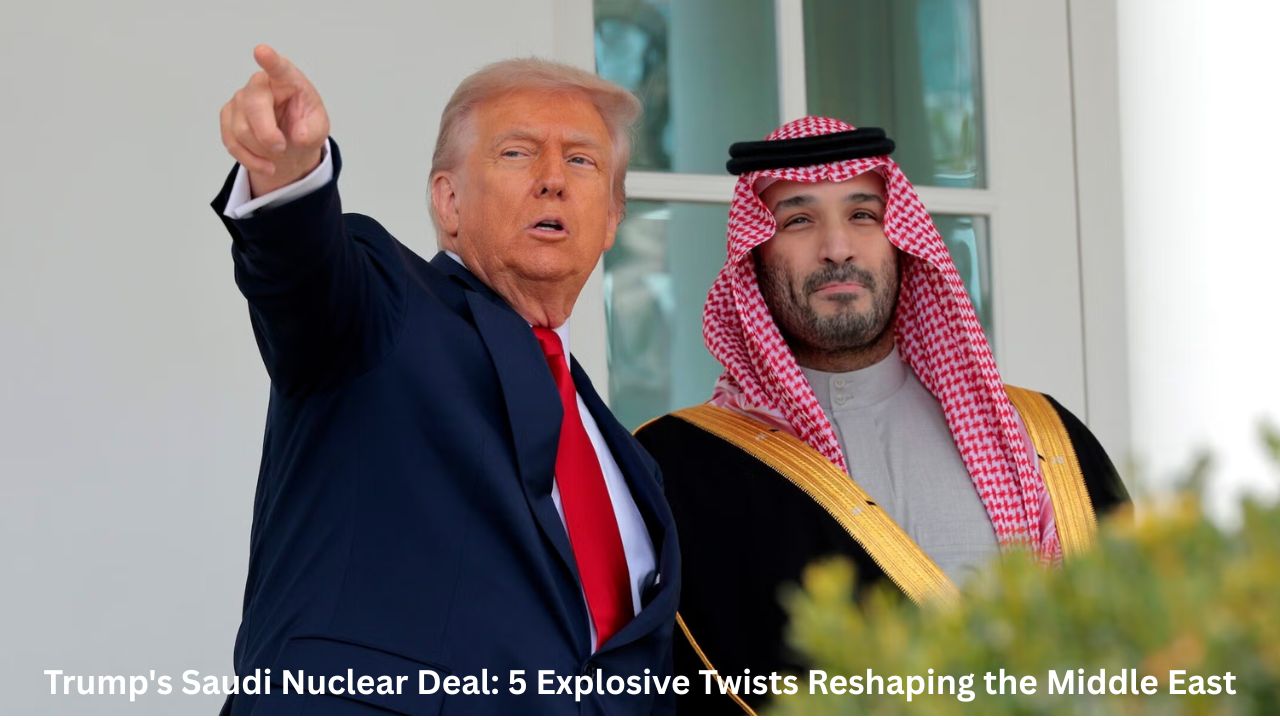
Trump’s Saudi Nuclear Deal: 5 Explosive Twists Reshaping the Middle East as experts warn of a Gulf arms race. A landmark civil nuclear agreement between Washington and Riyadh has quickly turned into one of the most contentious foreign policy stories of the summer.
Just a day after US and Saudi officials signed a 30-year nuclear cooperation pact, President Donald Trump attached a major new condition:
Saudi Arabia must join the Abraham Accords and normalise ties with Israel, or the deal will not move forward as planned.
The announcement has triggered a wave of reactions — from Riyadh’s silence to sharp criticism in Washington over nuclear safeguards, uranium enrichment, and the deal’s timing amid an active US-Israel war with Iran. For readers around the world, this is not just a regional story.
It touches global energy markets, nuclear non-proliferation rules that have held for decades, and the broader question of how far the United States is willing to go to reshape alliances in the Middle East.
Here’s what’s actually in the deal, why it’s controversial, and what could happen next.
Trump’s Saudi Nuclear Deal: 5 Explosive Twists Reshaping the Middle East
What the US-Saudi Nuclear Deal Actually Involves
On July 22, 2026, US Energy Secretary Chris Wright and Saudi Energy Minister Prince Abdulaziz bin Salman signed a Section 123 agreement — the legal framework required before Washington can share nuclear technology with any country — along with a separate bilateral safeguards pact.
Together, the documents formalise an understanding first reached during Crown Prince Mohammed bin Salman’s November 2025 visit to the White House.
The 30-year agreement hands American companies, led by nuclear reactor giant Westinghouse, the leading role in building out Saudi Arabia’s civilian nuclear power sector.
It also commits both governments to a two-year study on whether uranium enrichment inside the kingdom would be commercially viable, with any future enrichment facility reportedly built under a tightly controlled “black box” arrangement designed to keep sensitive technology out of Saudi hands.
The US Congress now has a 90-day window to review the agreement before it can take effect.
Saudi officials have framed the deal in purely economic terms, describing it as a way to diversify the kingdom’s energy mix, free up more crude oil for export, and expand technology cooperation between the two countries.
The Trump administration initially echoed that framing too — without mentioning Israel at all.
Trump’s New Condition: Join the Abraham Accords
That changed within 48 hours. Speaking to reporters and posting on social media, Trump said the nuclear deal is conditional on Saudi Arabia joining the Abraham Accords, the US-brokered normalisation framework that has already seen the United Arab Emirates, Bahrain, Morocco and Sudan establish formal ties with Israel.
Asked whether the Department of Energy had gotten ahead of him by announcing the deal without that condition attached, Trump insisted nobody had acted without his knowledge, saying it “was always understood” internally, even if it wasn’t stated publicly at signing.
His message was blunt:
Saudi Arabia has to become a member of the Accords, and in his view, the time for that step has arrived.
It marked a significant hardening of the US position, transforming what Riyadh had hoped would be a straightforward economic and technology partnership into a piece of leverage in the far more difficult politics of Middle East normalisation.
Why Saudi Arabia Isn’t Rushing to Normalise With Israel
Riyadh has not publicly responded to Trump’s latest comments.
But the kingdom’s long-standing position is well known:
Saudi Arabia has repeatedly said it will not establish formal diplomatic relations with Israel without a credible pathway toward Palestinian statehood — something Israel’s current government has firmly rejected.
That gap has stalled Saudi-Israel normalisation talks for years, even as other Gulf states moved ahead.
Tying the nuclear deal to normalisation puts Crown Prince Mohammed bin Salman in an uncomfortable position:
either walk back years of public commitments on the Palestinian issue, or risk losing a nuclear partnership that Saudi officials have described as central to the kingdom’s long-term energy and technology strategy.
The Bigger Worry: Nuclear Proliferation in the Gulf
Beyond the Israel question, the deal has alarmed non-proliferation experts for a different reason: what it doesn’t include.
Unlike the 2009 US-UAE nuclear agreement — often called the regional “gold standard” because it explicitly barred Abu Dhabi from enriching uranium or reprocessing spent fuel — the Saudi pact contains no such outright ban.
Riyadh has pointedly declined to renounce enrichment altogether, and the agreement reportedly skips the International Atomic Energy Agency’s Additional Protocol, which grants inspectors broader access to nuclear sites.
The Missing Gold Standard
Analysts at groups including the Arms Control Association and the Carnegie Endowment have warned that if the Saudi deal is ratified without enrichment restrictions, it could become a precedent other countries — Turkey, Egypt, even the UAE — point to when seeking similar terms of their own.
That, in turn, raises the risk of a broader proliferation cascade across an already volatile region.
Some US media reports have suggested the deal could allow Saudi Arabia to enrich uranium domestically for power generation, though Trump has since said publicly there “will be no enrichment of material,” leaving real ambiguity about what the final, ratified terms will actually permit.
The Pakistan Factor: A Nuclear Shadow Over the Deal
Adding another layer of complexity is Saudi Arabia’s defense relationship with nuclear-armed Pakistan.
The two countries signed a Strategic Mutual Defense Agreement in September 2025, committing each to treat an attack on the other as an attack on both — language that echoes NATO’s Article 5.
A senior Saudi official described the pact at the time as a “comprehensive defensive agreement that encompasses all military means” when asked whether it extended to Pakistan’s nuclear arsenal, without ruling it out.
That ambiguity matters. Saudi Arabia has a documented history of financially supporting Pakistan’s nuclear weapons program in its early years, and Crown Prince Mohammed bin Salman has said publicly, including in a 2018 interview, that the kingdom would pursue its own nuclear weapon if Iran ever built one.
With Pakistan’s nuclear umbrella now informally shadowing Saudi defense policy, critics argue the new US nuclear deal — however civilian in intent — arrives at a moment when Riyadh already has multiple potential pathways toward weapons-relevant capability.
Conservative and Congressional Pushback
The deal has also exposed divisions within Trump’s own political base and in Congress.
Democratic Representative Brad Sherman argued that a US administration actively fighting a war partly over Iran’s nuclear ambitions should not simultaneously be enabling proliferation elsewhere for commercial reasons.
Senator Ed Markey warned the agreement risks sparking a regional nuclear arms race rather than preventing one.
Notably, Secretary of State Marco Rubio spent years in the Senate pushing for exactly the kind of enrichment restrictions this deal appears to lack — a contradiction critics have been quick to highlight, even as Rubio has since insisted the agreement will not lead to proliferation because US contractors will directly oversee the project.
Timing: A Deal Signed Amid a Live War With Iran
Perhaps the most striking element of the story is its timing. The nuclear pact was finalised while US and Israeli forces continue military strikes against Iran, in a conflict that began after February 2026 airstrikes killed Iran’s supreme leader and has dragged on through repeated ceasefire collapses since.
Saudi Arabia itself hosts US military installations that have come under Iranian attack during the war, and the nuclear deal was signed just days after Yemen’s Houthi rebels announced a maritime blockade targeting the kingdom.
For supporters of the deal, the logic is straightforward:
locking Saudi Arabia into US nuclear technology and fuel supply chains — ahead of Chinese, Russian or French competitors — strengthens Washington’s hand in the region for decades.
For critics, doing so in the middle of a live war over nuclear weapons proliferation sends a deeply mixed message to the rest of the world.
What This Means for Global Markets and Security
Beyond the diplomacy, the deal carries real stakes for global energy and security. A nuclear-powered Saudi Arabia would free up more of its oil for export rather than domestic electricity generation, potentially affecting global crude supply over the coming decades.
At the same time, any perception that non-proliferation standards are weakening in the Gulf could unsettle markets and alliances well beyond the Middle East, particularly if it accelerates nuclear ambitions in Iran, Turkey, or elsewhere.
Congress’s 90-day review window means the deal’s final shape — and whether Trump’s Abraham Accords condition survives contact with Saudi Arabia’s own red lines — remains very much unresolved.
Conclusion
What began as a straightforward energy and technology partnership between Washington and Riyadh has evolved into a much bigger geopolitical puzzle.
Trump’s insistence that Saudi Arabia join the Abraham Accords adds a political price tag to a deal that was already drawing scrutiny over weak nuclear safeguards, an unresolved Pakistan defense relationship, and its timing amid an active war with Iran.
Whether Saudi Arabia accepts that price, whether Congress ratifies the agreement as written, and whether the region’s non-proliferation framework holds together in the process are all questions that will likely take months, not days, to answer.
For now, one thing is clear: a deal originally framed as a commercial energy partnership has become a defining test of US strategy in the Middle East — one the rest of the world will be watching closely.
Also Read: Pakistan-Saudi Arabia Defense Pact: Nuclear Umbrella and Regional Implications
Related Posts:
- 5 Powerful Highlights as Trump Lands Second Nobel…

- 11 Explosive Revelations From Ted Cruz’s Leaked…

- Trump Ends 33-Year Pause: U.S. to Resume Nuclear…

- Trump’s Historic Gaza Ceasefire Deal 2025 - Powerful…

- Trump’s 20-Point Gaza Peace Plan Gains Urgent Global…

- Trump’s 2025 Gaza Peace Plan Signing and Historic…
