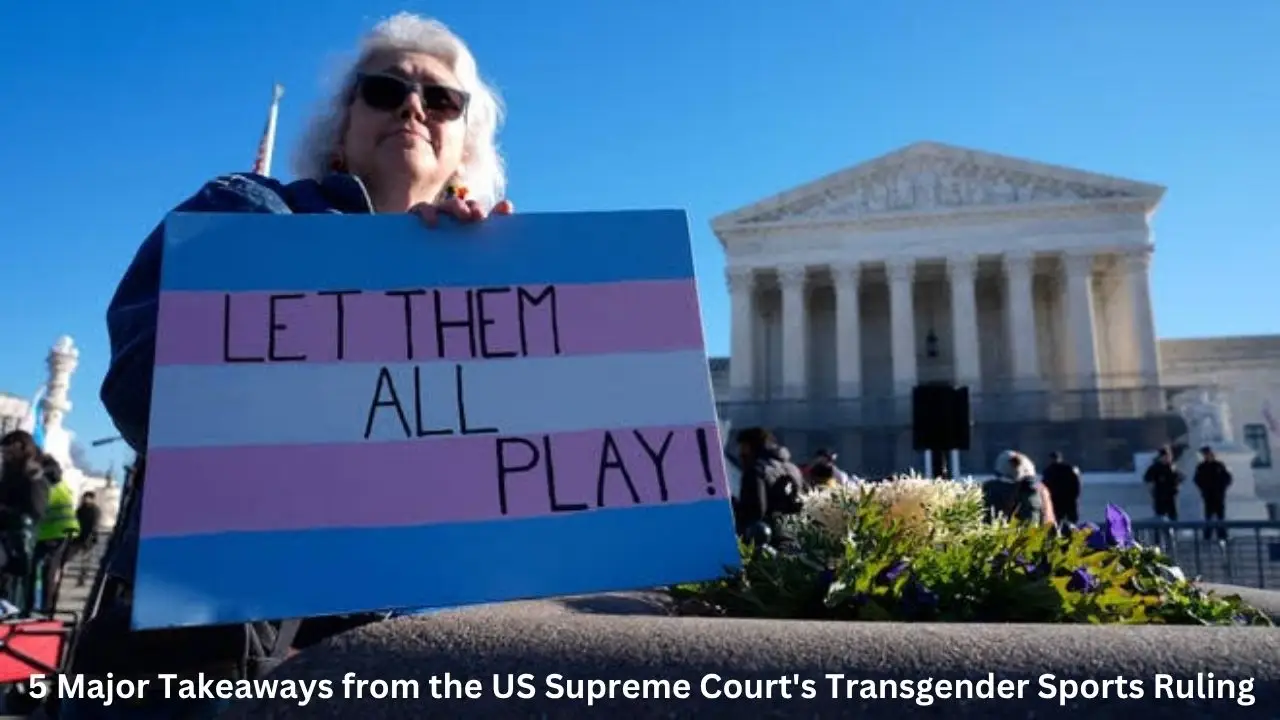
5 Major Takeaways from the US Supreme Court’s Transgender Sports Ruling that could reshape school athletics. The United States Supreme Court has issued one of its most closely watched decisions of the year, upholding state laws in Idaho and West Virginia that restrict transgender girls and women from participating on girls’ and women’s school sports teams.
The ruling is expected to shape education policy, athletic participation, and civil rights litigation across the country for years to come. The decision addresses a contentious issue that has divided lawmakers, educators, athletes, parents, and advocacy groups.
At its core is a difficult legal and social question:
how should schools balance fairness in athletic competition with protections against discrimination?
Although the ruling directly concerns laws in two states, its impact extends much further. More than two dozen U.S. states have enacted similar restrictions, and the Supreme Court’s decision provides significant legal support for those measures while influencing future challenges nationwide.
Supporters describe the judgment as a victory for fairness and competitive integrity in girls’ sports. Opponents argue it limits opportunities for transgender students and raises concerns about equality and inclusion.
As a result, the ruling has become one of the defining legal decisions in the broader national debate over transgender rights.
5 Major Takeaways from the US Supreme Court’s Transgender Sports Ruling
Background: How the Cases Reached the Supreme Court
The ruling stems from legal challenges to laws enacted in Idaho and West Virginia that require participation in girls’ and women’s school sports to be based on biological sex as defined under state law.
The Idaho case challenged the state’s Fairness in Women’s Sports Act, while the West Virginia case involved the state’s Save Women’s Sports Act. Both laws were challenged by transgender students who argued that the restrictions violated constitutional protections and federal anti-discrimination law.
Lower federal courts reached differing conclusions, allowing the Supreme Court to step in and resolve the legal questions surrounding whether such state laws violate the Equal Protection Clause of the Fourteenth Amendment or Title IX, the federal law prohibiting sex discrimination in education.
The outcome was closely watched because it represented the Court’s first comprehensive examination of transgender participation in school sports.
What the Supreme Court Decided
The Supreme Court concluded that the challenged state laws may remain in effect, holding that they do not violate either the Equal Protection Clause or Title IX. The decision allows states to establish separate girls’ and boys’ athletic competitions based on biological sex for school sports.
The majority reasoned that states have legitimate interests in preserving fairness and safety in female athletic competitions. According to the Court, lawmakers may determine that biological differences can be relevant in competitive sports and may therefore organize school athletics accordingly.
Importantly, the ruling does not create a nationwide federal ban on transgender athletes participating in sports. Instead, it confirms that states may adopt these restrictions without violating the Constitution or Title IX as interpreted by the Court. States that have chosen different policies remain free to maintain them unless future legislation changes the legal framework.
The Court’s Legal Reasoning
A central question before the Court was whether the state laws discriminated unlawfully on the basis of sex or transgender status.
The majority concluded that the laws classify participation according to biological sex in the context of athletic competition rather than denying educational opportunities altogether. The Court found that states may determine separate eligibility rules for girls’ and boys’ teams when pursuing objectives such as competitive fairness and athlete safety.
The justices also rejected arguments that Title IX requires schools to allow transgender girls to compete on girls’ teams regardless of state law. Instead, the Court held that Title IX does not prohibit states from organizing school athletics around biological sex under these circumstances.
Legal scholars say the judgment will likely become a leading precedent in future disputes involving education policy, athletics, and transgender rights.
Immediate Political and Public Reactions
The ruling prompted swift reactions across the political spectrum. Former President Donald Trump welcomed the decision, describing it as a significant victory for protecting women’s sports.
Many Republican lawmakers and conservative organizations argued that the judgment supports fairness in athletic competition and affirms the authority of states to regulate school sports.
Civil rights organizations and LGBTQ+ advocacy groups strongly criticized the decision. They argued that excluding transgender students from girls’ sports could contribute to discrimination and negatively affect the well-being of transgender youth.
Several advocacy groups indicated they would continue pursuing legal and legislative efforts aimed at expanding protections for transgender students.
Educational institutions and athletic associations are also expected to study the decision carefully, as schools in different states evaluate how the ruling affects their existing participation policies.
What the Ruling Means for Schools and Student-Athletes
The Supreme Court’s decision is expected to have an immediate impact on public schools, school districts, athletic associations, and state education departments across the United States.
While the ruling directly addresses laws in Idaho and West Virginia, its legal reasoning is likely to influence policies in more than two dozen states that have enacted similar restrictions on transgender athletes participating in girls’ and women’s school sports.
For states that already have comparable laws in place, the judgment provides greater legal certainty. School administrators and athletic associations now have stronger guidance regarding how these laws may be implemented under the Constitution and federal education law.
Schools that had delayed policy changes while awaiting the Court’s decision may now move forward with updating their athletic eligibility rules.
In states without such legislation, however, the legal landscape remains more diverse. Some states continue to allow transgender students to compete according to their gender identity, often under state civil rights laws or education policies.
Because the Supreme Court’s ruling permits—but does not require—states to adopt restrictions based on biological sex, different approaches are likely to continue across the country.
For student-athletes, the decision carries significant personal consequences. Supporters argue that it protects opportunities for girls and women by ensuring fair competition, particularly in sports where physical performance can influence outcomes.
Opponents contend that transgender students may experience exclusion from school activities that play an important role in education, personal development, and social inclusion.
Educators and school leaders now face the challenge of implementing state laws while fostering respectful and inclusive learning environments for all students.
Broader Implications for Title IX and Future Litigation
The Court’s ruling is also expected to shape how Title IX is interpreted in future legal disputes involving gender identity and school athletics.
Since its enactment in 1972, Title IX has been widely recognized for expanding educational and athletic opportunities for girls and women. Over the years, courts and federal administrations have differed on how the law should apply to transgender students, particularly in areas such as sports participation, restroom access, and school accommodations.
By concluding that Title IX does not prohibit states from organizing school sports based on biological sex, the Supreme Court has established an important legal precedent. However, constitutional experts caution that the ruling is limited to athletic participation and does not automatically determine the outcome of other cases involving transgender rights in education, healthcare, employment, or public accommodations.
Legal scholars expect additional lawsuits involving gender identity to continue reaching federal courts. Questions surrounding anti-discrimination protections, educational access, and state authority remain subjects of ongoing legal and political debate.
Reactions From Across the Political Spectrum
The decision sparked immediate reactions from elected officials, advocacy organizations, educators, athletes, and legal experts.
Supporters of the ruling described it as a victory for women’s sports. They argued that maintaining separate athletic competitions based on biological sex protects competitive fairness, scholarship opportunities, and athlete safety. Several governors and lawmakers from states with existing restrictions welcomed the judgment, saying it affirmed their authority to regulate school athletics.
Former President Donald Trump praised the decision, calling it a significant step toward protecting women’s sports. Other conservative leaders argued that the ruling reflects the view that biological differences can be relevant in athletic competition and should be considered when establishing eligibility rules.
LGBTQ+ advocacy organizations expressed disappointment, arguing that transgender students should have equal opportunities to participate in school activities consistent with their gender identity.
Several groups stated that they would continue advocating for legislative reforms, educational policies, and future legal challenges aimed at expanding protections for transgender youth.
Civil rights organizations also voiced concern that the decision could contribute to social exclusion and increase challenges faced by transgender students. Mental health professionals have emphasized the importance of ensuring that all students continue to receive appropriate educational support and access to safe school environments regardless of future policy changes.
International Perspective
The Supreme Court’s judgment has drawn attention well beyond the United States, reflecting the global nature of debates surrounding gender identity and competitive sports.
Countries around the world have adopted varying approaches to transgender participation in athletics. Some nations permit participation based on gender identity under certain eligibility standards, while others require medical criteria or have introduced restrictions similar to those now upheld in parts of the United States.
International sporting organizations have also revised their policies in recent years, with several governing bodies introducing sport-specific eligibility rules based on scientific research, competitive fairness, and athlete safety.
Because the United States plays a significant role in global education and international sports, the Court’s ruling is likely to be examined by policymakers, educators, legal scholars, and sporting organizations worldwide.
Although the decision applies only within the US legal system, it contributes to broader international discussions about balancing inclusion, fairness, and competitive integrity.
What Happens Next?
While the Supreme Court has resolved an important constitutional question, the broader debate over transgender participation in sports is unlikely to end.
States that already have similar laws are expected to continue implementing them, while legislatures in other states may consider introducing new measures based on the Court’s reasoning. At the same time, states with more inclusive policies are expected to maintain their existing approaches unless new legislation is enacted.
Schools, athletic associations, and education officials will now review participation policies to ensure compliance with both state laws and the Supreme Court’s decision.
Legal experts also anticipate future court cases addressing related issues beyond athletics, including healthcare access, gender identity protections, school accommodations, and anti-discrimination laws. Each of these issues raises distinct constitutional and statutory questions that may eventually require further judicial review.
As public attitudes, scientific research, and legislative priorities continue to evolve, policymakers are likely to face ongoing pressure to develop solutions that address both fairness in competition and the rights of transgender students.
Why This Decision Matters Beyond Sports
Although the case focused on school athletics, its significance extends well beyond playing fields and gymnasiums.
The ruling illustrates how constitutional law, education policy, civil rights, and public opinion increasingly intersect on issues involving gender identity. It also demonstrates the continuing role of the Supreme Court in resolving complex legal questions that carry significant social and political implications.
For schools, the decision provides legal clarity while also creating new responsibilities to implement policies thoughtfully and respectfully. For lawmakers, it reinforces the authority of states to regulate school sports within constitutional boundaries. For advocacy organizations on all sides of the debate, it marks another chapter in a broader national conversation that is far from over.
Perhaps most importantly, the decision reminds policymakers that legal rulings affect real students, families, coaches, educators, and communities. Regardless of differing views, many observers agree that maintaining respectful dialogue and ensuring the well-being of all young people should remain central to future discussions.
Conclusion
The US Supreme Court’s decision to uphold state laws restricting transgender girls and women from participating in female school sports represents one of the most consequential education and civil rights rulings of 2026.
By concluding that states may organize school athletics based on biological sex without violating the Constitution or Title IX, the Court has established an important legal precedent that will influence schools, lawmakers, and future litigation across the country.
Supporters view the judgment as a victory for fairness, competitive integrity, and the protection of opportunities for female athletes. Opponents argue that it limits participation for transgender students and raises continuing concerns about equality and inclusion. These differing perspectives ensure that the broader public debate over transgender rights and athletic participation will continue long after the Court’s decision.
While the ruling resolves key constitutional questions surrounding state sports laws, it does not settle every legal issue involving gender identity in education. Future cases addressing healthcare, discrimination protections, and school policies are likely to return to the courts in the years ahead.
For the international community, the decision underscores the growing global discussion over how societies balance inclusion, fairness, and equal opportunity in competitive sports. As governments, educational institutions, and sporting organizations continue to review their own policies, the Supreme Court’s ruling will remain a significant reference point in one of the most closely watched legal and social debates of the decade.
Also Read: 9 Shocking Moments from Trump Dinner Shooting That Left the World Stunned
Also Read: US Supreme Court Upholds State Laws Barring Transgender Women From Female Sports
Related Posts:
- 7 Heartbreaking Facts About Venezuela's Earthquake Disaster

- 7 Powerful Facts About Ayatollah Ali Khamenei’s…

- 9 Explosive Claims as Trump Says US Winning Iran War

- In 8 Moves, EU Targets China-Linked Refineries and…

- ICC Issues Arrest Warrants for Taliban Leaders Over…

- 3 Explosive Conditions Iran Sets to End War with US…