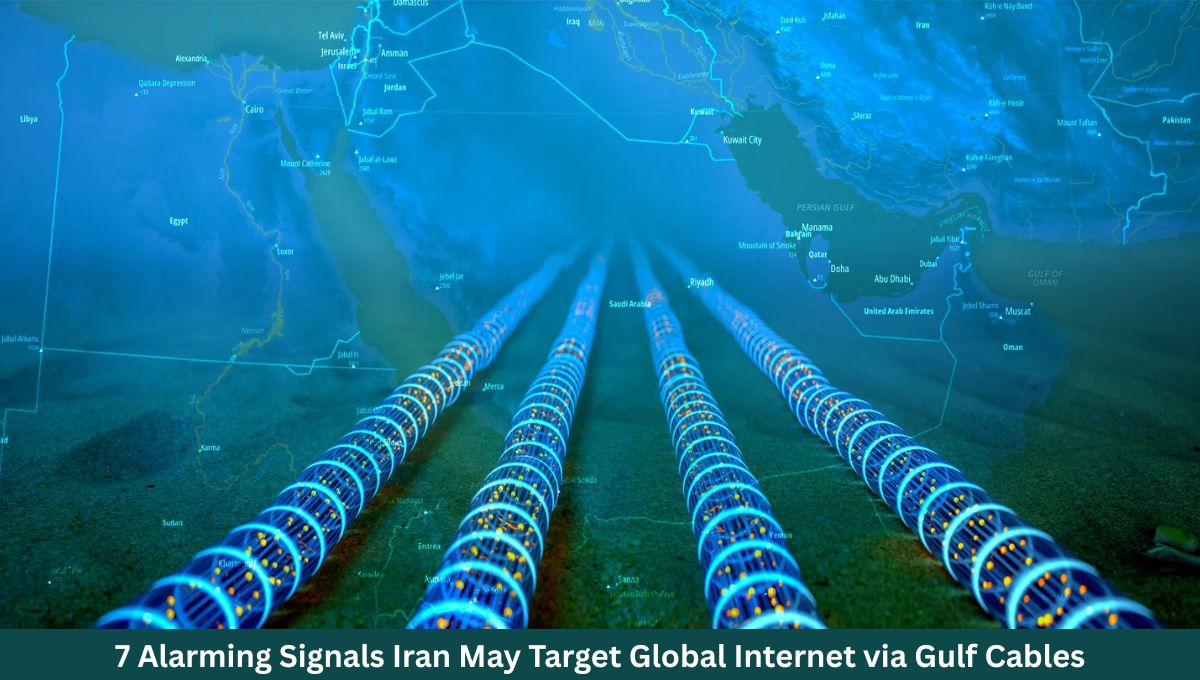
7 Alarming Signals Iran May Target Global Internet via Gulf Cables, raising fears of a new ‘data war’. The ongoing geopolitical tensions in the Middle East are entering a new and potentially more disruptive phase. Beyond oil tankers, naval blockades, and missile exchanges, a quieter but far more far-reaching threat is emerging—one that could impact billions of people worldwide.
Thank you for reading this post, don't forget to subscribe!Recent signals linked to Iran’s powerful military arm, the Islamic Revolutionary Guard Corps (IRGC), have drawn attention to the vulnerability of undersea internet cables in the Persian Gulf.
These cables form the backbone of global connectivity, powering everything from financial systems to everyday communication. The implications are profound.
If these cables are disrupted—whether deliberately or accidentally—the effects could ripple across continents, disrupting economies, slowing internet services, and destabilizing digital infrastructure.
7 Alarming Signals Iran May Target Global Internet via Gulf Cables
The Strait of Hormuz: More Than an Oil Lifeline
Most people associate the Strait of Hormuz with oil. Roughly 20% of the world’s energy supplies pass through this narrow corridor.
But beneath its waters lies something equally critical: a dense network of fiber-optic cables carrying vast amounts of global data.
These submarine cables connect Asia, Europe, and the Middle East, making the strait a dual chokepoint—for both energy and information.
Why This Matters
- Over 95% of global internet traffic travels via undersea cables
- The Gulf region acts as a major digital transit hub
- Financial markets, cloud services, and communications rely heavily on this network
Any disruption here wouldn’t stay local—it would quickly become a global issue.
IRGC’s Warning: Signal or Strategy?
A report circulated by Tasnim News Agency, widely linked to the IRGC, mapped out critical digital infrastructure in the Gulf region. While presented as analysis, experts interpret it as a strategic signal.
The report highlighted:
- Undersea cable routes
- Landing stations in Gulf countries
- Cloud data hubs in the UAE and Bahrain
Rather than neutral information, the framing suggested these assets could serve as pressure points in a broader conflict.
A Subtle but Serious Message
This kind of signaling is common in modern warfare.
By identifying vulnerabilities, a state can:
- Deter adversaries
- Increase leverage in negotiations
- Prepare the ground for escalation
In this case, the message is clear:
digital infrastructure is now part of the battlefield.
A Hidden Vulnerability: Why Undersea Cables Are Hard to Protect
Unlike military bases or ports, undersea cables are difficult to monitor and defend.
Key Challenges
- Geographic spread: Thousands of kilometers across ocean floors
- Limited surveillance: Minimal real-time monitoring
- Repair complexity: Requires specialized ships and permissions
- Clustered routes: Multiple cables run close together in chokepoints
In the Strait of Hormuz, cables are tightly packed due to geographic constraints, increasing the risk of multiple simultaneous disruptions.
What Happens If Cables Are Cut?
The consequences of cable damage depend on scale.
Minor Damage (1–2 cables)
- Slower internet speeds
- Temporary rerouting of data
- Limited regional impact
Major Disruption (multiple cables)
- Widespread outages
- Banking and payment system failures
- Cloud service disruptions
- Communication breakdowns
In extreme scenarios, entire regions could face digital blackouts lasting weeks or months.
Global Impact: Why This Is Everyone’s Problem
1. Economic Shockwaves
Global markets depend on real-time data flows.
A disruption could:
- Delay financial transactions
- Disrupt stock exchanges
- Impact international trade
2. Cloud Infrastructure Collapse
Major cloud providers operate data centers in the Gulf region.
Disruption could affect:
- Business operations worldwide
- AI systems and data processing
- Enterprise software platforms
3. Communication Breakdown
From emails to video calls, modern communication relies on stable internet infrastructure.
A large-scale outage could impact:
- Governments
- Emergency services
- Media networks
Why India and Asia Are Particularly Vulnerable
Countries like India rely heavily on westward data routes passing through the Middle East.
Key Risks for India
- Slower internet speeds
- Disruptions in digital payments
- Impact on IT and outsourcing sectors
India’s alternative routes via Southeast Asia exist—but they cannot fully replace the capacity lost through Gulf pathways.
The Rise of “Data Warfare”
The concept of targeting digital infrastructure marks a shift toward what analysts call data warfare.
What Is Data Warfare?
It involves disrupting:
- Internet connectivity
- Cloud systems
- Communication networks
Unlike traditional warfare, it:
- Leaves no visible destruction
- Has immediate global impact
- Targets economic and social systems
This evolution reflects how deeply digital infrastructure is embedded in modern life.
A Pattern Emerging: Digital Targets Already in Focus
Recent developments suggest this threat is not purely theoretical.
Reports have indicated:
- Previous cable disruptions in the Red Sea
- Threats from regional groups targeting infrastructure
- Concerns over attacks on cloud facilities
While not all incidents are confirmed or directly linked, they highlight a growing trend:
digital systems are becoming strategic targets.
The Role of Gulf Nations
Countries like the UAE, Qatar, and Bahrain play a central role in global connectivity.
Why They Matter
- Host major data centers
- Serve as internet transit hubs
- Support global financial systems
Their heavy reliance on undersea cables makes them particularly exposed.
Legal and Strategic Implications
Targeting undersea cables raises complex legal questions.
International Law
While maritime law protects navigation rights, protections for digital infrastructure are less defined.
Strategic Risks
- Escalation into cyber conflict
- Retaliatory attacks
- Global economic instability
The lack of clear enforcement mechanisms complicates responses.
The Fragile Ceasefire Context
This warning comes amid a fragile ceasefire between Iran and the United States. Donald Trump recently extended the truce to allow negotiations, but tensions remain high.
Military readiness continues, and economic pressure—especially in the Strait of Hormuz—persists. The digital threat adds another layer of uncertainty.
Could This Trigger a Global Crisis?
Experts warn that simultaneous disruption of multiple cables could lead to:
- Regional internet blackouts
- Global market instability
- Supply chain disruptions
Combined with existing energy tensions, this could amplify economic shocks worldwide.
The Bigger Picture: A Changing Battlefield
Modern conflicts are no longer limited to land, sea, and air.
They now include:
- Cyberspace
- Data infrastructure
- Economic systems
The Gulf situation reflects this shift.
What Happens Next?
Several scenarios are possible:
1. De-escalation
Diplomatic efforts succeed, and threats remain theoretical.
2. Limited Disruption
Isolated incidents cause temporary outages.
3. Major Escalation
Coordinated attacks disrupt multiple systems, triggering global consequences.
The outcome depends heavily on geopolitical developments in the coming weeks.
Conclusion: A Quiet Threat With Global Reach
The focus on undersea cables marks a turning point in how conflicts are understood. What was once invisible infrastructure is now a strategic asset—and a potential target.
The warning linked to Iran’s IRGC underscores a critical reality: the systems that power modern life are more vulnerable than many realize.
From financial markets to everyday communication, the world depends on a fragile network beneath the oceans. And in times of conflict, that network can quickly become a fault line.
The question is no longer whether digital infrastructure could be targeted—but how prepared the world is if it is.
Also Read: 7 Explosive Signals IRGC Tightens Grip as Iran Faces Power Shift Crisis
Related Posts:
- 3 Explosive Conditions Iran Sets to End War with US…

- 7 Powerful Facts About Ayatollah Ali Khamenei’s…

- 10 Explosive Warnings as Donald Trump Calls Iran…
- 10 Powerful Revelations from the Trump–Putin Call on…

- 9 Explosive Claims as Trump Says US Winning Iran War

- 7 Explosive Signs Russia Is Quietly Backing Iran in…