

7 Shocking Revelations About Mojtaba Khamenei’s Health Crisis and Iran’s Power Shift toward military generals. Iran is navigating one of the most complex and opaque leadership crises in its modern history. At the center of this unfolding situation is Supreme Leader Mojtaba Khamenei, who has reportedly suffered severe injuries following a devastating strike that killed his father and predecessor.
Thank you for reading this post, don't forget to subscribe!While officially in power, Mojtaba’s physical condition and limited public presence have triggered a profound shift in governance.
The result is a hybrid leadership structure increasingly dominated by military elites, particularly the Islamic Revolutionary Guard Corps (IRGC), at a time when Iran is engaged in high-stakes geopolitical tensions with the United States.
This article provides a comprehensive, global-facing breakdown of the situation, its implications, and what it means for regional stability and international diplomacy.
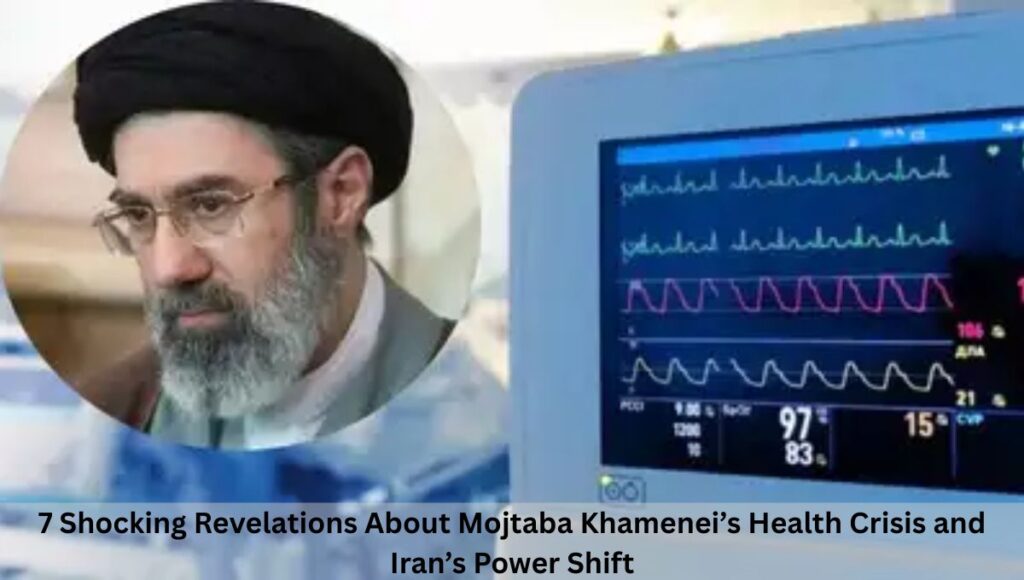
7 Shocking Revelations About Mojtaba Khamenei’s Health Crisis and Iran’s Power Shift
The Strike That Changed Iran’s Leadership
The turning point came on February 28, when a coordinated strike targeted Iran’s top leadership compound. The attack resulted in the death of long-time Supreme Leader Ayatollah Ali Khamenei and several key figures within Iran’s political and military establishment.
Mojtaba Khamenei, his son, survived—but not without sustaining critical injuries.
According to multiple reports:
- One of his legs required three surgeries and may need a prosthetic replacement
- His hand underwent surgical repair and is still recovering
- Severe burns to his face and lips have impaired his ability to speak
- He may require reconstructive plastic surgery
Despite these injuries, officials describe him as mentally alert and engaged in decision-making processes.
A Leader in Hiding
Unlike his father, who maintained a visible and authoritative presence, Mojtaba has remained completely out of public view since assuming power.
No:
- Public speeches
- Video appearances
- Audio messages
Instead, all communications attributed to him are:
- Written statements
- Broadcast via state media
- Delivered through intermediaries
Security concerns are a major factor. Iranian officials reportedly fear that any traceable movement toward Mojtaba could expose his location to adversaries, particularly Israel.
As a result:
- Even senior officials avoid visiting him
- Access is restricted to doctors and essential personnel
- Communication relies on handwritten letters delivered through secure human courier networks
This method, while secure, significantly slows decision-making and limits direct leadership engagement.
The Rise of the IRGC: A Parallel Power Structure
With Mojtaba physically constrained and isolated, real power has increasingly shifted to the Islamic Revolutionary Guard Corps (IRGC).
Key Developments:
- Military commanders now drive strategic decisions
- Civilian leadership has been sidelined on critical issues
- The IRGC influences both domestic governance and foreign policy
Analysts describe the current system as a “board-style leadership model,” where:
- Mojtaba acts as a symbolic authority
- Generals function as decision-makers
This marks a stark departure from the centralized authority of his father.
“Director of the Board”: A New Governance Model
Former insiders have described Mojtaba’s role as akin to a corporate chairman rather than an absolute ruler.
Characteristics of this system:
- Collective decision-making by military elites
- Strategic choices presented to Mojtaba for approval
- Reduced direct intervention by the Supreme Leader
This decentralized structure has both advantages and risks:
- Advantage: Faster military response during wartime
- Risk: Fragmentation and internal power struggles
So far, reports suggest that the generals remain aligned, minimizing immediate instability.
Civilian Leadership Pushed to the Margins
Iran’s elected government, including:
- President Masoud Pezeshkian
- Foreign Minister Abbas Araghchi
has seen its influence significantly reduced.
Their current role:
- Maintaining internal stability
- Managing food and fuel supplies
- Overseeing day-to-day governance
Strategic decisions—especially those involving war, diplomacy, and nuclear policy—are largely controlled by military leadership.
Diplomatic Fallout: Talks with the United States Collapse
The internal power shift has had immediate consequences for diplomacy.
Key developments:
- Planned negotiations with the United States in Islamabad were canceled
- Military leaders opposed talks amid ongoing US naval pressure
- Civilian leaders reportedly supported continued engagement
Ultimately, the IRGC prevailed, leading to:
- Collapse of talks
- Increased uncertainty around future negotiations
This reflects a broader shift where diplomacy is now filtered through military priorities rather than political consensus.
The Strait of Hormuz: A Global Flashpoint
Iran’s strategic decisions—particularly regarding the Strait of Hormuz—carry global consequences.
Why it matters:
- A critical chokepoint for global oil supply
- Any disruption impacts international markets
Under the current structure:
- Military commanders control decisions on opening or closing the strait
- These decisions are used as leverage in geopolitical negotiations
This has heightened global concern, especially among energy-dependent economies.
Information Control and Psychological Strategy
Mojtaba’s absence has fueled speculation worldwide. In response, Iranian authorities have adopted controlled messaging strategies.
Tactics include:
- Written statements attributed to Mojtaba
- State media amplification
- Use of AI-generated visuals in some cases
This approach serves multiple purposes:
- Maintains perception of leadership continuity
- Shields decision-makers from criticism
- Prevents adversaries from assessing vulnerability
Is Iran Facing a Power Vacuum?
Despite speculation, most analysts agree that Iran is not experiencing a traditional power vacuum.
Instead, power has:
- Shifted from a single leader
- To a network of military elites
Current reality:
- Authority still exists—but is distributed
- The system remains functional, though altered
However, long-term stability depends on:
- Continued alignment among generals
- Mojtaba’s recovery and potential reassertion of authority
Global Implications
This leadership transformation has far-reaching consequences beyond Iran.
1. Middle East Stability
- Increased unpredictability in military decisions
- Greater risk of escalation with Israel and Gulf states
2. US-Iran Relations
- Harder negotiations due to fragmented authority
- Military influence reduces diplomatic flexibility
3. Energy Markets
- Potential volatility in oil prices
- Strategic use of the Strait of Hormuz as leverage
4. Global Security
- Increased role of hardline elements
- Reduced transparency in decision-making
The Road Ahead: Scenarios to Watch
Scenario 1: Mojtaba Recovers and Consolidates Power
- Reassertion of centralized authority
- Reduced influence of generals
Scenario 2: Continued Military Dominance
- Institutionalization of collective leadership
- Long-term shift in Iran’s political structure
Scenario 3: Internal Friction Emerges
- Power struggles among military elites
- Potential instability
At present, Scenario 2 appears most likely.
Conclusion: A System Transformed, Not Broken
Iran’s leadership is undergoing a significant transformation under extraordinary circumstances.
Mojtaba Khamenei remains:
- The formal head of state
- Mentally engaged
- Symbolically important
But real power has shifted toward a collective military leadership model that prioritizes strategic control over centralized authority.
This evolution reflects:
- Adaptation under pressure
- Structural resilience
- A new phase in Iran’s political history
For global observers, the key takeaway is clear:
Iran’s system is not collapsing—it is evolving.
And that evolution will shape the future of geopolitics in the Middle East and beyond.
Also Read: 7 Shocking Revelations About Mojtaba Khamenei’s Escape, Injuries & Iran’s Leadership Crisis
Also Read: Who Is Calling the Shots In Iran? Inside the Rise of IRGC Strongman Ahmad Vahidi
Related Posts:
- 5 Major Takeaways from the US Supreme Court's…

- 7 Powerful Facts About Ayatollah Ali Khamenei’s…
- 3 Explosive Conditions Iran Sets to End War with US…
- 7 Heartbreaking Facts About Venezuela's Earthquake Disaster
- 9 Explosive Claims as Trump Says US Winning Iran War

- 7 Dead in Explosive Iran Protests as Economic Anger…
