
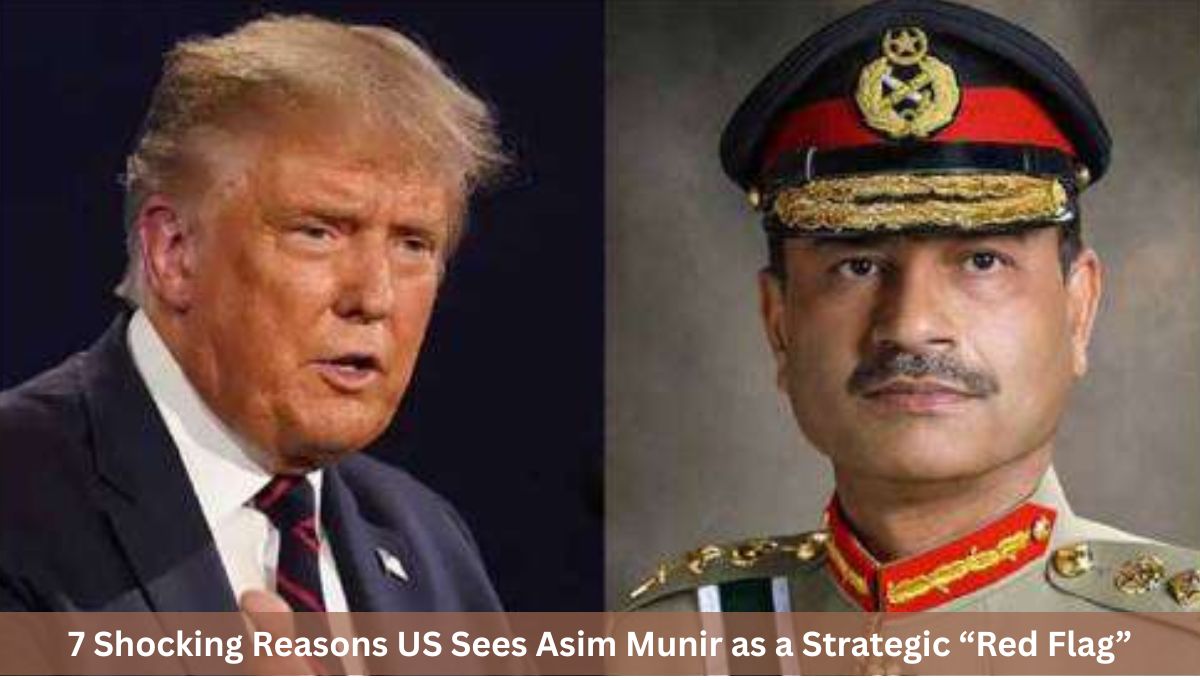
7 Shocking Reasons US Sees Asim Munir as a Strategic “Red Flag” despite Trump’s backing. In a rapidly shifting geopolitical landscape, alliances are rarely straightforward. The latest developments involving Pakistan’s Army Chief Asim Munir have triggered intense debate within global policy circles.
While former US President Donald Trump has openly praised Munir and relied on him as a key intermediary in sensitive negotiations with Iran, sections of the US intelligence community and strategic analysts are sounding alarms.
Their concern is simple yet profound:
can a figure so deeply connected to both Washington and Tehran truly serve as a neutral mediator?
As tensions simmer across the Middle East and South Asia, Munir’s unique positioning has placed him at the center of a high-stakes diplomatic balancing act—one that could either unlock peace or complicate already fragile relationships.
7 Shocking Reasons US Sees Asim Munir as a Strategic “Red Flag”
The Rise of Asim Munir: From Intelligence Officer to Global Power Broker
A Career Built on Strategic Access
Asim Munir’s rise within Pakistan’s military establishment has been swift and consequential.
Having served as the Director General of Military Intelligence and later as head of the Inter-Services Intelligence (ISI), Munir developed deep insights into regional power dynamics.
His tenure in intelligence roles between 2016 and 2017 proved especially pivotal.
During this period, he reportedly established key relationships with Iranian military and intelligence officials—connections that are now under scrutiny.
Consolidation of Power
Since becoming Pakistan’s Army Chief in late 2022, Munir has not only strengthened his influence within the military but has also emerged as a dominant force in shaping Pakistan’s foreign policy.
Critics argue that his leadership reflects a broader trend:
the increasing dominance of the military over civilian governance in Pakistan.
This consolidation of authority has made Munir both a powerful decision-maker and a controversial figure internationally.
Why the US Intelligence Community Is Concerned
1. Deep Ties with Iran’s Military Establishment
One of the primary concerns raised by US intelligence is Munir’s longstanding relationship with Iran’s military leadership, including figures from the Islamic Revolutionary Guard Corps (IRGC).
These ties reportedly extend to high-ranking officials such as Qassem Soleimani and Hossein Salami.
While both figures are now deceased, their influence within Iran’s military doctrine remains significant.
For US policymakers, these connections raise a fundamental question: could Munir’s loyalties be divided?
2. Dual Role as Mediator and Insider
Munir is currently playing a crucial role as a backchannel mediator between the United States and Iran.
On paper, this positions him as a valuable diplomatic asset. However, intelligence officials warn that his dual access to both sides could pose a strategic risk.
Acting as both a negotiator and a confidant to Iranian leadership creates potential conflicts of interest that are difficult to ignore.
Trump’s Trust vs Intelligence Skepticism
A Personal Rapport
Donald Trump has repeatedly expressed admiration for Asim Munir, even referring to him as his “favorite field marshal.”
Their relationship reportedly strengthened during the India-Pakistan crisis of May 2025, when Munir played a role in de-escalating tensions.
Trump’s reliance on Munir reflects his broader preference for strong, decisive leaders who can deliver quick results.
A Strategic Gamble
However, this personal rapport appears to be at odds with the caution advised by intelligence officials and think tanks.
Experts argue that trust based on personal chemistry may overlook deeper structural risks.
The concern is not just about Munir as an individual, but about the broader implications of relying on Pakistan’s military establishment as a diplomatic partner.
Pakistan’s Reputation: A “Perfidious Ally”?
Historical Context
The skepticism surrounding Pakistan is not new. US analysts frequently cite the country’s role during the Afghanistan conflict as a reason for caution.
While Pakistan received significant US aid, it was also accused of maintaining ties with the Taliban—a dual approach that has led to its characterization as an unreliable or “perfidious” ally.
Implications for Current Policy
This historical baggage continues to shape current assessments.
Analysts argue that Pakistan’s strategic behavior often prioritizes its own regional interests, even when they conflict with those of its allies.
In this context, Munir’s role as an intermediary becomes even more complex.
The Iran Factor: Strategic Depth or Strategic Risk?
Iran’s Perspective
From Iran’s point of view, Munir’s involvement in negotiations is advantageous.
His established relationships within Iranian military and intelligence circles provide a level of trust that few foreign figures can match.
This trust has enabled Pakistan to position itself as a neutral mediator in US-Iran tensions.
US Concerns
For the United States, however, this same trust is a double-edged sword.
The fear is that Munir could leverage his position to subtly advance Iranian interests, intentionally or otherwise.
This concern is amplified by the ongoing negotiations over Iran’s nuclear program, where even minor shifts in strategy can have major consequences.
3. The Backchannel Diplomacy Dilemma
Backchannel diplomacy is often necessary in high-stakes negotiations, but it comes with inherent risks.
Munir’s role as a facilitator between Washington and Tehran exemplifies these challenges.
On one hand, his involvement has kept lines of communication open during a period of heightened tension.
On the other hand, the lack of transparency in such channels raises questions about accountability and alignment.
4. The Military’s Growing Influence in Pakistan
Erosion of Civilian Authority
Analysts note that Munir’s rise coincides with a broader trend: the increasing marginalization of civilian leadership in Pakistan.
Critics point to crackdowns on political opposition and the sidelining of key figures as evidence of this shift.
Foreign Policy Implications
This concentration of power within the military has significant implications for foreign policy.
Decisions are increasingly being shaped by strategic and security considerations rather than democratic processes.
For international partners, this raises concerns about predictability and transparency.
5. The Ideological Dimension
Munir’s public statements offer insights into his worldview.
At the Margalla Dialogue in 2024, he warned against the dangers of unchecked freedom of expression, emphasizing the need for regulation to preserve moral values.
Such views suggest a preference for centralized control and disciplined governance—traits that align with his military background but may clash with Western democratic norms.
6. The Strategic Importance of Pakistan
A Key Regional Player
Despite the concerns, Pakistan remains a crucial player in regional geopolitics.
Its geographic position, military capabilities, and relationships with both Western and Eastern powers make it an indispensable partner.
Balancing Act
For the United States, the challenge lies in balancing the need for cooperation with the risks associated with that partnership.
Munir embodies this dilemma: he is both an asset and a potential liability.
7. The Future of US-Iran Talks
Progress and Setbacks
Recent negotiations between the United States and Iran, facilitated by Pakistan, have shown mixed results.
While dialogue continues, key issues—particularly Iran’s nuclear commitments—remain unresolved.
Munir’s Role
As talks progress, Munir’s role will likely remain central.
His ability to maintain trust on both sides could prove decisive, but it also means that any misstep could have far-reaching consequences.
Expert Opinions: Divided Views
Caution from Think Tanks
Experts from leading think tanks argue that Munir’s ties to Iran should not be overlooked.
They caution against placing excessive trust in a figure whose interests may not fully align with those of the United States.
A Pragmatic Perspective
Others take a more pragmatic view, suggesting that Munir’s unique position could be leveraged to achieve diplomatic breakthroughs that would otherwise be impossible.
The Bigger Picture: Geopolitics in Flux
The debate over Asim Munir is emblematic of a larger shift in global geopolitics. Traditional alliances are evolving, and new power dynamics are emerging.
In this environment, figures like Munir—who operate across multiple spheres of influence—are becoming increasingly important.
Conclusion: A High-Stakes Balancing Act
Asim Munir’s role in global diplomacy highlights the complexities of modern geopolitics.
His ability to engage with both the United States and Iran positions him as a key player in efforts to de-escalate tensions.
Yet, this same positioning raises legitimate concerns about loyalty, transparency, and strategic risk.
For US policymakers, the challenge is clear: how to leverage Munir’s influence without compromising national interests.
Whether he ultimately proves to be a bridge to peace or a source of strategic vulnerability remains to be seen. What is certain, however, is that the stakes could not be higher.
Final Thoughts
In a world where diplomacy often operates in shades of gray, Asim Munir represents both opportunity and uncertainty.
His story is not just about one individual, but about the evolving nature of power, trust, and strategy in international relations.
As the United States navigates its relationship with Pakistan and its broader engagement with Iran, the decisions made today will shape the geopolitical landscape for years to come.
Also Read: 8 Powerful Reasons Why Asim Munir Is Dominating US–Iran Peace Talks
Also Read: Trump’s ‘favourite field marshal’ Asim Munir’s Iran ties a red flag for US: Report
Related Posts:
- 9 Explosive Claims as Trump Says US Winning Iran War

- 5 Major Takeaways from the US Supreme Court's…

- 5 Powerful Highlights as Trump Lands Second Nobel…

- 11 Explosive Revelations From Ted Cruz’s Leaked…

- 7 Heartbreaking Facts About Venezuela's Earthquake Disaster

- Trump’s 20-Point Gaza Peace Plan Gains Urgent Global…
