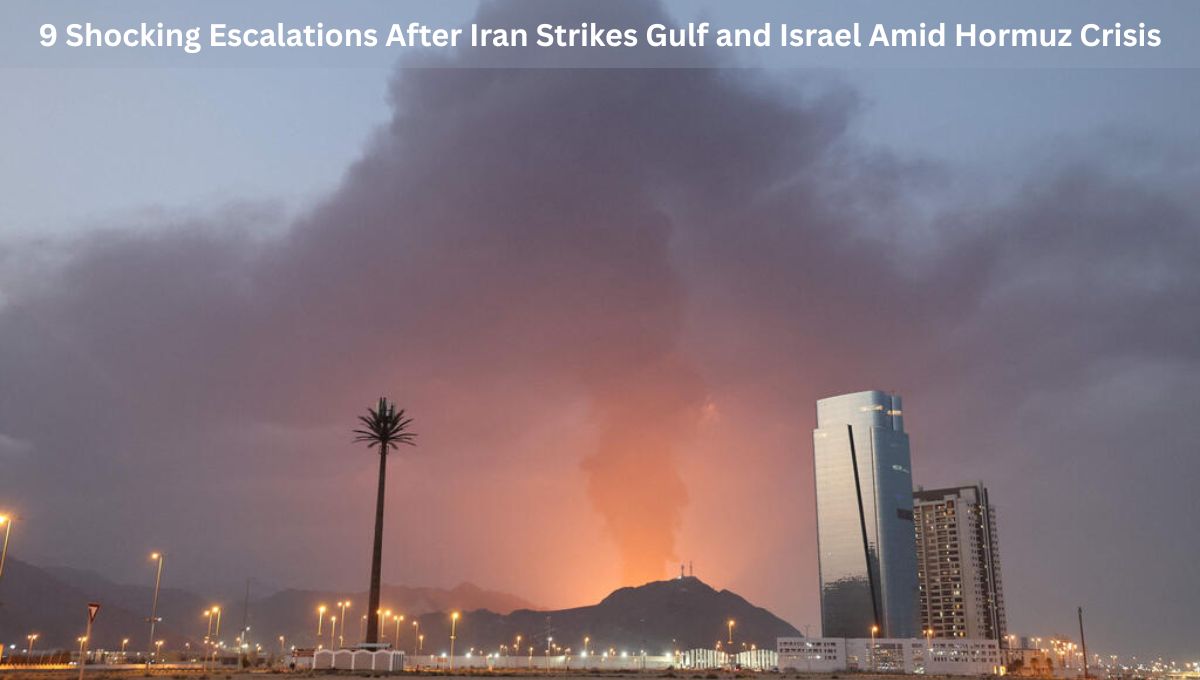
9 Shocking Escalations After Iran Strikes Gulf and Israel Amid Hormuz Crisis, triggering global economic shock. The ongoing war involving Iran, Israel, and the United States has entered a far more dangerous phase. What began as targeted military strikes has now expanded into a regional confrontation involving Gulf nations, key shipping routes, and global energy markets.
Iran’s latest claims—that U.S. troop relocations from military bases have forced it to target urban areas—highlight how rapidly the conflict is evolving. Civilian zones are increasingly becoming part of the battlefield, raising serious humanitarian and geopolitical concerns.
At the same time, the killing of Iran’s top security officials, including Ali Larijani and Gholamreza Soleimani, has triggered a wave of retaliation that is reshaping the conflict’s trajectory.
9 Shocking Escalations After Iran Strikes Gulf and Israel Amid Hormuz Crisis
Iran Confirms Larijani’s Death and Vows Retaliation
A Major Blow to Iran’s Leadership
Iran officially confirmed the death of Ali Larijani, the secretary of its Supreme National Security Council, in an Israeli airstrike.
His killing comes just weeks after the death of Supreme Leader Ayatollah Ali Khamenei, creating a leadership vacuum at the highest levels.
Larijani was widely regarded as:
- A central strategist in Iran’s war planning
- A key link between military and political leadership
- A potential diplomatic channel with global powers
His death is seen as one of the most significant losses for Iran in recent history.
Simultaneous Loss of Military Leadership
Alongside Larijani, Israel also confirmed the killing of General Gholamreza Soleimani, head of the Basij paramilitary force.
This dual loss has:
- Weakened Iran’s internal security structure
- Disrupted coordination between military units
- Intensified calls for revenge within Iran
Iran’s Retaliation: Missile Strikes and Regional Expansion
Cluster Warhead Attacks on Israel
In response, Iran launched missile strikes on Israel, including attacks on Tel Aviv and surrounding areas.
Reports indicate the use of cluster warheads, which disperse multiple submunitions mid-air.
These weapons:
- Increase damage over a wide area
- Complicate interception efforts
- Raise concerns over civilian safety
The strikes killed civilians in Ramat Gan and caused widespread damage across central Israel.
Operation “True Promise 4” Intensifies
Iran’s Islamic Revolutionary Guard Corps (IRGC) announced that its retaliatory campaign—referred to as “Operation True Promise 4”—has entered an advanced phase.
Scale of the Attack
According to Iranian reports:
- Over 100 targets were struck in Israeli territory
- Multiple missile systems were deployed
- Air defense systems were reportedly overwhelmed in some areas
The strikes targeted key locations, including:
- Tel Aviv
- Haifa port
- Be’er Sheva
- Strategic infrastructure in the Negev region
Technological Escalation
Iran’s use of advanced missile systems signals a shift in strategy.
Weapons reportedly used include:
- Khorramshahr-4 missiles
- Qadr ballistic missiles
- Emad and Kheibar Shekan systems
This reflects a move toward more sophisticated and harder-to-intercept attacks.
New Threat: The Sejjil “Dancing Missile”
One of the most notable developments is Iran’s deployment of the Sejjil medium-range ballistic missile.
Why It Matters
The Sejjil missile represents a major technological advancement:
- Solid-fuel propulsion allows rapid launch
- Road-mobile systems increase survivability
- Maneuverability complicates interception
With a range of approximately 2,000 kilometers, it can strike targets across the Middle East from deep Iran.
Strategic Implications
The use of such missiles indicates:
- A shift from deterrence to active deployment
- Reduced warning time for adversaries
- Increased pressure on missile defense systems
This development raises the stakes significantly.
Gulf Nations Under Fire
Missile Interceptions in UAE and Qatar
Iran expanded its retaliation beyond Israel, targeting Gulf countries hosting U.S. military assets.
Key developments include:
- Missile interceptions in the United Arab Emirates
- Defensive actions by Qatar’s air defense systems
- Attacks near U.S. bases and infrastructure
Urban Targeting Concerns
Iran claims that U.S. forces relocating from military bases into urban environments have forced it to strike city areas.
This has:
- Increased civilian risk
- Complicated defensive responses
- Raised international concern over escalation
Strait of Hormuz Crisis Deepens
Global Oil Lifeline at Risk
The Strait of Hormuz remains a critical flashpoint. Around 20% of global oil supply passes through this narrow waterway.
Recent developments include:
- Threats to oil tankers
- Military activity near shipping routes
- Partial disruptions to maritime traffic
Despite tensions, about 90 ships reportedly crossed the strait, indicating continued but fragile operations.
Oil Prices Surge and Global Impact
Energy Markets Under Pressure
The conflict has triggered a sharp rise in oil prices:
- Prices have increased roughly 45% since late February
- Brent crude has remained above $100 per barrel
- Volatility continues across global markets
Economic Ripple Effects
Rising energy costs are impacting:
- Inflation rates worldwide
- Transportation and logistics
- Food production and supply chains
The International Energy Agency has warned of the worst oil crisis since the 1970s.
United States Expands Military Action
Strikes on Iranian Coastline
The U.S. military confirmed strikes on Iranian missile sites near the Strait of Hormuz, using heavy bunker-buster bombs.
These strikes aimed to:
- Neutralize anti-ship missile threats
- Protect international shipping lanes
- Limit Iran’s strategic capabilities
Alliance Fractures
Despite calls for support, many U.S. allies have declined involvement.
This has:
- Exposed divisions within NATO
- Increased pressure on U.S. forces
- Complicated multinational coordination
Lebanon Drawn Deeper Into Conflict
Strikes on Beirut
Israel has expanded its operations into Lebanon, targeting Hezbollah positions.
Recent reports indicate:
- Airstrikes in central Beirut
- Civilian casualties and injuries
- Widespread displacement
Regional Escalation Risks
The involvement of Lebanon raises the possibility of:
- Multi-front warfare
- Increased civilian casualties
- Further destabilization of the region
Humanitarian Situation Worsens
Rising Casualties
Thousands have been killed across:
- Iran
- Israel
- Lebanon
- Gulf states
Civilian populations are bearing the brunt of the conflict.
Food and Energy Crisis Warning
The World Food Programme warns that:
- Tens of millions could face hunger
- Fertilizer and energy shortages may worsen
- Developing nations are particularly vulnerable
Air Travel and Trade Disruptions
Airspace Closures
Much of the Middle East airspace remains restricted due to:
- Missile threats
- Drone activity
- Ongoing military operations
Impact on Aviation
Airlines are facing:
- Increased fuel costs
- Route diversions
- Flight cancellations
This is adding to global economic strain.
Who Could Replace Ali Larijani?
Possible Successor: Saeed Jalili
Speculation is growing around Saeed Jalili as a potential replacement.
His profile includes:
- Former national security advisor
- Chief nuclear negotiator
- Strong hardline stance
Shift Toward Hardliners
If Jalili is appointed:
- Iran’s policy may become more rigid
- Diplomatic flexibility could decline
- Conflict escalation risks may increase
Strategic Implications of Leadership Change
Impact on Negotiations
The next national security chief will play a key role in:
- War strategy
- Diplomatic outreach
- Internal power balance
Larijani’s absence removes a figure capable of bridging divisions.
Global Stakes: Why This Conflict Matters
Energy Security
The conflict directly threatens global energy supply, affecting:
- Oil prices
- Industrial output
- Economic stability
Geopolitical Balance
The war is reshaping alliances and power dynamics across:
- The Middle East
- Europe
- Asia
Risk of Wider War
With multiple countries involved, the risk of escalation remains high.
Conclusion: A Conflict at a Critical Juncture
The Middle East is facing one of its most volatile moments in decades. The killing of Ali Larijani and the subsequent wave of retaliatory strikes have transformed the conflict into a broader regional crisis.
From missile attacks on cities to threats against global oil supply routes, the stakes continue to rise.
The involvement of Gulf nations, the United States, and Israel suggests that this is no longer a localized conflict but a global concern. As military operations intensify and diplomatic options narrow, the world watches closely.
The coming days will be crucial in determining whether the situation moves toward further escalation or a fragile path to de-escalation.
Also Read: 3 Explosive Conditions Iran Sets to End War with US and Israel
Also Read: Why did US and Israel attack Iran and how long could the war last?
Related Posts:
- 3 Explosive Conditions Iran Sets to End War with US…
- 7 Powerful Facts About Ayatollah Ali Khamenei’s…
- 9 Explosive Claims as Trump Says US Winning Iran War

- 10 Explosive Warnings as Donald Trump Calls Iran…
- 10 Explosive Strikes: Israel Bombs Tehran Oil Depots…

- 5 Major Takeaways from the US Supreme Court's…