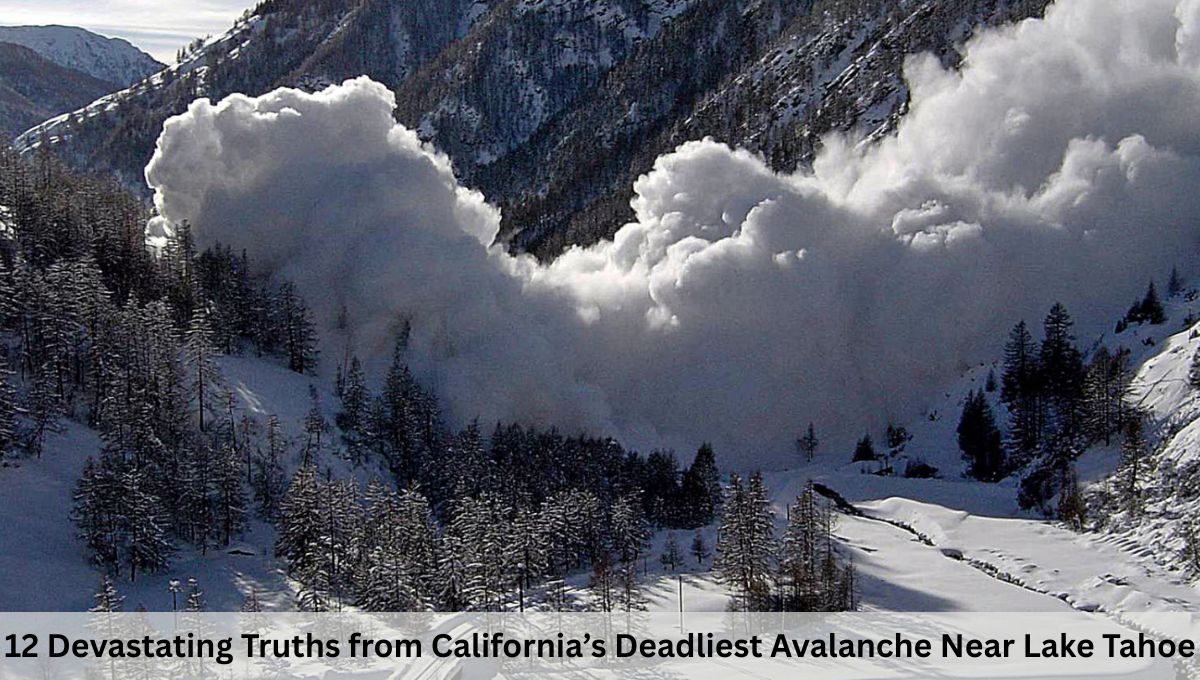
12 Devastating Truths from California’s Deadliest Avalanche Near Lake Tahoe that left eight skiers dead, one missing. A catastrophic avalanche in Northern California’s Sierra Nevada mountains has become the deadliest avalanche in the state’s recorded history, killing eight backcountry skiers and leaving one person still missing as rescue operations transitioned into a grim recovery mission.
Thank you for reading this post, don't forget to subscribe!The avalanche struck on Tuesday near Castle Peak, a popular but dangerous backcountry skiing destination northwest of Lake Tahoe, amid extreme winter storm conditions.
Authorities confirmed that six skiers survived after enduring nearly 11 hours stranded in whiteout conditions, while the remaining members of the group were buried by snow, ice, rocks, and debris in a powerful slide that spanned roughly the length of a football field.
“This is now a recovery mission,” Shannan Moon, Sheriff of Nevada County Sheriff’s Office, said at a somber press briefing. “This is a horrible tragedy.”
12 Devastating Truths from California’s Deadliest Avalanche Near Lake Tahoe
What Happened on Castle Peak: Timeline of the Avalanche
Avalanche Strikes During Return to Trailhead
The group—made up of professional guides and experienced clients—was concluding a three-day backcountry ski trip and returning toward the trailhead when the avalanche struck around 11:30 a.m. local time.
According to Blackbird Mountain Guides, which led the expedition, the skiers were navigating low-angle terrain below steeper slopes when a massive slab of snow released from above.
A wave of snow, ice, rocks, and debris swept across the slope with overwhelming force, burying multiple people within seconds.
Group Details: Who Was on the Trip
Authorities initially reported conflicting numbers but later confirmed:
- 15 total participants
- 4 professional guides
- 11 clients
- 6 survivors rescued
- 8 confirmed dead
- 1 still missing and presumed dead
Of the nine skiers who were not rescued alive:
- Seven were women
- Two were men
- They were from multiple U.S. states
- Names have not been publicly released
Rescue Efforts Under Extreme Conditions
Multi-Agency Response Mobilized
More than 50 rescuers were deployed from multiple agencies, including:
- California Department of Forestry and Fire Protection
- Nevada County Search and Rescue
- Placer County Sheriff’s Office
- Tahoe Nordic Search and Rescue
- Washoe County Sheriff’s Office
- Truckee Fire
- Ski patrol rescue teams from nearby resorts
Rescuers approached the scene on skis and snowcats, with snowmobiles held back due to the extreme avalanche risk.
Survivors Communicated via Emergency Beacons
The six survivors managed to stay alive by:
- Using avalanche beacons and satellite communicators
- Activating iPhone SOS emergency signals
- Sending text messages to rescuers
- Building a makeshift shelter from tarps in treed terrain
“One of my personnel was communicating with one of the guides for over four hours,” said Don O’Keefe of California’s Office of Emergency Services.
The survivors were finally rescued 11 hours later, with two requiring hospital treatment.
Avalanche Classified as Highly Destructive
D2.5 on Avalanche Destructive Scale
The avalanche was classified as D2.5 on a five-level destructive scale.
- D2: Large enough to bury a person
- D3: Powerful enough to bury a car or destroy a house
“This was right in the middle,” Sheriff Moon said. “It had enormous force.”
Why Conditions Were So Dangerous
Winter Storm Created a Perfect Avalanche Setup
According to the Sierra Avalanche Center, the Central Sierra Nevada—including the greater Lake Tahoe region—was under high to extreme avalanche danger.
Key contributing factors included:
- Rapid snowfall rates of 3–4 inches per hour
- Gale-force winds redistributing snow
- A fragile, sugary weak layer beneath fresh snow
- North-facing slopes particularly unstable
An avalanche warning (Level 4 of 5) was in effect at the time of the slide.
“Natural avalanches were likely,” the center warned. “Human-triggered avalanches were very likely.”
Why Backcountry Terrain Is More Dangerous Than Resorts
Unlike ski resorts, backcountry areas:
- Do not have avalanche mitigation systems
- Do not use controlled detonations
- Do not close unsafe slopes
- Leave all risk assessment to skiers themselves
Several ski resorts around Lake Tahoe were fully or partially closed during the storm—but the backcountry remained accessible.
Questions Raised About Decision-Making
Warnings Issued Before the Trip
The Sierra Avalanche Center had:
- Issued an Avalanche Watch on Sunday
- Upgraded it to a full Avalanche Warning hours before the slide
Blackbird Mountain Guides had also posted publicly about unstable snow conditions, warning of “unpredictable avalanches.”
Whether the guides were aware of the upgraded warning before departure remains unclear.
Sheriff Moon said authorities are still reviewing the decision-making process but emphasized that responsibility ultimately lies with the guiding company.
A Historic Tragedy in U.S. Avalanche History
Officials confirmed the Castle Peak disaster is:
- The deadliest avalanche in California history
- The deadliest in the U.S. since 1981, when 11 climbers died on Mount Rainier
For comparison:
- An avalanche killed seven people at Alpine Meadows in 1982
- A snowmobiler died near Castle Peak earlier this year
- The U.S. averages 25–30 avalanche deaths annually
Emotional Toll on Rescuers and Community
Among the victims was the spouse of a Tahoe Nordic Search and Rescue team member.
“This is hitting our team extremely hard,” said Wayne Woo. “This is not just a rescue—it’s personal.”
California Governor Gavin Newsom called the incident a “horrible tragedy,” adding: “We mourn this profound loss.”
Understanding Avalanches: Why Survival Windows Are Small
According to the Colorado Avalanche Information Center:
- 93% survive if rescued within 15 minutes
- After 45 minutes, survival drops to 20–30%
- After 2 hours, survival is rare
The biggest killer is not trauma—but suffocation.
Essential Avalanche Safety Gear
Experts say three tools are essential in backcountry travel:
- Avalanche beacon (transceiver)
- Probe
- Shovel
Additional life-saving equipment includes:
- Avalanche airbag backpacks
- GPS satellite communicators
- Wilderness first-aid training
“Rescue takes time,” said Mike Duffy, an avalanche instructor. “That gear buys you time.”
Castle Peak: Beauty and Danger Combined
Standing at 9,110 feet, Castle Peak is one of the most iconic backcountry ski destinations near Donner Summit.
The area:
- Was closed to the public for nearly a century before reopening
- Lies in “truly rugged, wild terrain”
- Receives some of the heaviest snowfall in the U.S.
Its beauty has long drawn skiers—but also carries lethal risk during storm cycles.
Final Word: A Stark Warning for Backcountry Travelers
This tragedy is a brutal reminder that even expert-led trips are vulnerable to nature’s extremes.
As climate volatility increases and storms intensify, avalanche forecasting and conservative decision-making are becoming matters of life and death.
For now, Castle Peak stands silent—its slopes marked not just by snow, but by loss.
Key Takeaway for Global Readers
This was not a resort accident.
It was a backcountry avalanche during one of the most dangerous storm cycles of the season—underscoring how quickly adventure can turn fatal when conditions collapse.
Also Read: 30 Dead in Japan’s Brutal Snow Disaster as Record Storm Paralyzes Nation
Related Posts:
- 11 Powerful Impacts as Winter Storm Cripples US…
- 9 Alarming Impacts of a Massive U.S. Winter Storm
- 9 Devastating Impacts of America’s Historic Winter…
- 7 Stunning Reasons Saudi Arabia’s Desert Saw Snow…

- Japan Earthquake 2026: Deadly 7.1 Kumamoto Quake…
- 7 Heartbreaking Facts About Venezuela's Earthquake Disaster