9 Powerful Signals from PM Modi’s Letter to Bangladesh PM Tarique Rahman That Reset India–Dhaka Ties after months of interim turbulence. When Narendra Modi chose to extend a personal invitation to Bangladesh’s newly sworn-in prime minister Tarique Rahman, it was more than a routine congratulatory gesture.
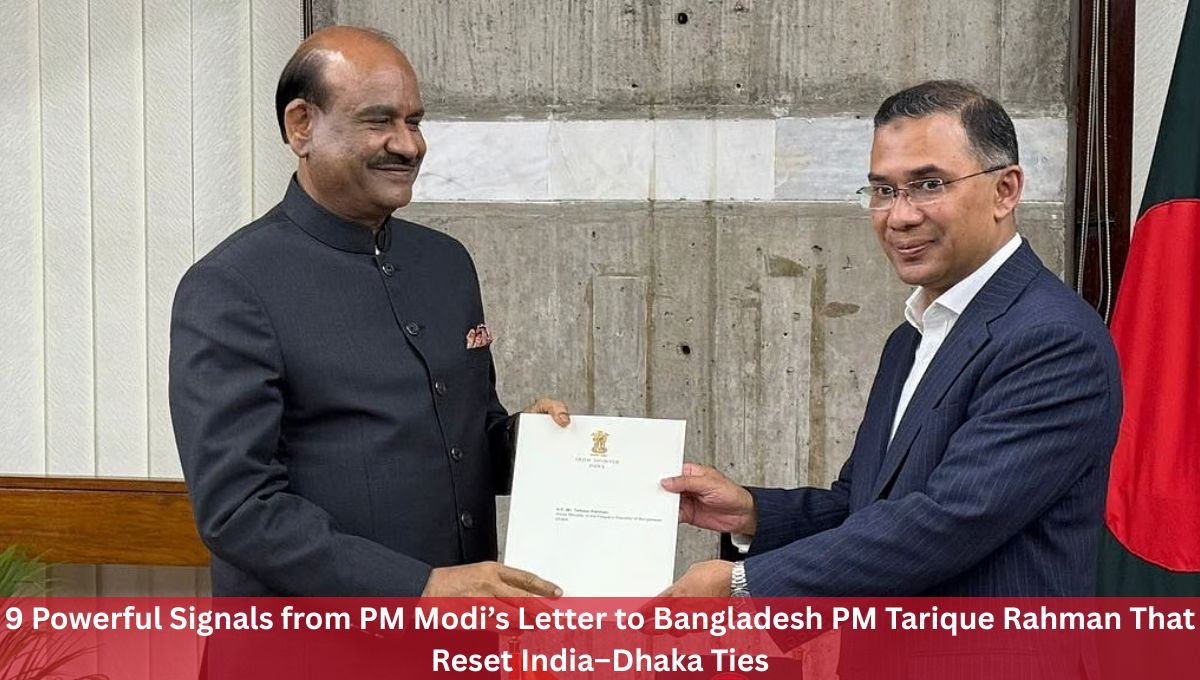
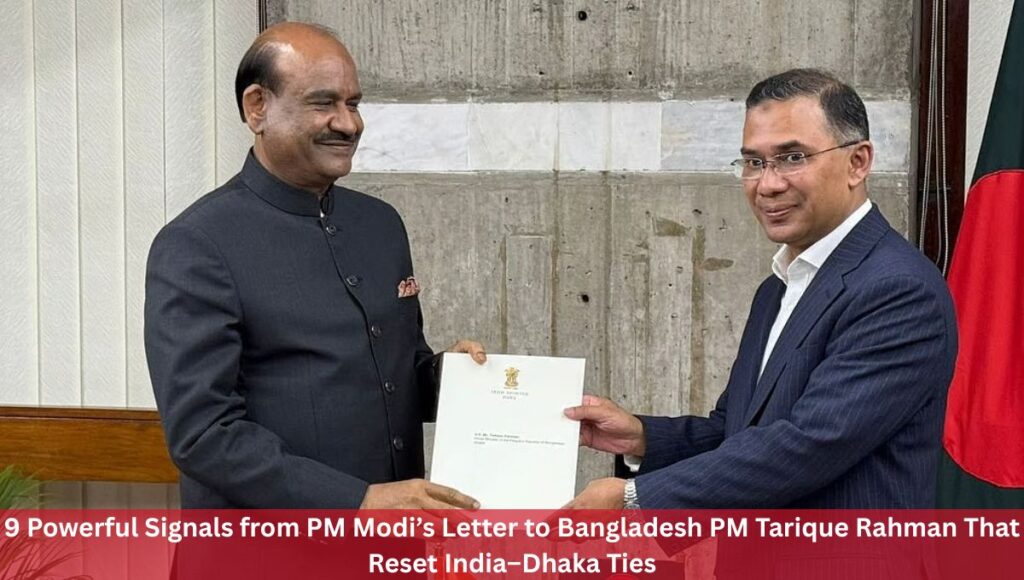
Hand-delivered in Dhaka by Om Birla, the letter marked India’s first substantive political outreach to the new leadership in Bangladesh after a prolonged and uneasy interim phase.
For New Delhi, the message was carefully calibrated:
India is ready to turn the page — but cautiously.
9 Powerful Signals from PM Modi’s Letter to Bangladesh PM Tarique Rahman That Reset India–Dhaka Ties
Why This Letter Matters More Than It Appears
Diplomatic letters between neighbouring leaders are common. What made this one different was timing, tone, and context.
Bangladesh has just emerged from:
- A violent political upheaval in 2024
- Months of caretaker governance under Muhammad Yunus
- A landslide election that returned the Bangladesh Nationalist Party (BNP) to power
Relations with India during the interim period had visibly cooled, marked by:
- Repeated attacks on minority communities
- Sharp rhetoric from Dhaka
- Strategic uncertainty over Bangladesh’s foreign policy orientation
Against this backdrop, Modi’s letter was read in diplomatic circles as a reset signal.
What PM Modi’s Letter to Tarique Rahman Said
In his message, Prime Minister Modi wrote:
“I extend my warmest congratulations to you on the victory of the Bangladesh Nationalist Party at the just-concluded parliamentary elections in Bangladesh and on your appointment as the next Prime Minister of Bangladesh.”
The letter went beyond protocol, extending a formal invitation:
“I take this opportunity to invite you, along with Dr Zubaida Rahman and your daughter Zaima, to visit India at a mutually convenient time. A warm welcome awaits you in India.”
Modi also struck a forward-looking tone, expressing confidence that Rahman’s leadership would guide Bangladesh toward:
- Peace
- Stability
- Prosperity
And reaffirmed the deep-rooted friendship between India and Bangladesh based on:
- Shared history
- Cultural ties
- Common aspirations
Om Birla’s Role: Symbolism and Substance
That the letter was delivered by Lok Sabha Speaker Om Birla was itself symbolic.
Birla:
- Represented India at Rahman’s oath-taking
- Held a courtesy meeting with the new prime minister
- Conveyed Modi’s congratulations both in person and by phone
Posting on X after the ceremony, Birla wrote:
“Glad to attend the swearing-in ceremony of the new government of Bangladesh led by Prime Minister Tarique Rahman in Dhaka today.
India stands ready to support Bangladesh’s endeavours to build a democratic, progressive and inclusive nation.”
In diplomatic terms, this was New Delhi signalling institutional continuity, not just executive goodwill.
Why PM Modi Skipped the Swearing-In Ceremony
Despite the warm outreach, Modi himself did not attend the ceremony.
The reason was pragmatic.
The interim government in Dhaka had invited Modi, but the Indian prime minister cited prior commitments in Mumbai with Emmanuel Macron, who was on an official visit to India.
Rather than cancelling either engagement, Modi chose to:
- Stay back
- Delegate representation to Om Birla
- Follow up immediately with a personal letter
Diplomats say this helped avoid any perception of snub while maintaining protocol balance.
A Relationship Strained Under Interim Rule
India–Bangladesh ties deteriorated sharply after the ouster of Sheikh Hasina in 2024.
Under the interim administration led by Muhammad Yunus:
- India raised concerns over minority safety
- Dhaka pushed a more nationalist tone
- Strategic trust eroded
New Delhi responded by dialling down political engagement, adopting a wait-and-watch posture until elections restored an elected government.
Rahman’s decisive mandate changed that equation overnight.
The BNP Landslide and Why It Matters to India
The BNP’s victory was not narrow — it was overwhelming.
- Two-thirds majority in parliament
- End of caretaker governance
- Clear public mandate
For India, this meant:
- A stable counterpart in Dhaka
- Reduced risk of prolonged unrest
- A chance to recalibrate ties with an elected leadership
Indian officials privately describe Rahman as someone they are “cautiously optimistic” about.
Tarique Rahman: A Leader India Is Still Reading
Rahman’s political profile presents both opportunity and uncertainty.
On one hand:
- He spent 17 years in exile in London
- He has no prior governing experience
- His party has had rocky relations with India in the past
On the other:
- He returned to Dhaka promising stability
- He emphasised economic revival
- He inherited a country in urgent need of investment
Indian diplomats believe economic reality may drive pragmatism.
Rahman’s ‘Bangladesh First’ Doctrine
Rahman has been clear that:
“The interests of Bangladesh and its people will determine our foreign policy.”
This “Bangladesh First” stance has raised eyebrows in New Delhi, but officials note that:
- Similar doctrines exist in India and elsewhere
- It does not automatically imply hostility
- Outcomes will depend on implementation
The invitation to India provides an early test.
Echoes of a Personal History: Modi’s Condolence Letter
The Modi–Rahman channel is not new.
In December last year, Modi sent a condolence letter to Rahman after the death of his mother, former prime minister Khaleda Zia.
In that letter, Modi recalled:
- His 2015 meeting with Khaleda Zia
- Her role as Bangladesh’s first woman PM
- Her contribution to India–Bangladesh ties
The personal tone mattered — it kept communication open during a politically frozen phase.
A Cabinet That Signals Both Continuity and Change
Rahman’s cabinet blends:
- Veteran BNP figures
- Technocrats
- Minority representatives
Notable inclusions include:
- Mirza Fakhrul Islam Alamgir
- Amir Khasru Mahmud Chowdhury
- Khalilur Rahman, a technocrat and former national security adviser
India is watching closely, particularly the foreign affairs portfolio, for clues about Dhaka’s strategic direction.
Minorities, Stability, and India’s Core Concern
One of New Delhi’s biggest worries during the interim phase was:
- Violence against minority communities
- Lack of accountability
Rahman’s government now faces immediate pressure to:
- Restore law and order
- Signal zero tolerance for communal violence
- Reassure neighbours
Indian officials say progress here will heavily influence bilateral momentum.
Regional Optics: Who Attended the Swearing-In
The ceremony in Dhaka drew wide regional attention.
Among those present:
- Mohamed Muizzu
- Tshering Tobgay
- Pakistan’s planning minister Ahsan Iqbal
India’s choice of Om Birla signalled high-level engagement without over-exposure.
India’s Strategic Calculation
For India, Bangladesh is not just a neighbour:
- It is a connectivity hub to the Northeast
- A key partner in Bay of Bengal security
- A growing economic partner
A hostile or unstable Dhaka would complicate:
- Border management
- Trade routes
- Regional security
Hence the speed of Modi’s outreach.
Why the Invitation to India Is Crucial
If Rahman accepts Modi’s invitation soon, it would:
- Cement early trust
- Set the tone for bilateral engagement
- Reassure investors and regional partners
Diplomats say such a visit could unlock:
- Trade talks
- Infrastructure cooperation
- Security coordination
Cautious Optimism in New Delhi
Indian officials are realistic.
They remember:
- Past BNP governments’ friction with India
- Differences over insurgency and security
- Periodic diplomatic chill
But they also recognise:
- Bangladesh’s economic vulnerabilities
- Regional instability
- Rahman’s need for legitimacy
This creates space for engagement.
Conclusion: A Reset, Not a Blank Cheque
PM Modi’s letter to Tarique Rahman is best understood as:
- A diplomatic opening
- A signal of readiness
- A test of intent
It is not unconditional trust. It is measured optimism.
For Dhaka, the invitation offers a chance to redefine ties. For New Delhi, it is a bet that stability and pragmatism will prevail.
The next moves — especially Rahman’s response — will determine whether this moment becomes a true reset or merely a polite pause in a complicated relationship.
Also Read: 11 Powerful Moments as Tarique Rahman Returns to Bangladesh After 17 Years
Also Read: PM Modi’s old letter to Tarique Rahman had a big hint about India-Bangladesh ties