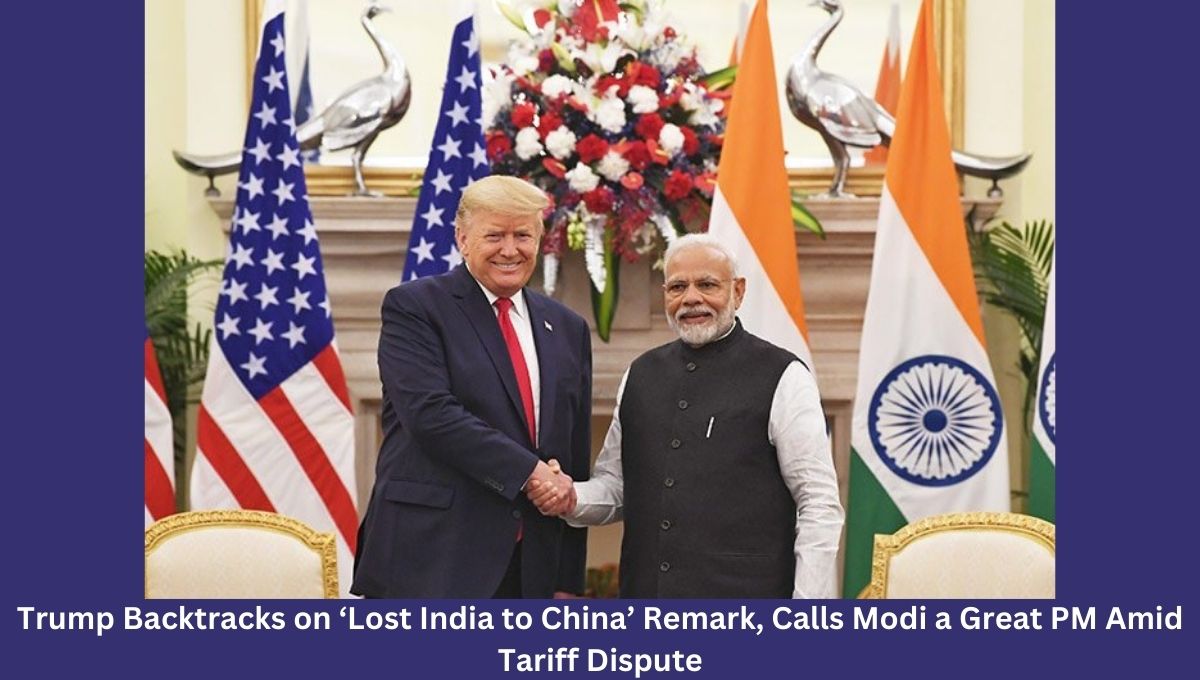
Softening his stance, Trump Backtracks on ‘Lost India to China’ Remark, Calls Modi a Great PM Amid Tariff Dispute. United States President Donald Trump appeared to backtrack on his explosive Truth Social post in which he declared that Washington had “lost India and Russia to China.” Speaking to reporters at the White House, Trump clarified that he does not believe the US has lost New Delhi, despite his disappointment over India’s increasing energy imports from Russia.
The comments marked a significant shift in tone from the earlier remark, which stirred global attention after Trump posted a photo of Prime Minister Narendra Modi alongside Russian President Vladimir Putin and Chinese President Xi Jinping at the Shanghai Cooperation Organisation (SCO) summit in Tianjin.
“I don’t think we have [lost India]. I’ve been very disappointed that India would be buying so much oil from Russia. I let them know that. We put a very big tariff on India 50 percent, a very high tariff. I get along very well with [PM] Modi, as you know. He was here a couple of months ago,” Trump told ANI.
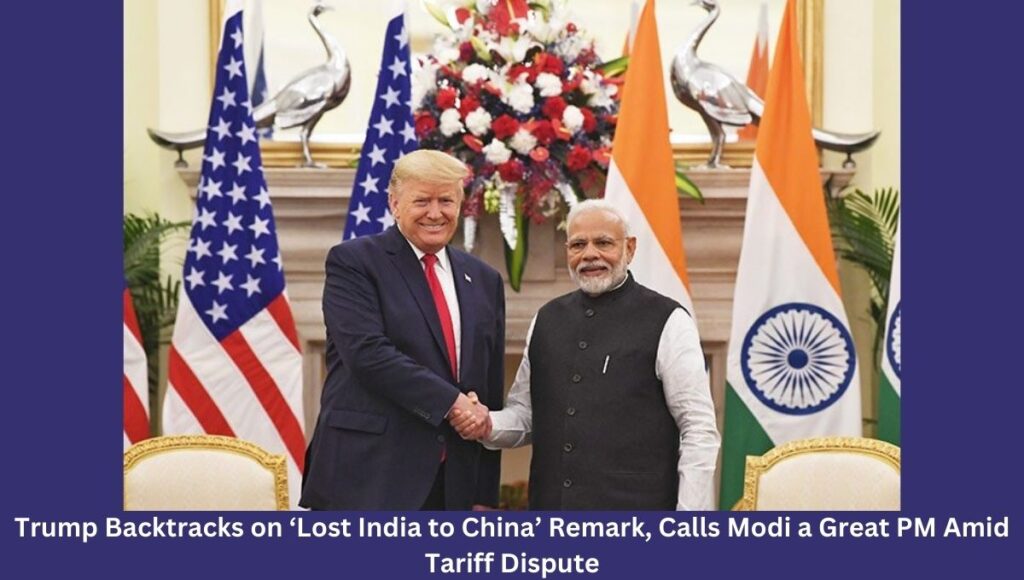
Trump Backtracks on ‘Lost India to China’ Remark, Calls Modi a Great PM Amid Tariff Dispute
Trump’s Truth Social Post Sparks Global Debate
The controversy began when Trump shared a picture of the three leaders, Modi, Xi, and Putin together at the SCO summit. His caption read:
“Looks like we’ve lost India and Russia to deepest, darkest China. May they have a long and prosperous future together!”
The blunt assessment suggested that New Delhi and Moscow were aligning more closely with Beijing, potentially undermining Washington’s global strategy.
Analysts quickly interpreted the post as a sign of fraying India-US relations at a time when trade disputes and geopolitical alignments are in flux.
India’s Ministry of External Affairs (MEA) declined to comment directly on the post, with spokesperson Randhir Jaiswal stating: “I have no comments to offer on this post at this moment.”
The Tariff War Between the US and India
At the heart of the tension lies Trump’s imposition of 50% tariffs on Indian goods, which took effect on August 27. The duties were introduced in two stages:
- 25% base tariff on Indian imports, citing “unfair trade practices.”
- Additional 25% penalty tariff in response to India’s continued imports of Russian crude oil.
Trump defended the steep tariffs, saying:
“We put a very big tariff on India, 50 percent tariff, very high tariff. I’ve been very disappointed that India would be buying so much oil from Russia. And I let them know that.”
The move has been described as the harshest trade action taken by Washington against New Delhi in decades, pushing relations to their lowest point in over twenty years.
Trump Still Affirms Friendship With Modi
Despite the sharp trade measures and strong rhetoric, Trump was careful to emphasize his personal bond with Prime Minister Modi.
“I always will. I’ll always be friends with Modi. He’s a great Prime Minister. I’ll always be friends, but I just don’t like what he is doing at this particular moment.
But India and the United States have a very special relationship. There is nothing to worry about. We just have moments on occasion,” Trump told ANI.
This dual messaging tariff pressure coupled with praise for Modi reflects Trump’s long-standing approach of combining hard bargaining with warm personal diplomacy.
Also Read: PM Modi, U.S. President Trump praise each other, hail bilateral ties
US Officials Echo Trump’s Concerns
Several senior officials in the Trump administration echoed the president’s disappointment over India’s trade and energy policies:
- Peter Navarro, Senior Counsellor for Trade and Manufacturing, accused India of “profiteering” from Russian oil sales and warned that Indian tariffs were costing American jobs.
- Kevin Hassett, Director of the National Economic Council, said: “The trade team and the President are disappointed that India continues to fund Russia’s Ukraine war. Hopefully, it’s a diplomatic issue that will have positive developments soon.”
Navarro, in particular, has frequently targeted India, even going as far as to accuse Indian elites of exploiting the crisis. His latest remarks drew criticism in New Delhi, with the MEA rejecting them as “inaccurate statements.”
Bolton Joins the Critics of Trump’s Tariffs
Former US National Security Advisor John Bolton, who served under Trump from 2018 to 2019, criticized the 50% tariffs as damaging to US-India relations.
In a post on X (formerly Twitter), Bolton wrote:
“The White House has set U.S.-India relations back decades, pushing Modi closer to Russia and China. Beijing has cast itself as an alternative to the U.S. and Donald Trump.”
Bolton argued that instead of strengthening ties with India, Trump’s tariff strategy risked pushing New Delhi further toward Moscow and Beijing exactly what Trump’s Truth Social post had suggested.
India’s Balancing Act: Russia, China, and the US
India has consistently defended its foreign policy as independent and non-aligned. New Delhi has maintained that its relations with Russia, China, and the United States are based on “their own merit” and should not be judged through the lens of a third country.
Regarding oil imports, Indian officials have stressed that Russian crude purchases are essential for national energy security and to cushion Indian consumers from volatile global markets.
Union Minister Piyush Goyal recently reassured that trade negotiations with the US were ongoing:
“There is nothing to worry about. Such negotiations need to be handled with patience, and there is never a timeline for them.”
SCO Summit: The Photo That Triggered Trump
The SCO summit in Tianjin was a diplomatic showcase for China, Russia, and India, where Modi, Xi, and Putin appeared in a display of unity.
The optics of the event, with Modi standing alongside America’s two main rivals, provided ammunition for Trump’s criticism.
Analysts said the image reinforced Beijing’s efforts to present itself as an alternative global power center to Washington.
For Trump, who has long focused on bilateral deals rather than multilateral frameworks, the SCO photo seemed to crystallize his frustration with New Delhi’s independent stance.
Trump’s U-Turn: A Calculated Recalibration?
Trump’s rapid shift from declaring India “lost to China” to reaffirming a “special relationship” with Modi appears to be a calculated recalibration.
Observers note that Trump has often used blunt social media posts to test diplomatic waters, only to soften his stance later in person.
By walking back his remark, Trump likely aimed to reassure both American allies and Indian leaders that Washington still values the India-US partnership, even as he exerts maximum pressure on trade and energy issues.
India-US Ties: A Relationship Tested
The US and India share deep strategic, economic, and cultural ties. Yet, the current tariff war and energy disagreements have strained what has long been described as one of the most consequential bilateral relationships in the world.
Even with Trump’s latest assurances, the imposition of 50% tariffs and harsh criticism from US officials reflect a relationship under stress.
Still, Trump’s insistence that he will “always be friends” with Modi highlights the enduring personal rapport between the two leaders a factor that may help keep the partnership from unraveling completely.
Conclusion: Special Relationship Under Pressure
Donald Trump’s fluctuating remarks from declaring the US had “lost” India and Russia to China, to affirming his close ties with Modi capture the complexity of modern India-US relations.
Trade wars, energy politics, and global realignments have put the relationship under pressure, but both sides continue to emphasize its “special” nature. For now, Washington’s tariffs remain in place, and India continues to purchase Russian oil.
The big question is whether diplomacy, backed by personal trust between Trump and Modi, can steer the partnership back toward stability.
Also Read: BRICS Leaders to Hold Virtual Summit on Trump Tariffs and Multilateralism