In a dramatic escalation of tensions, Pakistan Warns of Imminent Indian Military Strike Within 36 Hours Over Kashmir Attack. Pakistan’s Information Minister Attaullah Tarar, on Wednesday, raised alarm over what he described as “credible intelligence” suggesting that India may launch a military strike within the next 24 to 36 hours against Pakistan.
The warning comes amid escalating tensions between the two nuclear-armed neighbors following a deadly terror attack in the Pahalgam region of Indian-administered Kashmir, which claimed the lives of 26 civilians on April 22.
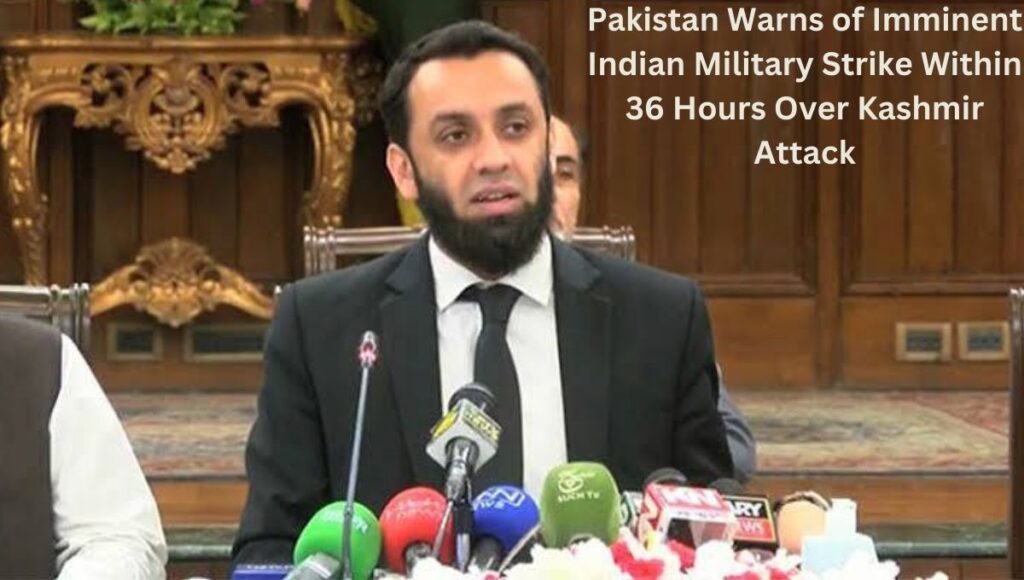
Pakistan Warns of Imminent Indian Military Strike Within 36 Hours Over Kashmir Attack
“Credible Intelligence” Cited by Pakistan’s Government
On social media platform X, Tarar, in a statement posted, “Pakistan has credible intelligence that India intends to launch a military strike within the next 24 to 36 hours using the Pahalgam incident as a false pretext.”
Any act of aggression, he warned would be met with a “decisive response,” placing the onus for potential regional consequences squarely on New Delhi.
India Alleges Pakistani Links to Pahalgam Attack
In the Pahalgam terror attack, India has accused “Pakistani elements,” thus intensifying friction between the two long-time adversaries. Indian Prime Minister Narendra Modi has granted the armed forces “complete operational freedom” to respond to the attack. On April 24, in a speech Modi vowed to “identify, track, and punish every terrorist and their backers” responsible for the carnage.
India’s Ministry of External Affairs as yet has not officially responded to Pakistan’s warning.
Pakistan Denies Involvement, Offers Neutral Probe
Categorically, Islamabad has denied any role in the Pahalgam attack, while they proposed a “credible, transparent, and independent investigation” by a neutral panel of international experts.
Tarar stated, “Pakistan has been a victim of terrorism itself and truly understands the pain of this scourge. Rather than reason, India appears to have chosen confrontation, which could have catastrophic consequences.”
Heightened Military and Diplomatic Measures
In the aftermath of the attack, both countries have unleashed a wave of retaliatory measures:
- India suspended the Indus Waters Treaty, a key water-sharing agreement brokered by the World Bank.
- Pakistan responded by closing its airspace to Indian flights.
- India expelled Pakistani military attachés and shut down the Attari-Wagah border for bilateral movement.
- Pakistan retaliated by halting cooperation under the 1972 Simla Agreement.
These moves signal a dangerous escalation between the nuclear-armed states, both of which have fought multiple wars primarily over Kashmir.
Defense Minister Asif: Pakistan on High Alert
Pakistan’s Defense Minister Khawaja Muhammad Asif, further amplifying the gravity of the situation, confirmed that the country is on “high alert” and views an Indian incursion as “imminent.” In an interview with Reuters, Asif stressed that if there were a direct threat to Pakistan’s national existence, the nuclear weapons would be considered.
Kashmir: The Flashpoint
The contested Kashmir region remains at the heart of India-Pakistan hostilities. Muslim-majority Kashmir is claimed in full by both Islamic Pakistan, and Hindu-majority India, though each country controls only a portion of the territory. The region for past conflicts has been a flashpoint and in bilateral relations continues to be a volatile issue.
Long-standing tensions have been reignited by the April 22 attack in Pahalgam, with India pushing forward a diplomatic and military offensive to hold perpetrators accountable, and Pakistan urging international restraint.
International Community Urged to Intervene
Other Pakistani officials and Tarar have called on the global community to closely monitor the situation, warning that the responsibility for any further deterioration lies with India.
Tarar emphasized, “The international community must recognize the severity of the situation. Pakistan reiterates its resolve to defend its sovereignty and territorial integrity at all costs.”
What’s Next?
The situation remains dangerously poised, with both nations braced for potential military engagement. The world watches as diplomatic ties deteriorate and the threat of a wider conflict looms. Given the nuclear capabilities are possessed by both countries, any miscalculation could have far-reaching consequences not only for South Asia but for global peace and stability.
Conclusion
In South Asia, as tensions escalate, the current developments underscore the urgent need for diplomacy, restraint, and international mediation. With India vowing retribution for the Pahalgam attack, and Pakistan warning of an imminent Indian strike, the possibility of armed conflict cannot be ruled out.
The next 24 to 36 hours will be crucial in determining, if the region spirals into a dangerous confrontation or cooler heads prevail.
Also Read: Kashmir attack: How India might strike Pakistan – what history tells us