
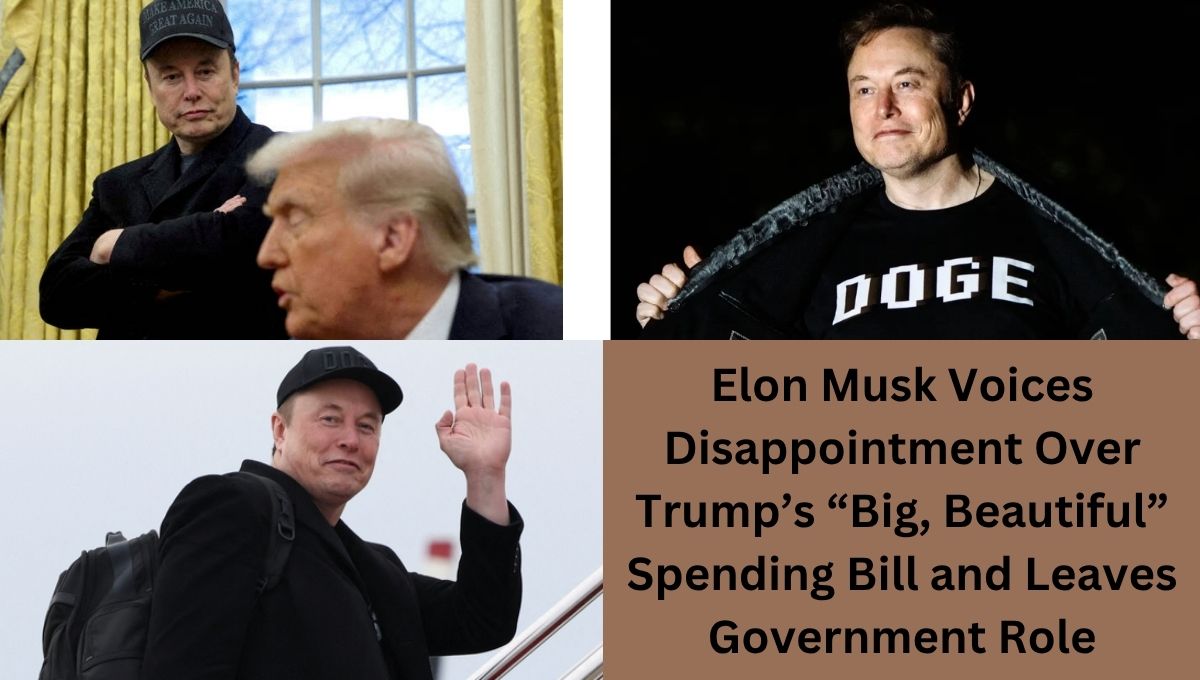
Billionaire entrepreneur and CEO of Tesla and SpaceX, Elon Musk Voices Disappointment Over Trump’s “Big, Beautiful” Spending Bill and Leaves Government Role. Elon Musk, has publicly voiced strong criticism against President Donald Trump’s latest tax and spending legislation, popularly called the “One Big Beautiful Bill.”
Despite Musk’s earlier heavy support for Trump in the 2024 election donating over $250 million his recent comments reveal growing tension between the tech magnate and the administration.
In a recent interview with CBS Sunday Morning, Musk described the bill as contradictory to his own efforts to reduce government waste. “The bill increases the budget deficit, not decreases it,” Musk said, highlighting how the legislation undermines the cost-cutting mission he championed as head of the Department of Government Efficiency (DOGE).
Elon Musk Voices Disappointment Over Trump’s “Big, Beautiful” Spending Bill and Leaves Government Role
What Is the “One Big Beautiful Bill”?
The “One Big Beautiful Bill” is an extensive tax and spending package narrowly approved by the U.S. House of Representatives last week. The bill extends Trump’s 2017 tax cuts, boosts defense funding, and allocates $46.5 billion for border wall construction.
Crucially, it raises the federal debt ceiling by $4 trillion sparking heated debate among lawmakers from both parties.
Additionally, the bill imposes stricter work requirements on social safety net programs such as Medicaid and SNAP, which critics warn could worsen poverty for vulnerable Americans. Supporters, including Trump, argue these provisions promote fiscal responsibility and economic growth.
Elon Musk’s Role as Head of DOGE
Elon Musk was appointed head of DOGE shortly after Trump’s 2024 re-election to identify and eliminate wasteful government spending. Musk promised to cut $1 trillion through contract cancellations and workforce reductions.
However, independent assessments questioned the true impact of these efforts, with DOGE claiming $175 billion saved by April far below initial goals.
Despite these challenges, Musk remained outspoken about government inefficiencies until recently, when he publicly expressed frustration with the “Big Beautiful Bill,” stating, “I think a bill can be big or beautiful. I don’t know if it can be both.”
Political Fallout and Growing Republican Divisions
The passage of the bill has exposed clear rifts within the Republican Party. While some conservatives worry about ballooning national debt, others are concerned about Medicaid restrictions potentially harming constituents. Trump, meanwhile, pushes party unity to secure enough Senate votes for final passage.
Musk’s break from Trump adds another layer of complexity to these tensions. His stepping back from political spending and public critiques may signal a broader realignment as he refocuses on his business ventures.
Elon Musk’s Departure from the Trump Administration
On May 28, 2025, Elon Musk officially left his role as head of DOGE after a four-month tenure marked by controversy and mixed results.
His fixed-term appointment, limited by ethics laws to 130 days of service, concluded amid sweeping federal layoffs, agency shutdowns, and multiple lawsuits challenging DOGE’s authority.
Musk thanked President Trump on his social media platform X for the opportunity to work on cutting wasteful spending, expressing hope that DOGE’s mission would continue beyond his departure.
Key Actions and Controversies During Musk’s DOGE Leadership
Musk’s leadership saw drastic moves including:
- Thousands of federal employee layoffs at HHS, Department of Energy, and USAID
- Closure of the Federal Mediation and Conciliation Service (FMCS)
- Legal challenges over access to confidential government data
- Investigations into public broadcasters NPR and PBS for alleged bias
- Budget cuts totaling $150 billion—far below the initial $2 trillion target
Despite these upheavals, Musk faced considerable pushback from entrenched bureaucracies and courts, which blocked some layoffs and reforms.
Challenges Facing Tesla and SpaceX Amid Political Turmoil
Musk’s government role coincided with significant struggles at his companies. Tesla reported a dramatic 70% drop in earnings for Q1 2025, with European sales falling nearly 50%, partially due to backlash over Musk’s political involvement.
Tesla’s Cybertruck project has underperformed expectations with only 40,000 units sold in 2024 compared to the projected 250,000 annually. SpaceX also encountered setbacks, including a failed Starship launch over the Indian Ocean.
Musk’s social media platform, X, faced user backlash following controversial AI experiments, further complicating his public image.
What Lies Ahead for DOGE and Elon Musk?
With Musk’s departure, the future of DOGE is uncertain. President Trump has not named a successor, though hints suggest agency heads may carry forward the cost-cutting mission.
Musk described DOGE as more of a philosophy or “way of life,” suggesting its goals will persist.
For Musk, stepping away from politics appears to be a strategic shift back to stabilizing his private ventures.
Investor confidence remains cautiously optimistic, especially with Tesla’s upcoming autonomous robotaxi service launch in Austin, Texas. However, regulatory and operational hurdles still loom large.
Conclusion: A Complex Rift Between Business and Politics
Elon Musk’s public break with Trump over the “One Big Beautiful Bill” highlights deeper tensions between fiscal responsibility and political agendas.
His exit from the Trump administration and renewed focus on his corporations underline the difficulty billionaires face balancing political influence and business demands.
As Musk navigates challenges with Tesla, SpaceX, and his social platform, his waning political role signals shifting power dynamics within both the Republican Party and the tech world.
Also Read: Elon Musk Breaks with Trump Over ‘Big Beautiful Bill’: Says It Increases Deficit and Undermines DOGE
Also Read: Elon Musk is ‘disappointed’ with Donald Trump’s tax bill. Here’s why
Related Posts:
- Trump’s 20-Point Gaza Peace Plan Gains Urgent Global…

- Trump’s 2025 Gaza Peace Plan Signing and Historic…

- Donald Trump’s Lavish UK State Visit: From Kate…

- 10 Explosive Facts About Donald Trump’s $1 Billion…

- Israel–Hamas Ceasefire Under Strain: 4 More Hostage…

- 7 Explosive Reactions as Trump Threatens Military…
