Hamas Survives Israeli Assassination Attempt in Doha; Qatar Condemns Strike as ‘State Terrorism,’ calling It a serious blow to ceasefire negotiations and an escalation of regional tensions.” In an unprecedented escalation of the Gaza war, Hamas confirmed that its leadership survived an Israeli assassination attempt in Doha, Qatar, on Tuesday evening.
The strike, which killed at least six people including family members of senior Hamas leaders, has been condemned worldwide as a violation of Qatari sovereignty and a dangerous blow to ongoing ceasefire negotiations.
The Israeli government admitted responsibility for the attack, calling it a justified strike against “terrorist leaders,” while Qatar and other international actors denounced it as “state terrorism.” The unprecedented targeting of Hamas inside Doha has sent shockwaves through the Middle East and threatened to derail fragile truce talks.
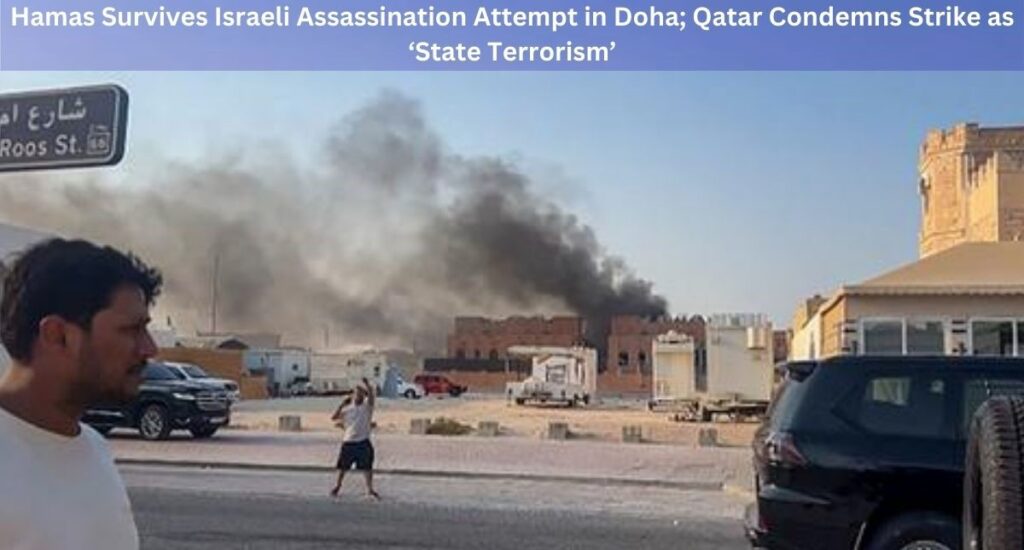
Hamas Survives Israeli Assassination Attempt in Doha; Qatar Condemns Strike as ‘State Terrorism’
What Happened in Doha?
The Strike on Hamas Leadership
According to official statements from Hamas, Israeli fighter jets launched a coordinated strike on a residential compound in Doha’s West Bay Lagoon district, where members of the Hamas political bureau were meeting to discuss the latest U.S.-backed ceasefire proposal.
The attack killed at least six people, including:
- Humam al-Hayya, son of senior Hamas leader Khalil al-Hayya
- Jihad Labad, director of Khalil al-Hayya’s office
- Several Hamas bodyguards and aides
- A Qatari security officer
Despite the fatalities, Hamas confirmed that its senior leaders, including chief negotiator Khalil al-Hayya, survived.
Israel Claims Responsibility
In a rare and rapid acknowledgment, Israeli Prime Minister Benjamin Netanyahu’s office said:
“Israel initiated it, Israel conducted it, and Israel takes full responsibility.”
Israeli officials said the strike, dubbed “Operation Summit of Fire,” was months in the making and involved 15 fighter jets using long-range precision munitions.
Hamas’ Reaction
Leadership Survives, But Losses Felt
Hamas declared that Israel had “failed in its attempt to assassinate” its negotiating delegation, framing the attack as part of Netanyahu’s efforts to sabotage peace.
In its official statement, Hamas described the strike as:
- “A heinous crime”
- “A blatant aggression”
- “A flagrant violation of all international laws and norms”
Hamas also accused the United States of complicity, claiming Washington’s support enabled Israel’s action.
Accusations Against the U.S.
Senior Hamas figure Suhail al-Hindi said the U.S. was “jointly responsible” for the attack. The group argued that Washington’s political and military backing of Israel emboldened the assault inside a U.S. ally’s capital.
Qatar’s Response
Condemnation from the Emir
Qatar’s Emir Sheikh Tamim bin Hamad Al Thani strongly condemned what he called a “reckless criminal attack” during a phone call with U.S. President Donald Trump.
He stressed that the strike was:
- A flagrant violation of Qatari sovereignty and security
- An act of state terrorism
- An attempt to undermine Qatar’s mediation role in Gaza ceasefire negotiations
Qatar’s Foreign Ministry Statement
Spokesperson Majed al-Ansari denied U.S. claims that Doha had been warned in advance, saying the only communication from Washington came after explosions had already begun.
Al-Ansari warned:
“This criminal attack constitutes a flagrant violation of all international laws and norms and a serious threat to the security and safety of Qataris and residents.”
Qatar announced the formation of a legal team to explore holding Israel accountable for violating its sovereignty.
International Condemnation
Arab Leaders Speak Out
- Saudi Arabia denounced the attack as “brutal Israeli aggression” and “a violation of Qatari sovereignty.”
- Egypt expressed concern that the strike undermined ongoing ceasefire mediation.
- Jordan and Oman joined in widespread condemnation.
Europe and Beyond
- UK Prime Minister Keir Starmer said the attack violated international law and risked regional escalation.
- French President Emmanuel Macron labeled it “unacceptable.”
- Canadian Prime Minister Mark Carney warned that the strike “directly imperils peace efforts.”
United Nations
UN Secretary-General António Guterres called the attack a “flagrant violation of sovereignty and territorial integrity.” He praised Qatar’s role in ceasefire talks and urged parties to focus on peace, not escalation.
The U.S. Position
Trump’s Delicate Balancing Act
U.S. President Donald Trump attempted to distance Washington from the attack, calling the incident “unfortunate.”
Press Secretary Karoline Leavitt said:
“Unilaterally bombing inside Qatar, a sovereign nation and close ally of the United States, does not advance Israel or America’s goals.”
At the same time, she added that “eliminating Hamas is a worthy goal.”
Trump confirmed he had spoken to both Netanyahu and Qatar’s emir following the attack, assuring Doha that such actions would not be repeated on Qatari soil.
Confusion Over U.S. Role
While the White House claimed it had notified Qatar before the strike, Doha flatly denied receiving any warning. This discrepancy has fueled speculation over Washington’s level of involvement.
Impact on Ceasefire Talks
Hamas Delegation Targeted During Negotiations
The timing of the strike was highly symbolic — Hamas leaders were meeting in Doha to discuss the latest U.S.-brokered ceasefire framework.
Hamas said the attack confirmed Israel’s unwillingness to negotiate, accusing Netanyahu of deliberately sabotaging talks.
Qatar’s Mediation Role at Risk
Qatar has hosted Hamas’ political bureau since 2012 and has been a central mediator, along with Egypt and the U.S., in attempts to end the Gaza war.
Qatari officials fear that Israel’s strike could paralyze ongoing negotiations and undermine trust in Doha’s neutrality as a diplomatic hub.
Analysts Weigh In
Hasan Alhasan of the International Institute for Strategic Studies warned:
“I wouldn’t be surprised if it brings mediation to a standstill.”
Israeli Justifications
Netanyahu’s Defense
Netanyahu said the action was necessary to weaken Hamas’ leadership abroad and prevent further attacks on Israel.
He framed the strike as a step toward peace:
“This action can open the door to an end of the war in Gaza.”
Security Officials’ Perspective
Israeli Defense Minister Israel Katz and military chief Eyal Zamir argued that Hamas leaders abroad remain legitimate military targets.
They emphasized that Hamas officials in Doha were responsible for the October 7, 2023 attack on Israel, which killed 1,200 people and triggered the Gaza war.
Humanitarian Fallout in Gaza
Gaza City Evacuation Orders
Coinciding with the Doha strike, Israel ordered the complete evacuation of Gaza City, ahead of what it called a decisive military takeover.
Residents, already enduring famine-like conditions, were told to head south. Leaflets dropped by Israeli planes directed civilians toward the coast.
Mounting Death Toll
According to Gaza’s health ministry, more than 64,600 Palestinians have been killed since October 2023, with thousands more missing or buried under rubble.
UN Human Rights Chief Volker Türk warned that Israel’s new assault on Gaza City would lead to:
- “More massive forced displacement”
- “More killing”
- “More unbearable suffering”
Reactions from Hostage Families
Families of the 48 remaining hostages in Gaza reacted with alarm to the Doha strike.
Einav Zangauker, whose son Matan is still held, wrote on X:
“It could be that in these very moments the prime minister has actually assassinated my Matan. Why does he insist on blowing up any chance of a deal?”
Opposition leader Yair Lapid echoed their concerns, warning that such actions could endanger hostages’ lives.
Wider Regional Implications
A Precedent-Setting Strike
Israel’s strike inside Doha is the first known Israeli attack on a Gulf Arab state, raising fears of future escalations across the region.
Qatar, home to the largest U.S. airbase in the Middle East (Al Udeid), now faces heightened security risks as Israel demonstrates its willingness to act beyond Gaza and Lebanon.
Growing Tensions
The strike threatens to:
- Complicate U.S.-Qatar relations
- Undermine ongoing ceasefire mediation
- Risk retaliation from Hamas or allied groups
- Encourage regional powers to push back against Israel’s extraterritorial operations
Conclusion
The Israeli assassination attempt on Hamas leaders in Doha marks a dangerous turning point in the Gaza war. By striking inside Qatar, a U.S. ally and key mediator, Israel has widened the battlefield beyond Gaza, risking diplomatic fallout and destabilizing regional security. While Hamas’ leadership survived, the strike has already succeeded in jeopardizing fragile ceasefire talks, angering international partners, and deepening fears of escalation.
Whether diplomacy can recover from this unprecedented act remains uncertain but what is clear is that the path to peace in Gaza just became far more treacherous.
Also Read: Israeli PM Netanyahu apologises to Qatar over Doha attack
Also Read: GCC Activates Joint Defence Mechanism as Doha Summit Condemns Israel’s Strike on Qatar
Related Posts:
- Netanyahu Apologises to Qatari PM Over Doha Strike…

- PM Modi Condemns Israeli Strikes on Doha: Qatar…

- Trump’s 20-Point Gaza Peace Plan Gains Urgent Global…

- Marco Rubio Visits Israel After Israeli Strike on…

- US, Qatar Near Defence Pact After Israeli Strike on…

- GCC Activates Joint Defence Mechanism as Doha Summit…