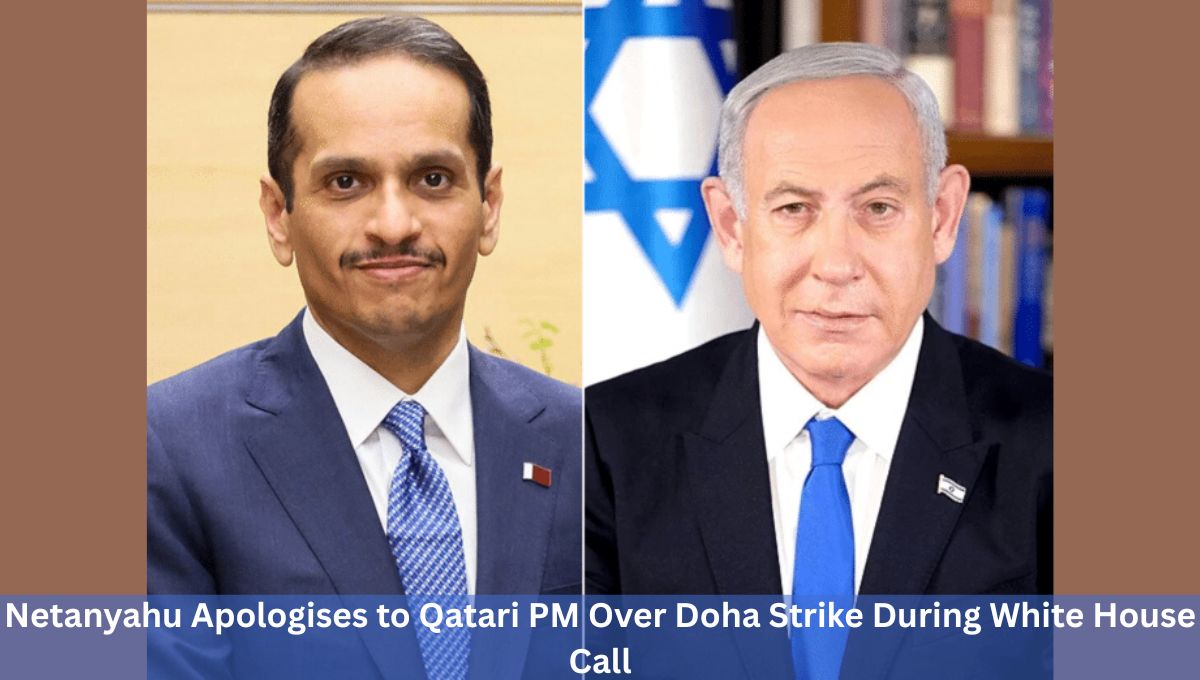
Netanyahu Apologises to Qatari PM Over Doha Strike During White House Call hosted by Donald Trump. Israeli Prime Minister Benjamin Netanyahu has issued a rare apology to Qatari Prime Minister Sheikh Mohammed bin Abdulrahman bin Jassim Al Thani over the September 9 Israeli strike on Doha, which killed a Qatari security guard and targeted senior Hamas officials.
The apology, delivered in a phone call hosted from the White House by U.S. President Donald Trump, has drawn global attention as it signals both Israel’s acknowledgment of a misstep and Washington’s renewed push for a breakthrough in the Gaza ceasefire negotiations.
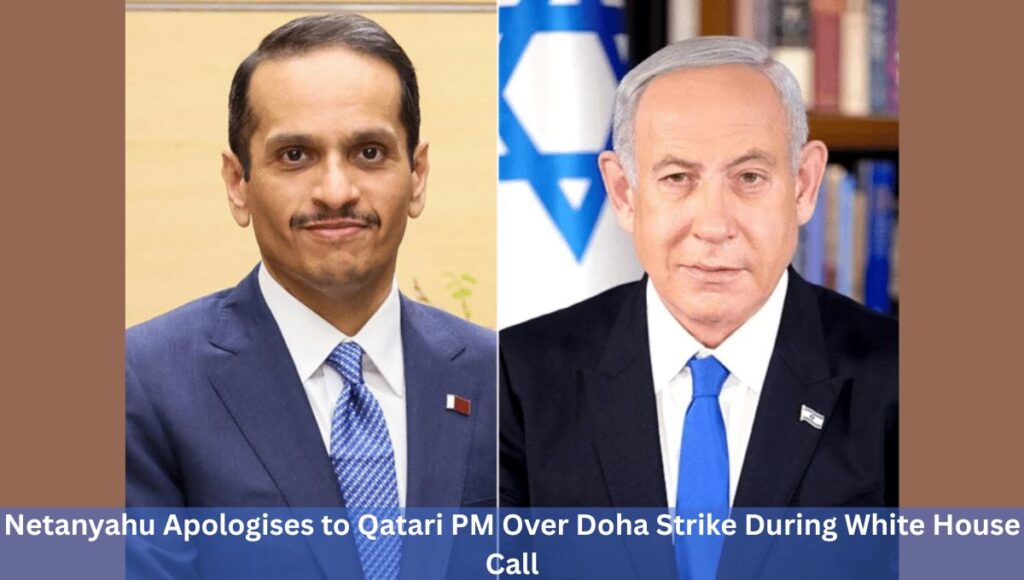
Netanyahu Apologises to Qatari PM Over Doha Strike During White House Call
The White House Call: A Diplomatic First
On Monday, Netanyahu—currently in Washington for talks with Trump—joined the U.S. President in a trilateral call with the Qatari leader. According to a White House statement, the Israeli prime minister expressed his “deep regret” over the violation of Qatari sovereignty and the death of Corporal Badr Al-Dosari, a member of Qatar’s Internal Security Force.
“As a first step, Prime Minister Netanyahu expressed his deep regret that Israel’s missile strike against Hamas targets in Qatar unintentionally killed a Qatari serviceman,” the White House said.
“He further expressed regret that, in targeting Hamas leadership during hostage negotiations, Israel violated Qatari sovereignty and affirmed that Israel will not conduct such an attack again in the future.”
Qatar confirmed the call, describing it as part of U.S. efforts to address the “repercussions of the Israeli aggression.”
What Happened in the September 9 Doha Strike
The Doha airstrike, carried out by Israel on September 9, was the first of its kind on Qatari soil. It targeted residences where Hamas political leaders, including Khalil Al-Hayya, were meeting to discuss a U.S.-backed ceasefire proposal.
Although Al-Hayya and other top Hamas figures survived, the attack killed six people—including lower-ranking Hamas members and a Qatari security officer. Witnesses in Doha described plumes of black smoke over the capital’s skyline, while Qatari state media broadcast funerals of the victims, including one coffin draped in a Qatari flag.
Qatar’s Ministry of Interior confirmed the death of Corporal Al-Dosari, calling him a martyr. The strike drew immediate condemnation from the United Nations, which labeled it a “flagrant violation” of Qatar’s sovereignty.
Also Read: Hamas claims leadership survived Israeli attack in Doha, but confirms six deaths
Qatar’s Reaction: Mediation on the Line
The attack deeply rattled Qatar’s role as a mediator in Gaza peace talks. Doha had long served as a critical backchannel between Hamas and Israel, often at Washington’s urging.
But after the strike, Qatari officials froze their mediation, warning that Israel’s actions jeopardized not only hostage negotiations but also Qatar’s broader diplomatic engagement.
Prime Minister Al Thani went so far as to demand that Netanyahu be “brought to justice” for the strike, calling it a reckless move that undermined peace efforts.
Trump’s Role: Frustration and Pressure
The apology also highlights the increasingly complicated relationship between Donald Trump and Netanyahu. U.S. officials revealed that Trump had been frustrated by Israel’s decision to strike in Doha without fully considering the risks to regional diplomacy.
Following the September 9 strike, Trump reportedly had a heated exchange with Netanyahu, calling the attack “not wise” and cautioning that it risked sabotaging ongoing peace negotiations.
Still, Trump hosted the apology call, signaling his interest in repairing strained ties between Israel and Qatar, which also hosts Al Udeid Air Base, the largest U.S. military installation in the Middle East.
Israel’s Justification: Following the 9/11 Playbook
While Netanyahu apologised to Qatar, he also defended Israel’s right to pursue Hamas leaders wherever they are located. In remarks from Washington, he invoked the memory of the September 11 attacks in the United States.
“What did America do in the wake of September 11th? It promised to hunt down the terrorists who committed this heinous crime, wherever they may be,” Netanyahu said.
“Israel is doing the same by targeting Hamas leaders.”
At the same time, he warned Qatar to expel Hamas leaders or bring them to justice, suggesting that Israel would “get the job done” if Doha refused.
International Reaction
United Nations
UN Secretary-General António Guterres condemned the strike in Doha, calling it a violation of international law and a dangerous escalation at a time when diplomacy was urgently needed.
Muslim Nations
Within days of the strike, nearly 60 Muslim-majority countries convened in Doha to express solidarity with Qatar and denounce Israel’s actions.
Hamas
Hamas accused both Israel and the United States of being jointly responsible for the assassination attempt. In a statement, the group said the strike would not alter its negotiating stance, insisting: “Israel has failed.”
Why the Apology Matters
Experts say Netanyahu’s apology is not just symbolic but crucial to restoring Qatar’s willingness to act as a mediator in Gaza ceasefire talks.
Sultan Barakat, a professor at Hamad Bin Khalifa University in Doha, noted:
“Qatar has said from the beginning that it would not be able to continue mediation efforts without a public apology and a confirmation from Netanyahu that he won’t attempt to do it again. This call was significant in that sense.”
For the U.S., the apology also ensures that a key partner in the Middle East is not alienated at a delicate moment in efforts to end the Gaza war and secure the release of Israeli hostages.
Netanyahu’s Fragile Position
The apology also comes at a politically sensitive time for Netanyahu. His governing coalition is under pressure at home, with divisions over the handling of the Gaza conflict, and Israel facing increasing diplomatic isolation abroad.
Analysts suggest that Netanyahu’s willingness to apologise to Qatar may have been shaped by both Trump’s insistence and the urgency of preserving some form of mediation to achieve a ceasefire.
Funeral in Doha: A Symbol of Resistance
The funerals held in Doha following the strike became a powerful symbol of Qatari defiance. The Emir, Sheikh Tamim bin Hamad Al Thani, personally joined prayers over the coffins of the victims.
State media broadcast images of mourners carrying both Qatari and Palestinian flags, underscoring the deep political and cultural solidarity between Doha and Gaza.
Israel’s Commitments Going Forward
During the White House call, Netanyahu reportedly assured Qatar that Israel would not repeat such an attack on its territory. Channel 12 reported that Israel is considering offering compensation to the family of the slain Qatari guard.
The White House described the exchange as a “heart-to-heart” call, while Qatar’s foreign ministry confirmed that Al Thani had welcomed the assurances and expressed readiness to continue contributing to regional security and stability.
Broader Implications for the Gaza Peace Process
The September 9 strike and subsequent apology underscore the fragile balance in Middle East diplomacy:
- Israel’s pursuit of Hamas leaders beyond Gaza risks destabilising relations with countries like Qatar.
- Qatar’s role as a mediator remains indispensable, given its leverage with Hamas.
- The U.S. is struggling to keep both allies aligned while advancing its ceasefire proposal.
Whether Netanyahu’s apology will translate into genuine progress remains uncertain. But for now, it has reopened a diplomatic channel that was on the verge of collapse.
Conclusion
The Doha strike marked a dangerous escalation in Israel’s conflict with Hamas, threatening to derail delicate negotiations. Netanyahu’s rare apology to Qatar—delivered from the White House alongside Donald Trump—may have eased immediate tensions but also exposed the limits of Israel’s unilateral actions in a region where mediation is critical.
With Gaza ceasefire talks still unresolved, the future role of Qatar remains essential. Netanyahu’s apology, however, is likely to be remembered as a significant diplomatic concession, setting the stage for whether fragile peace efforts can survive the ongoing war.
Related Posts:
- Trump’s 20-Point Gaza Peace Plan Gains Urgent Global…

- PM Modi Condemns Israeli Strikes on Doha: Qatar…

- Trump’s Historic Gaza Ceasefire Deal 2025 - Powerful…

- Hamas Survives Israeli Assassination Attempt in…

- Israel–Hamas Ceasefire Under Strain: 4 More Hostage…

- Rubio’s Urgent Note to Trump Before Gaza Peace Deal…