
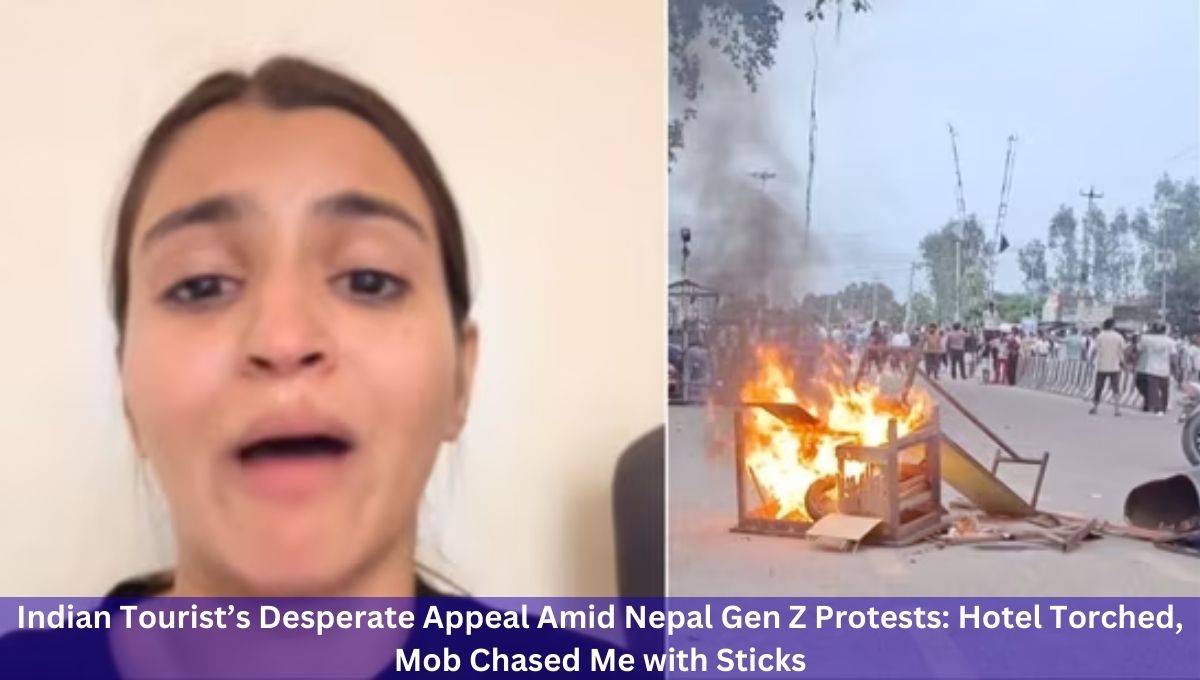
In Nepal, Upasana Gill, an Indian Tourist’s Desperate Appeal Amid Nepal Gen Z Protests: Hotel Torched, Mob Chased Me with Sticks. A chilling video from Nepal’s Pokhara city has gone viral, showing an Indian tourist, Upasana Gill, appealing to the Indian government for urgent help after her hotel was set on fire during the Gen Z protests. Gill, who had travelled to Nepal to host a volleyball league, said she narrowly escaped when mobs carrying sticks chased her.
The dramatic incident highlights the dangerous escalation of Nepal’s youth-led protests that began as a response to a social media ban but quickly spiralled into one of the country’s most intense political uprisings in decades.
Indian Tourist’s Desperate Appeal Amid Nepal Gen Z Protests: Hotel Torched, Mob Chased Me with Sticks
Indian Tourist’s Plea from Pokhara
In her video message, Upasana Gill described the terrifying ordeal as protesters torched her hotel, leaving her and other Indian nationals stranded.
“My name is Upasana Gill, and I request the Indian embassy to please help us. I am stranded here in Pokhara. The hotel where I was staying has been burned down. All my belongings were in my room. I barely managed to escape with my life when people were running behind me with very large sticks,” Gill said.
She added that protesters did not spare even tourists and set fires indiscriminately.
“They don’t care if someone is a tourist. They are setting fires everywhere without thinking. The situation has become very, very bad here. Please deliver this message to the Indian embassy,” she pleaded.
Background: Nepal’s Gen Z Movement
The protests, initially against the government’s ban on 26 social media platforms including Facebook, WhatsApp, Instagram, and YouTube, expanded into a nationwide revolt against corruption and inequality.
The turning point came on September 8, 2025, when police opened fire on peaceful demonstrators, killing 19 people, mostly school and college students. Over 500 were injured.
The killings sparked outrage, with young people defying curfews, storming government buildings, and torching the homes of political leaders.
On September 9, Prime Minister KP Sharma Oli resigned, bowing to pressure after ministers in his Cabinet also stepped down.
Also Read: Nepal’s Gen Z protests are a call for democratic renewal
Indian Embassy Issues Advisory
Following Gill’s video, the Indian Embassy in Kathmandu issued an urgent advisory, asking nationals to defer all travel to Nepal until the situation stabilises.
The embassy shared emergency helpline numbers:
- 📞 +977-9808602881 (WhatsApp enabled)
- 📞 +977-9810326134 (WhatsApp enabled)
The Ministry of External Affairs (MEA) in New Delhi echoed the advisory, urging Indians currently in Nepal to shelter indoors, avoid unnecessary movement, and stay alert.
“Indian citizens presently in Nepal are advised to shelter in their current places of residence, avoid going out onto the streets and exercise all due caution,” the MEA said.
Indian Tourists Rush Back Home
At the India-Nepal border in Sonauli (Uttar Pradesh), hundreds of Indian tourists were seen returning early from their Nepal trips.
- Pramila Saxena, who planned to visit Kathmandu’s Pashupatinath Temple with a group of 60 senior citizens, said:
“Our flight was cancelled. The situation is tense, so we are returning.”
- Another tourist, Ashok, described how his group was stranded overnight:
“We were going to Kathmandu, but the flight was cancelled. We stayed in a lodge overnight and now we are returning home.”
Uttar Pradesh on High Alert
With unrest spilling across the border, Uttar Pradesh Chief Minister Yogi Adityanath ordered police in border districts adjoining Nepal to remain on 24×7 high alert.
Additional forces were deployed, with surveillance and patrolling intensified to prevent any spillover violence.
Helpline numbers were also issued for Indians stuck in Nepal:
- 📞 0522-2390257
- 📞 0522-2724010
- 📞 9454401674 (WhatsApp enabled)
The UP Police said it was “fully committed to maintaining law and order in the state and providing all possible help to Indian citizens trapped in Nepal.”
Nepal’s Political Crisis
The Gen Z protests are being described as the most significant youth movement in Nepal’s history.
- On September 8 night, 19 young lives were lost when security forces opened fire.
- By September 9 afternoon, PM KP Sharma Oli resigned amid mounting anger.
- The Army stepped in as the only effective institution, with Army chief Ashok Raj Sigdel appealing for dialogue.
Despite lifting the social media ban late Monday night, the damage had been done. Protesters accused the government of decades of corruption, elite privilege, and ignoring the aspirations of Nepal’s youth.
Curfews and Shutdowns
Authorities imposed strict curfews in Kathmandu, Lalitpur, and Bhaktapur.
The Kathmandu District Administration announced restrictions within the Ring Road area, covering key locations such as:
- Balkumari Bridge
- Koteshwar
- Sinamangal
- Gaushala
- Chabahil
- Gongabu
- Kalanki
- Balkhu
Flights at Tribhuvan International Airport (TIA) were fully suspended, stranding thousands.
Nepali Celebrities Speak Out
The protests also drew responses from actors and public figures:
- Prajakta Koli, an Indian actress, postponed her planned Nepal visit, writing on Instagram:
“What happened in Nepal yesterday is heartbreaking. Any celebration at such a time feels inappropriate. My heart goes out to the families who suffered.”
- Manisha Koirala, Nepali actress and granddaughter of Nepal’s first prime minister, strongly condemned the violence, calling it a “black day”:
“When bullets respond to the voice of the people, outrage against corruption and demand for justice, it becomes a black day for Nepal.”
She posted images from the protests, including a blood-soaked shoe, to raise awareness.
Symbolic Acts of Defiance
Media reports showed protesters storming the residences of top leaders, including:
- Sher Bahadur Deuba (former prime minister)
- Arzoo Rana Deuba (foreign minister)
Instead of looting, they threw sacks of money into the streets, rejecting them as a symbol of defiance against corruption.
This unexpected symbolism has further fuelled the narrative that Nepal’s youth are rising not just against social media restrictions but against decades of systemic inequality.
Indian Government Response
The MEA and Indian Embassy are coordinating evacuation and safety measures for stranded Indians.
Indian nationals are advised to:
- Stay indoors
- Follow local advisories
- Contact the embassy helplines if stranded
The UP government is also monitoring the situation closely at the India-Nepal border, keeping emergency rooms and control centres operational round-the-clock.
Nepal’s Future at a Crossroads
The Gen Z protests have shown that Nepal’s youth are unwilling to remain silent on corruption, inequality, and lack of opportunities.
But the violent escalation, torching of homes, and attacks on tourists like Upasana Gill reveal the dangerous instability gripping the country.
With Prime Minister Oli gone, the Army stepping in, and curfews continuing, Nepal now faces a critical turning point.
Will dialogue prevail, or will violence deepen the crisis?
For now, stranded foreigners including Indians are anxiously waiting for safe passage home.
Conclusion
The video of Indian tourist Upasana Gill is a chilling reminder of how fast a protest can spiral into violence. What began as a demand for social media freedom has evolved into a youth-led revolution against corruption and governance failures in Nepal.
As Oli’s resignation leaves a power vacuum and the Army assumes control, the safety of citizens and foreign nationals remains the most urgent priority. India has already raised its alert levels, but for many like Gill, the fear and uncertainty remain real until they can return home safely.
Related Posts:
- Nepal Gen Z Protests Escalate: 112 Indian Tourists…

- Worried Migrants Head Home from India as Nepal’s Gen…

- Kathmandu Airport Reopens after Nepal Gen Z Protests…

- Nepal Lifts Social Media Ban Amid Youth Protests,…

- Bangladesh Bans Sheikh Hasina’s Awami League Under…
- Nepal Blocks Facebook, Instagram, YouTube and X: Ban…
