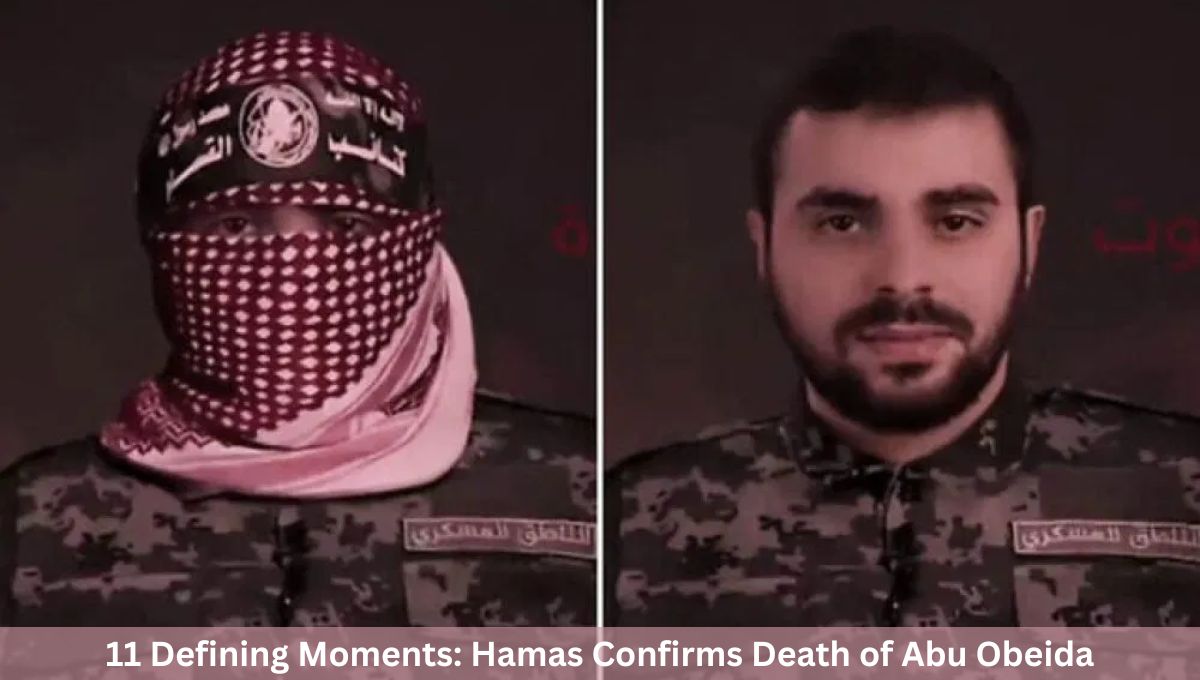
11 Defining Moments: Hamas Confirms Death of Abu Obeida, senior leaders in Gaza war. Hamas’s armed wing, the Ezzedine al-Qassam Brigades, has officially confirmed the death of its longtime masked spokesman, known as Abu Obeida, alongside several other senior commanders killed during Israel’s war on Gaza.
Thank you for reading this post, don't forget to subscribe!The confirmation, delivered in a video statement released on Monday, marks the first time the Palestinian group has publicly acknowledged the loss of one of its most recognisable and influential figures.
The announcement comes months after Israel said it had killed Abu Obeida in an airstrike, and at a critical political moment as ceasefire negotiations remain fragile and international pressure intensifies on all sides.
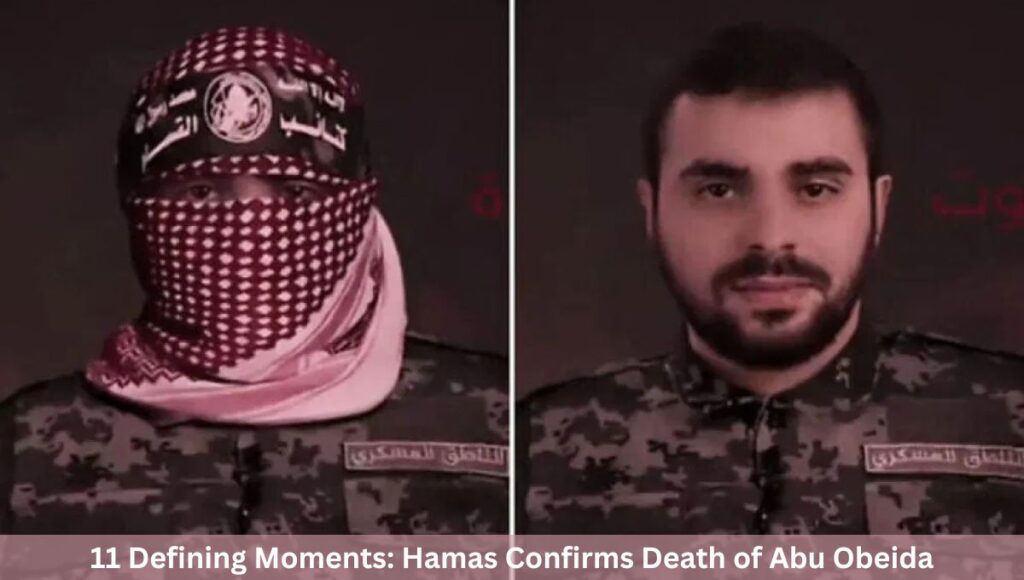
11 Defining Moments: Hamas Confirms Death of Abu Obeida
Official Confirmation After Months of Silence
In a recorded video message, a newly appointed masked spokesman for the al-Qassam Brigades confirmed that Abu Obeida and Mohammed Sinwar, Hamas’s former leader in Gaza, were killed earlier this year during Israeli military operations.
This statement ends months of speculation surrounding Abu Obeida’s fate. Israel had announced in August that it had killed him in an airstrike, but Hamas had neither confirmed nor denied the claim until now.
The new spokesman revealed Abu Obeida’s real identity for the first time, saying his name was Hudhayfah Samir Abdullah al-Kahlout, a detail previously known only to a small inner circle within Hamas.
“We announce with pride the martyrdom of the great leader … Abu Obeida,” the spokesman said, adding that he would inherit the name and role for future statements.
Who Was Abu Obeida?
Abu Obeida was one of the most prominent figures of Hamas’s military wing for nearly two decades. Born in Gaza in 1985 and raised in the Jabalia refugee camp, he joined Hamas at a young age and became affiliated with the al-Qassam Brigades before emerging as its spokesman in the mid-2000s.
He first appeared publicly in 2004, delivering briefings during Israeli military operations. After Israel’s withdrawal from Gaza in 2005, he was officially appointed as the sole spokesman of the brigades.
From that point onward, Abu Obeida became synonymous with Hamas’s military messaging. Appearing almost exclusively in military uniform with his face concealed behind a red keffiyeh, he delivered statements during wars, ceasefires, prisoner exchanges, and escalations with Israel.
For many Palestinians, he embodied what they describe as “resistance.” For Israel, he was seen as a central figure in Hamas’s propaganda and psychological warfare apparatus.
A Voice During War and Ceasefire
During the two-year war on Gaza, Abu Obeida was the primary source of battlefield updates from Hamas’s armed wing.
His statements addressed Israeli military operations, ceasefire violations, and negotiations over captive-for-prisoner exchanges.
His last known statement was delivered in early September, as Israel launched a renewed assault on Gaza City, declaring large parts of the area a combat zone.
At the time, hundreds of residential buildings were destroyed, and mass displacement of Palestinians followed.
Following that message, Abu Obeida disappeared from public view, fueling speculation about whether he had been killed, wounded, or forced into hiding.
Other Senior Hamas Commanders Killed
Alongside Abu Obeida, the al-Qassam Brigades confirmed the deaths of several other high-ranking commanders:
Mohammed Sinwar
Mohammed Sinwar, the younger brother of former Hamas leader Yahya Sinwar, was killed earlier this year. He had succeeded Mohammed Deif as chief of staff of the brigades after Deif’s death.
According to Hamas, Mohammed Sinwar led the armed wing through what it described as a “critically difficult phase” of the war before being killed by Israeli forces.
Mohammed Shabanah
Shabanah served as the head of Hamas’s Rafah Brigade, a key command position in southern Gaza. His death further weakened Hamas’s operational leadership in the area.
Hakam al-Issa and Raed Saad
Both were described as senior leaders within the brigades and were killed in separate Israeli attacks during the war.
These figures join a growing list of Hamas leaders confirmed killed since October 2023, including political chief Ismail Haniyeh, military commander Mohammed Deif, and long-time leader Yahya Sinwar.
Israel’s Claims and Military Strategy
Israel has consistently stated that eliminating Hamas’s leadership is a central objective of its military campaign following the October 7, 2023 attack on southern Israel.
The Israeli military said in May that it had killed Mohammed Sinwar, and later announced that Abu Obeida was killed in an airstrike on August 30.
Israeli officials have described Abu Obeida as a key component of Hamas’s media and propaganda operations.
According to Israel, the strike that killed him was based on intelligence regarding his location. Hamas has not disclosed details about how or where Abu Obeida was killed.
Ceasefire and Political Messaging
In his first statement, the new spokesman for the al-Qassam Brigades addressed the current ceasefire, which has been in place for more than two months.
He said Hamas remains committed to the truce, but accused Israel of repeated violations. At the same time, he firmly rejected calls for the group to disarm.
“Our people are defending themselves and will not give up their weapons as long as the occupation remains,” he said. “We will not surrender, even if we have to fight with our fingernails.”
He called on the international community to pressure Israel to adhere to the ceasefire and warned that Hamas reserves the right to respond to violations.
Ceasefire Death Toll and Humanitarian Impact
According to the Palestinian health ministry, since the ceasefire came into effect in October, at least 414 Palestinians have been killed and more than 1,140 wounded. Additionally, hundreds of bodies have been recovered from rubble and previously inaccessible areas.
Since the start of the war on October 7, 2023, the ministry says the total Palestinian death toll has reached 71,266, with over 171,000 injured.
The ministry does not distinguish between civilians and fighters in its counts but maintains detailed records that are widely considered reliable by international organisations.
Timing Ahead of Trump–Netanyahu Talks
The announcement of Abu Obeida’s death came just hours before a scheduled meeting between U.S. President Donald Trump and Israeli Prime Minister Benjamin Netanyahu in Florida.
The talks are expected to focus on the next phase of the ceasefire agreement, including Israel’s demand that Hamas disarm and that Gaza be demilitarised.
Israeli officials have said disarmament is a non-negotiable condition. Hamas, however, has categorically rejected the demand, calling instead for Israel to be disarmed.
A Symbolic Loss for Hamas
Abu Obeida’s death represents more than the loss of a spokesman. For nearly 20 years, he served as the public face of Hamas’s armed wing, shaping its messaging during some of the most violent episodes in the Israeli-Palestinian conflict.
His masked appearances became iconic across the Arab world, and his speeches were closely followed not only by supporters but also by Israeli officials and international analysts seeking insight into Hamas’s intentions.
“For many years, only a very small circle of Hamas officials knew his true identity,” a Hamas official said, underscoring the secrecy surrounding his role.
Leadership Decapitation and Hamas’s Future
Israel says it has decimated Hamas’s leadership structure, but analysts remain divided on whether these losses will fundamentally weaken the group.
While the deaths of senior leaders disrupt command and control, Hamas has historically demonstrated an ability to regenerate leadership and maintain operational capacity, particularly in asymmetric warfare conditions.
The immediate appointment of a new spokesman adopting Abu Obeida’s name reflects an effort to project continuity and resilience, even as the organisation acknowledges unprecedented losses.
A War That Continues to Reshape Gaza
More than a year after the war began, Gaza remains devastated. Entire neighbourhoods have been flattened, hundreds of thousands displaced, and basic infrastructure severely damaged.
The confirmation of Abu Obeida’s death underscores how deeply the conflict has reshaped Hamas’s leadership and Gaza’s political landscape.
As ceasefire talks continue and international mediation efforts struggle to gain traction, the announcement serves as a reminder that the human, political, and military consequences of the war are still unfolding.
Conclusion
The official confirmation of Abu Obeida’s death closes a long chapter in Hamas’s public narrative, ending the era of one of its most recognisable figures.
At the same time, it opens a new phase marked by leadership turnover, fragile ceasefires, and unresolved political demands.
With negotiations stalled, leadership losses mounting, and the humanitarian crisis deepening, the future of Gaza—and the broader Israel-Hamas conflict—remains uncertain.
Also Read: Israel Confirms Death of Hamas Chief Mohammad Sinwar in Precision Tunnel Strike
Also Read: Hamas reavealing a new Abu Obeida shows it has no intention to disarm, IDF sources say
Related Posts:
- Trump’s 20-Point Gaza Peace Plan Gains Urgent Global…

- 3 Explosive Conditions Iran Sets to End War with US…
- Israel’s Gaza Takeover Plan: What’s Been Achieved…

- 5 Key Developments as Israel Confirms Hamas Handed…

- 7 Powerful Facts About Ayatollah Ali Khamenei’s…
- 5 Major Takeaways from the US Supreme Court's…