

7 Explosive Facts Behind China’s ‘Bizarre’ Claim of Mediating India-Pakistan Tensions following operation sindoor. China has ignited a fresh diplomatic controversy by claiming it mediated the recent military confrontation between India and Pakistan—an assertion New Delhi has firmly rejected.
The claim, made by Chinese Foreign Minister Wang Yi, places Beijing alongside former US President Donald Trump, both of whom have sought credit for de-escalating one of South Asia’s most volatile crises in recent years.
Indian officials and government sources have described China’s assertion as “bizarre,” reiterating that the cessation of hostilities following Operation Sindoor in May 2025 was the outcome of direct military-to-military communication between India and Pakistan, without any third-party involvement.
The episode has once again underlined India’s long-standing position on strategic autonomy, bilateralism, and its categorical rejection of external mediation in matters involving Pakistan.
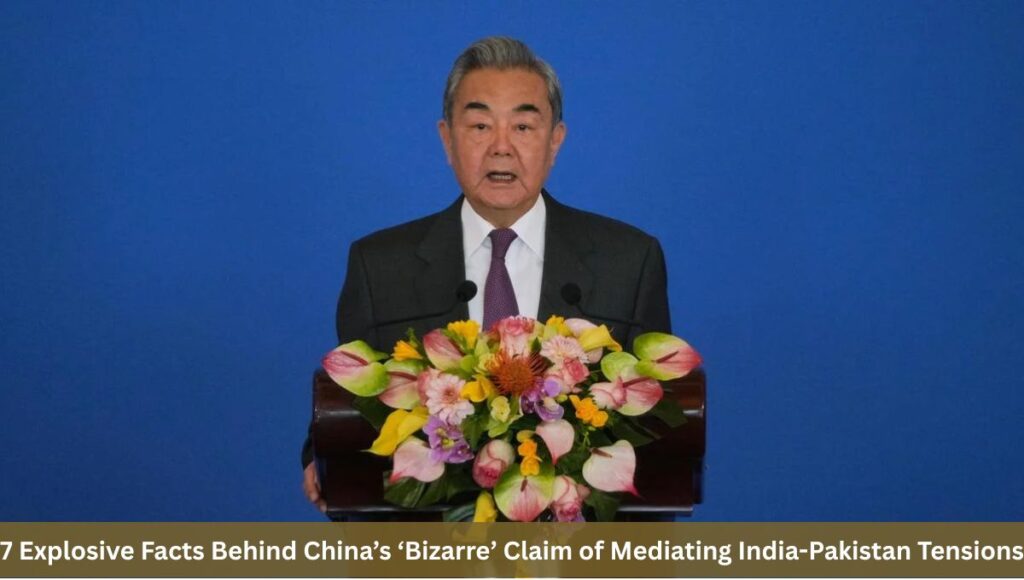
7 Explosive Facts Behind China’s ‘Bizarre’ Claim of Mediating India-Pakistan Tensions
What China Claimed: Wang Yi’s Statement in Beijing
Speaking at the “Symposium on the International Situation and China’s Foreign Relations” in Beijing, Chinese Foreign Minister Wang Yi listed India-Pakistan tensions among several global conflicts that China had allegedly helped “mediate” this year.
“This year, local wars and cross-border conflicts flared up more often than at any time since the end of World War II,” Wang said.
“Following this Chinese approach to settling hotspot issues, we mediated in northern Myanmar, the Iranian nuclear issue, the tensions between Pakistan and India, the issues between Palestine and Israel, and the recent conflict between Cambodia and Thailand.”
The remarks were widely reported by Chinese state media and international news agencies, triggering immediate pushback in New Delhi.
India’s Response: ‘No Role for Any Third Party’
While the Indian government has not issued a fresh official statement specifically addressing Wang Yi’s remarks, multiple senior sources in New Delhi have categorically dismissed China’s claim.
One official familiar with the developments described the assertion as “bizarre”, stressing that Beijing played no role whatsoever in bringing the conflict to an end.
Direct DGMO Talks Ended the Conflict
According to Indian officials:
- The ceasefire was initiated by Pakistan
- The agreement was reached directly between the Directors General of Military Operations (DGMOs) of India and Pakistan
- The understanding was finalised during a phone call on May 10, 2025, at 15:35 hours
- No third country—neither China nor the United States—was involved
The Ministry of External Affairs had already clarified this position during a press briefing on May 13, leaving little room for ambiguity.
“There is no room for third-party intervention in matters relating to India and Pakistan,” government sources reiterated.
Operation Sindoor: Background to the May 2025 Conflict
The four-day military confrontation between India and Pakistan was triggered by a terror attack in the Pahalgam valley of Jammu and Kashmir on April 22, which claimed the lives of 26 civilians, most of them tourists.
India’s Military Response
In retaliation, India launched Operation Sindoor, which involved:
- Precision airstrikes on terror infrastructure
- Targets located in Pakistan and Pakistan-occupied Kashmir (PoK)
- Subsequent strikes on select Pakistani military installations
The operation marked one of India’s most significant cross-border military responses in recent years and sent a strong signal regarding its counter-terror posture.
Escalation and De-Escalation
Pakistan responded by targeting Indian military installations, leading to intense aerial engagements and heightened regional tension.
Indian Air Force strikes reportedly caused substantial damage to Pakistani air bases, altering the strategic balance during the confrontation.
Following these losses, Pakistan’s DGMO reached out to his Indian counterpart, paving the way for the ceasefire.
China’s Role During the Conflict: Support, Not Mediation
China’s claim of mediation has drawn particular scrutiny because of its deep military and strategic ties with Pakistan.
China as Pakistan’s Largest Arms Supplier
According to official data cited by Indian authorities:
- Over 81% of Pakistan’s military hardware is of Chinese origin
- Chinese-supplied systems include combat aircraft, missiles, radars, and air defence equipment
Indian military officials have stated that Beijing used the May conflict as a “live laboratory” to test and showcase the performance of its weapons systems in real combat conditions.
Surveillance and Intelligence Allegations
Several media reports and official assessments have suggested that China provided:
- Real-time surveillance inputs
- Technical and operational assistance
- Strategic support during aerial engagements
These factors make Beijing’s mediation claim particularly contentious in New Delhi.
Diplomatic Posture: China’s Call for ‘Restraint’
On the diplomatic front, China adopted a carefully calibrated position during the conflict.
On May 7, the Chinese Foreign Ministry issued a statement expressing “regret” over India’s airstrikes while calling on both sides to exercise restraint.
“China finds India’s military operation early this morning regrettable. We are concerned about the ongoing situation,” the statement said.
Indian analysts viewed this response as tilted in Pakistan’s favour, further undermining China’s credibility as a neutral mediator.
Echoes of Trump: A Familiar Mediation Claim
China’s assertion has drawn inevitable comparisons with US President Donald Trump, who has repeatedly claimed that Washington played a key role in brokering peace between India and Pakistan during the same period.
Indian officials have rejected Trump’s claims just as firmly, maintaining consistency in their position.
“Perhaps the Chinese side is following in the footsteps of the US,” one New Delhi-based source remarked.
India’s message to both Washington and Beijing has remained unchanged: bilateral issues with Pakistan are not open to external mediation.
India’s Long-Standing Policy on Third-Party Mediation
India’s rejection of external mediation is rooted in decades of diplomatic doctrine.
Key Principles
- Issues with Pakistan are strictly bilateral
- Agreements such as the Simla Agreement reinforce this framework
- Third-party involvement is seen as undermining sovereignty
New Delhi has consistently argued that accepting mediation would legitimize Pakistan’s attempts to internationalize bilateral disputes.
China-India Relations: A Sensitive Backdrop
Wang Yi’s remarks come at a delicate moment in India-China relations, which have only recently begun stabilizing after years of tension along the Line of Actual Control (LAC).
Post-Ladakh Normalisation Efforts
- Military disengagement in eastern Ladakh concluded in October 2024
- Diplomatic channels have since focused on rebuilding trust
- China recently invited Prime Minister Narendra Modi to the Shanghai Cooperation Organisation (SCO) summit in Tianjin
Despite these gestures, Beijing’s mediation claim risks reopening old wounds and complicating normalization efforts.
Disinformation Allegations and Strategic Messaging
China’s role during Operation Sindoor has also been scrutinized internationally.
A report by the US-China Economic and Security Review Commission alleged that Beijing orchestrated a disinformation campaign following the conflict.
Key Allegations
- Use of fake social media accounts
- Circulation of AI-generated images showing fabricated aircraft debris
- Attempts to undermine the reputation of French Rafale fighter jets
- Promotion of Chinese military platforms such as the J-35
China has denied these allegations but has not provided detailed rebuttals.
Why China Is Claiming Mediation Now
Analysts suggest several motivations behind Beijing’s claim:
- Positioning itself as a global peacemaker
- Countering US diplomatic influence
- Enhancing its image among Global South nations
- Deflecting criticism over its military support to Pakistan
However, India’s firm rebuttal has limited the diplomatic impact of the claim.
Conclusion: A Claim India Will Not Accept
China’s assertion that it mediated India-Pakistan tensions following Operation Sindoor has found no acceptance in New Delhi.
Indian officials remain unequivocal:
the May 2025 ceasefire was a direct bilateral military decision, initiated after Pakistan sought de-escalation.
By dismissing Beijing’s remarks as “bizarre,” India has once again reinforced its long-standing opposition to third-party intervention, even as global powers attempt to shape narratives around South Asia’s most enduring rivalry.
As geopolitical competition intensifies, India’s stance sends a clear message—peace with Pakistan, when it comes, will be decided in New Delhi and Islamabad, not Beijing or Washington.
Also Read: Trump Repeats Claim He Mediated India-Pakistan Ceasefire Amid Denials from New Delhi
Also Read: ‘Ceasefire was bilateral’: India dismisses China’s bizarre mediation claim on Pakistan standoff
Related Posts:
- 7 Big Takeaways: Macron’s High-Stakes China Visit…

- 7 Heartbreaking Facts About Venezuela's Earthquake Disaster

- China Hosts SCO Summit 2025 and Military Parade as…
- 7 Powerful Facts About Ayatollah Ali Khamenei’s…
- 3 Explosive Conditions Iran Sets to End War with US…
- In 8 Moves, EU Targets China-Linked Refineries and…
