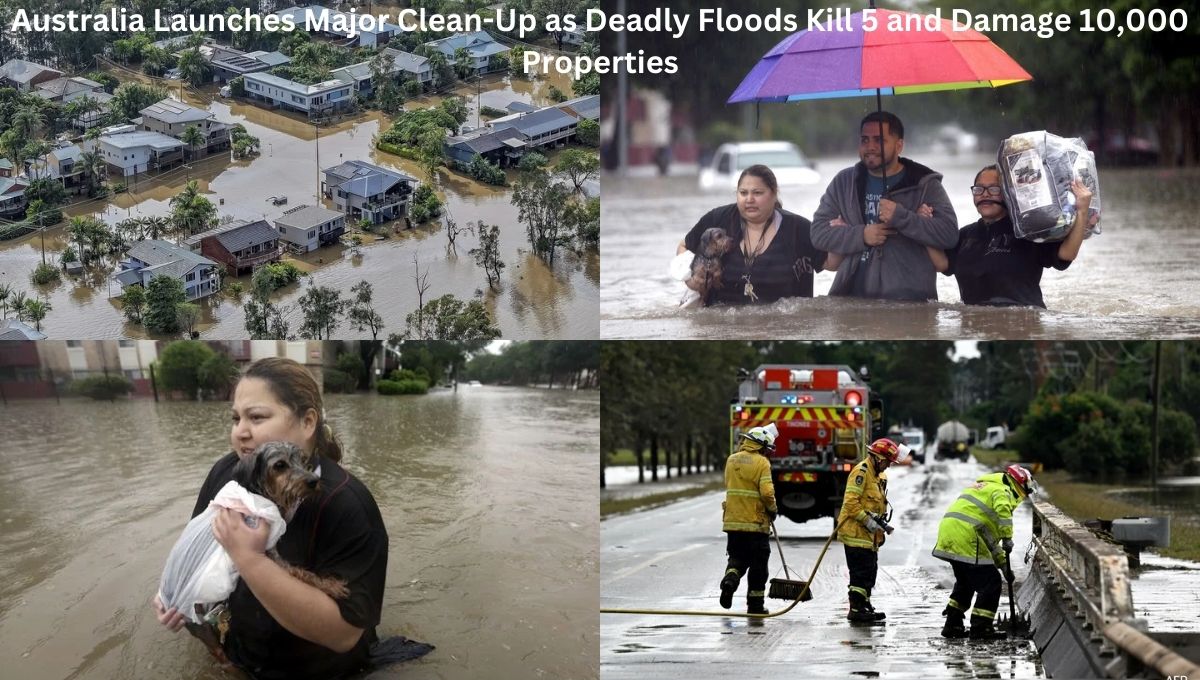
Following devastating floods Australia Launches Major Clean-Up as Deadly Floods Kill 5 and Damage 10,000 Properties. Australia has begun a massive clean-up operation in the eastern state of New South Wales (NSW) that claimed five lives, stranded tens of thousands, and damaged over 10,000 properties.
As floodwaters slowly recede, emergency services are racing to reach isolated communities and assess the scale of destruction caused by one of the worst flood events in recent years.
Australia Launches Major Clean-Up as Deadly Floods Kill 5 and Damage 10,000 Properties
A Catastrophic Weather Event
The torrential rains, described as a record-breaking weather event, dumped months’ worth of rainfall over just three days, particularly affecting the mid-north coast region of New South Wales.
Entire towns were cut off, livestock was swept away, homes were inundated, and roads submerged. The death toll stands at five, with the most recent casualty being a man in his 80s found near Taree, one of the hardest-hit towns.
Prime Minister Anthony Albanese expressed deep sorrow over the lives lost and reiterated the government’s commitment to recovery efforts. “It’s awful to hear the news of more loss of life.
We’re working closely with federal, state, and local governments to ensure Australians get the support they need,” he said in a post on X.
Thousands Isolated and Displaced
At the peak of the disaster, around 50,000 people were isolated due to the fast-rising floodwaters. Despite improving conditions, thousands remain cut off, and hundreds are still in evacuation centers, according to the NSW State Emergency Services (SES).
“We will continue to resupply those isolated residents by land, water, and air,” said SES Chief Superintendent Paul McQueen, urging people not to venture into floodwaters or go sightseeing in affected areas.
As of Saturday, more than 600 rescues had been carried out in the previous 72 hours, with 52 rescues made overnight alone. Officials warn that stagnant water poses serious health risks, including the presence of contaminants, vermin, and snakes.
Clean-Up Operation Underway
With waters beginning to recede, the focus has shifted to a massive recovery and clean-up mission. Emergency service teams from across Australia have been drafted in to assist, with nearly 200 additional personnel supporting damage assessments and flood relief efforts.
“So far, 480 properties have been assessed, many with significant damage, some uninhabitable,” said Allison Flaxman, Acting Assistant Commissioner of NSW SES. Drones have been used to deliver essential medicine and supplies to cut-off towns.
The NSW Premier, Chris Minns, praised emergency workers for their heroism. “We would have had hundreds of deaths if it wasn’t for the bravery and courage of our emergency services over the last 72 hours,” he said.
Ongoing Risks and Weather Concerns
While rain has eased, challenges remain. The Bureau of Meteorology warns of high winds and ocean swells in the coming days, which could lead to local inundation around high tides in low-lying coastal areas.
Emergency warnings still remain in effect for northern NSW, and residents are urged to stay alert. Train services, including those to Sydney Airport, were disrupted due to flooded tracks, and two of the airport’s three runways were closed temporarily on Friday morning, delaying numerous flights.
Climate Change and Repeated Disasters
Australia has been increasingly vulnerable to extreme weather events, a phenomenon scientists link to climate change. Following years of drought and devastating bushfires, the country has experienced frequent flooding since 2021, severely impacting the same communities repeatedly.
“What once were rare downpours are now becoming the new normal climate change is rewriting Australia’s weather patterns,” said Davide Faranda, a weather researcher at ClimaMeter.
Andrew Hall, CEO of the Insurance Council of Australia, stressed the urgent need for flood-resilient infrastructure. “Flood events are hitting the same places again and again. We need to break that cycle,” he told the Australian Broadcasting Corporation.
He also highlighted a growing concern around underinsurance, particularly among households already struggling with cost-of-living pressures.
Government Support and Next Steps
Prime Minister Albanese is expected to visit Taree in the coming days, after being forced to cancel a prior trip due to dangerous conditions. “We’re here to say, very clearly, you’re not alone,” he said during a visit to Maitland in the Hunter region.
The government has pledged continued assistance throughout the clean-up and recovery period, including financial aid, temporary housing, and mental health support for affected residents.
Emergency services continue to urge caution, reminding Australians not to drive through floodwaters and to report any hazards such as damaged power lines or contaminated water.
Conclusion
As the waters recede, Australia is once again confronted with the harsh reality of increasingly destructive natural disasters. The current New South Wales flooding has tested the nation’s emergency response systems and underscored the pressing need for climate resilience and better infrastructure planning.
With thousands still recovering and a long road ahead, community solidarity and coordinated government action will be critical in the weeks and months to come.
Also Read: Anthony Albanese Secures Historic Second Term as Australia Rejects Trump-Style Politics
Also Read: Federal government announces roadmap to clean up transport sector