Gaza’s Grief: 112 Victims Finally Laid to Rest in Historic Mass Funeral nearly three years after an Israeli strike. Nearly three years after their homes were reduced to rubble in a single night, 112 members of two extended Gaza City families were finally laid to rest this week — closing one of the longest and most painful chapters of grief to emerge from the Israel-Hamas war.
Thousands of mourners gathered on Tuesday in Gaza City to bury the remains of members of the Abu Sharia and al-Hassayna families, recovered after a grueling, months-long excavation of the site where an Israeli strike destroyed a residential compound in November 2023.
Gaza’s Civil Defense agency described it as one of the largest, and possibly the single largest, mass funeral held in Palestinian history.
Gaza’s Grief: 112 Victims Finally Laid to Rest in Historic Mass Funeral
What Happened in Sabra in November 2023
The tragedy traces back to November 22, 2023, roughly six weeks into the war that began after Hamas’s October 7, 2023, attack on Israel, in which around 1,200 people were killed and some 250 others were taken hostage.
According to Gaza’s Hamas-run Civil Defense agency, Israeli warplanes struck a cluster of residential buildings in the Sabra neighborhood of southern Gaza City while residents slept, collapsing the structures onto the extended Abu Sharia and al-Hassayna clans.
Palestinian officials say the strike killed roughly 300 members of the two families combined, including dozens of children, women, and several people with disabilities.
Around half of the victims were pulled from the wreckage in the chaotic days immediately following the attack, using little more than rough tools and bare hands.
The rest remained entombed beneath the rubble for nearly three years.
The Israeli military has said that during that period of the war it struck roughly 300 targets across Gaza, but it has not specifically confirmed the Sabra strike or the reported death toll tied to it.
A 136-Hour Recovery Operation
What changed this summer was a dedicated recovery effort launched by Gaza’s Civil Defense on July 14.
Crews spent an estimated 136 hours digging through the collapsed buildings, ultimately recovering 112 sets of remains.
Officials say around 157 people from the original attack are still believed to be missing, either still buried beneath the rubble or otherwise unaccounted for.
Civil Defense spokesperson Mahmoud Basal said the work has been agonizingly slow due to a severe shortage of heavy machinery in Gaza.
He said that with roughly ten excavators, bulldozers, and cranes, crews could likely finish clearing the remaining sites within three months — equipment that, for now, remains largely out of reach.
Identifying the Dead
Because most of the remains had decomposed to skeletal fragments after nearly three years underground, identifying individual victims required a painstaking combination of forensic work and family memory.
Basal said relatives helped identify loved ones through clothing, old injuries, distinguishing marks, and personal items such as jewelry or engraved necklaces, while some victims were identified through surgical hardware like bone fixation plates.
Scenes From the Funeral
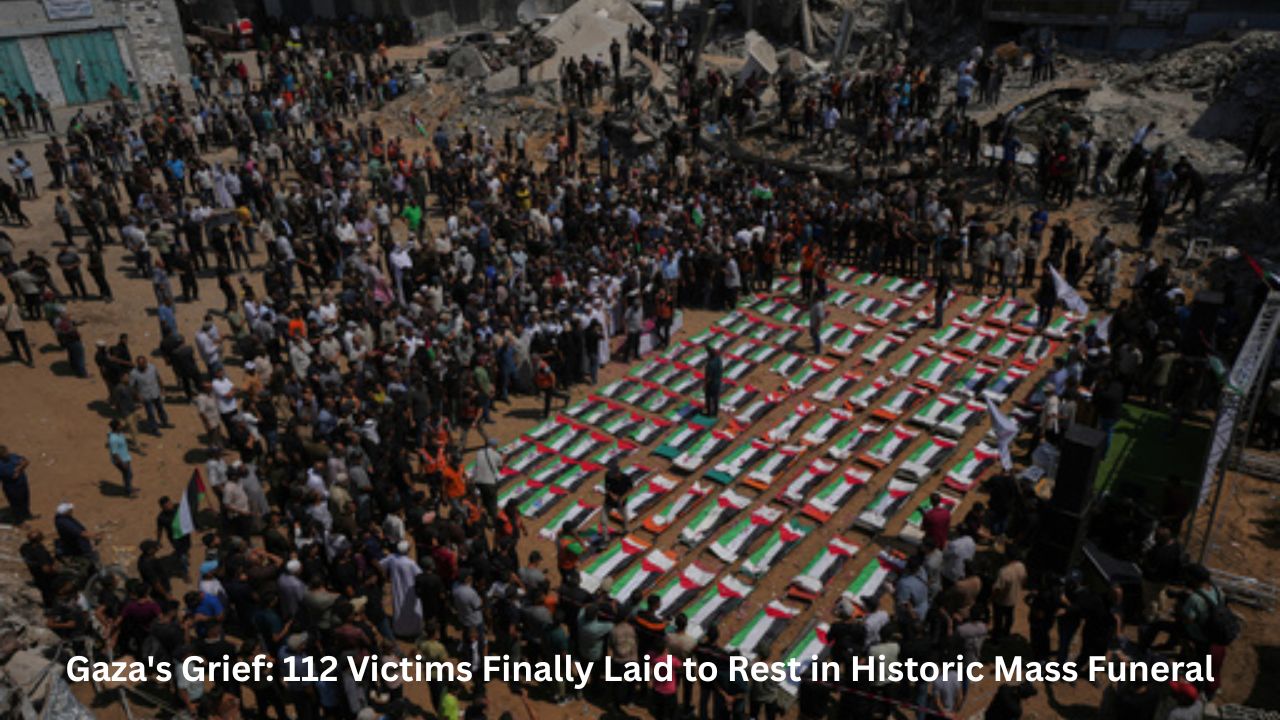
Rows of stretchers bearing the remains, each wrapped in a Palestinian flag, were laid out near the ruins of the destroyed homes before the funeral began.
Photographs of the dead were pinned to some of the bundles, and large banners bearing portraits of the youngest victims stood as a backdrop to the ceremony.
Witnesses described mourners scattering bougainvillea petals over the remains as women and children looked on from the tops of partially collapsed buildings nearby.
After funeral prayers, the bodies were carried through narrow streets on stretchers and buried together in a cemetery in Gaza City’s Zeitoun neighborhood.
Basal, addressing the crowd, is reported to have asked why so many children and women in Gaza have died over the course of the war — a question that echoed the raw grief of a community that has now spent nearly three years searching for its dead.
One relative of the victims, Taysir Al-Hassayna, told reporters the day had reopened old wounds even as it offered some closure, saying his family took comfort in believing their loved ones died as martyrs.
Palestinian researchers and rights advocates who attended or followed the funeral described it as a moment that captured the broader scale of loss across Gaza.
Several described the procession as turning years of casualty statistics into something tangible — rows of coffins that finally gave shape to numbers that had, for a long time, existed only on paper.
For families who had spent years unsure whether their relatives would ever be recovered at all, the funeral offered a rare, if painful, sense of resolution.
Hundreds Still Missing Beneath the Rubble
Tuesday’s funeral, while historic in scale, is far from the end of Gaza’s recovery effort.
Palestinian rights groups estimate that roughly 200 additional members of the Abu Sharia family alone may still be buried at the Sabra site, with many remains likely too decomposed to ever be fully identified.
Separately, Gaza health ministry officials have said that around 7,400 people across the territory remain missing and presumed buried beneath rubble from the broader war.
The Assembly of Palestinian Clans and Families used the occasion to call on the international, US-backed Board of Peace overseeing Gaza’s reconstruction to speed up efforts to recover the remaining bodies, clear debris, and support rebuilding — noting that while this particular burial may have ended one family’s long wait, thousands of others are still searching.
A Fragile Ceasefire and a Push for Peace
The mass funeral took place against the backdrop of a tense, still-unfolding ceasefire.
A truce was reached in October under a broader peace framework championed by US President Donald Trump, which calls for Hamas to disarm in exchange for a phased Israeli withdrawal from the territory.
That second phase has proven difficult to implement, with negotiations continuing between Israeli officials, the Board of Peace’s regional envoy, Nickolay Mladenov, and mediators including Qatar.
Israeli security sources said this week that the military has tightened internal approval requirements for strikes in Gaza, with “targeted elimination” operations now reportedly requiring sign-off from the IDF’s chief of staff rather than lower-ranking regional commanders — a shift that came after the Board of Peace’s envoy raised concerns over recent strikes.
Qatari officials have publicly accused Israel of slow-walking the deal’s implementation, while Israeli leaders maintain that Hamas has yet to fully disarm as the agreement requires.
The Toll of the Wider War
Gaza’s Hamas-run health ministry, which does not distinguish between combatant and civilian deaths, puts the overall death toll since the war began in October 2023 at more than 73,000 people.
Israeli military officials have said they believe that overall figure is largely accurate, while estimating that two to three civilians have been killed for every combatant.
Independent estimates suggest a large share of the dead are women and children, and Gaza’s infrastructure — hospitals, homes, water systems, and roads — has sustained extensive damage over the course of the conflict.
Why This Story Resonates Globally
For audiences far from the Middle East, Tuesday’s funeral is a stark reminder of how wars leave wounds that persist long after the fighting quiets down.
Recovery efforts like the one in Sabra — slow, under-resourced, and emotionally devastating for the families involved — echo similar post-conflict searches for the missing in places like the Balkans, Rwanda, and Syria, where identifying and burying the dead has often taken years or even decades.
As the world watches the Gaza ceasefire’s uncertain next phase play out, this funeral is a reminder that the human cost of the conflict is still being counted, family by family, name by name.
It also highlights a challenge facing post-conflict zones worldwide: the shortage of heavy machinery, forensic resources, and trained personnel needed to recover and identify the dead with dignity.
International aid organizations have repeatedly flagged the lack of excavation equipment in Gaza as a major obstacle to closing out these recovery operations, a logistical gap that has real, lasting consequences for grieving families waiting for answers.
Conclusion
Tuesday’s mass funeral in Gaza City brought a measure of closure to two extended families who spent nearly three years not knowing exactly where, or how, their loved ones’ remains lay.
But with roughly 157 people from the Sabra strike alone still unaccounted for, and thousands more missing across the wider territory, the burial of 112 people marks a milestone rather than an ending.
As reconstruction efforts continue and the fragile ceasefire between Israel and Hamas moves through its difficult next phase, families across Gaza are still waiting — for equipment, for answers, and for the chance to finally bury their own dead.
Also Read: 2,596 Arms Shipments: Shocking Amnesty Report Ties India to Israel’s Gaza War
Also Read: 40 children among 112 war victims laid to rest in Gaza after more than 2 years under rubble
Related Posts:
- Afghan Women Left to Die After Earthquake as…

- 7 Powerful Facts About Ayatollah Ali Khamenei’s…
- 7 Heartbreaking Facts About Venezuela's Earthquake Disaster
- 7 Powerful Facts About Iran's Historic Khamenei…
- 5 Key Developments as Israel Confirms Hamas Handed…

- Trump's Dramatic Day: Zelensky and Netanyahu Both…