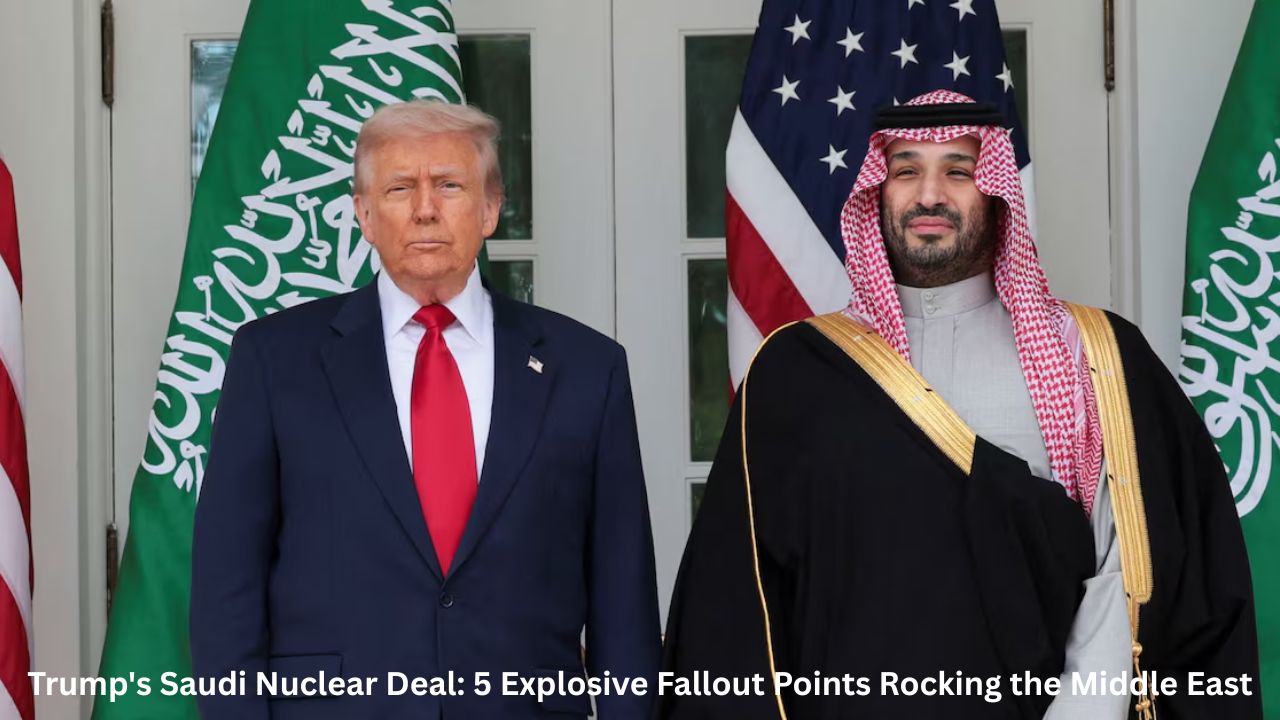
Trump’s Saudi Nuclear Deal: 5 Explosive Fallout Points Rocking the Middle East as Netanyahu, a U.S. Senator, and Iran voice concerns. It took less than 24 hours for one of the biggest energy agreements in Middle East history to turn into one of its messiest diplomatic puzzles. Days ago, Washington and Riyadh signed a landmark civilian nuclear cooperation pact.
Then, before the ink had properly dried, President Donald Trump added a condition nobody saw coming:
Saudi Arabia would have to normalize relations with Israel first.
The result is a geopolitical tangle involving a wary Israeli prime minister, a skeptical US senator, an unusually blunt UN ambassador, and a kingdom that has not said a word publicly.
All of it is unfolding against the backdrop of a grinding, five-month-old US-Iran conflict that shows no sign of winding down.
Here is what is actually in the deal, why it has so many people nervous, and where things go from here.
Trump’s Saudi Nuclear Deal: 5 Explosive Fallout Points Rocking the Middle East
What’s Actually in the US-Saudi Nuclear Agreement
The core of the story is a 30-year civilian nuclear cooperation agreement, often referred to as a “123 agreement” after the section of the US Atomic Energy Act that governs how America shares nuclear technology with other countries.
It was signed alongside a separate bilateral safeguards agreement by US Energy Secretary Chris Wright and his Saudi counterpart, Prince Abdulaziz bin Salman.
On paper, the pact is about energy, not weapons.
The US Department of Energy has framed it as a way to give American firms priority access to build out Saudi Arabia’s nuclear power sector, a market that could be worth tens of billions of dollars over the coming decades.
Saudi Arabia already has an ambitious civilian nuclear roadmap, reportedly aiming for as many as 16 reactors and roughly 17 gigawatts of capacity by 2040, and Washington wants American companies, not Russian or French ones, building that pipeline.
Like any deal of this size, it does not take effect automatically.
The agreement now heads to the US Congress, which has 90 session days to review it and could object, though overriding a presidential veto would require a two-thirds majority in both chambers.
Trump’s Last-Minute Curveball: The Abraham Accords Condition
Here is where things get complicated. A day after the agreement was formally signed, Trump posted on social media that the deal was “totally subject” to Saudi Arabia joining the Abraham Accords, the framework his first administration used in 2020 to normalize relations between Israel and several Arab states, including the UAE and Bahrain.
He also added a specific line about the nuclear side of things: “There will be no enrichment of material!”
White House press secretary Karoline Leavitt backed up the president’s position, telling reporters the agreement is “off” unless Riyadh normalizes ties with Israel.
She noted that Trump had not personally spoken with Saudi Crown Prince Mohammed bin Salman since posting the condition, though the topic had come up in earlier conversations between the two leaders.
That is a significant ask. Saudi Arabia has, for years, tied any recognition of Israel to a credible pathway toward Palestinian statehood, a position Crown Prince Mohammed bin Salman has reiterated publicly more than once.
As of now, Riyadh has not issued a formal response to Trump’s new condition, leaving the entire arrangement in a kind of diplomatic limbo.
Netanyahu’s Cautious Welcome
Israeli Prime Minister Benjamin Netanyahu, for his part, seemed pleased that Trump had linked the nuclear deal to normalization, something Israel has pushed for since the original Abraham Accords were signed.
Speaking to Fox News, he praised the move but was careful to draw a hard line around the word “civilian.”
He said the last thing Israel wants, and presumably the last thing Trump wants either, is a military nuclear program taking shape in Saudi Arabia.
It is a telling comment. Israel is widely believed to be the only nuclear-armed state in the Middle East, though it has never officially confirmed this, and maintaining that position has long been a quiet but firm pillar of Israeli foreign policy.
Israeli officials have reportedly gone further behind closed doors, pushing for Saudi Arabia to commit explicitly to never enriching uranium on its own soil, a demand that goes beyond what the current agreement is said to require.
Why the Timing Has Senators Worried
Not everyone in Washington is comfortable with how this is unfolding, and the criticism is not coming only from Democrats.
Republican Senator John Kennedy of Louisiana used a Sunday appearance on CBS’s Face the Nation to voice his own doubts about the deal, less about its substance and more about its timing.
Kennedy pointed out the awkward optics of the moment: the United States is currently engaged in active hostilities with Iran partly over concerns about its nuclear ambitions, while simultaneously signing a nuclear cooperation agreement with another regional power.
“It’s just not good timing,” he said, describing global tensions as being at the point where “the world’s on a hair trigger.”
To be clear, Kennedy said his objection was not to civilian nuclear cooperation in principle, and he continued to back Trump’s broader approach to Iran, including sustained economic and military pressure, while stopping short of endorsing a full ground war.
Meanwhile, UN Ambassador Mike Waltz offered a more reassuring picture on Fox News Sunday, describing the agreement as establishing a basic framework, with negotiations still underway to iron out the details.
He characterized the deal as strictly civilian, said it would mark the first US sale of nuclear reactor technology to Saudi Arabia in decades, and insisted Riyadh has agreed to full international inspections with no export of enrichment capability from the American side.
The Enrichment Question Nobody Has Fully Answered
That reassurance runs into a genuine ambiguity at the heart of the deal. Unlike the 2009 US-UAE nuclear agreement, often called the “gold standard” because the UAE agreed to permanently forgo uranium enrichment and spent fuel reprocessing, the Saudi arrangement reportedly leaves the door open to future enrichment, subject to a joint US-Saudi review down the line rather than a hard ban.
Some analysts have also flagged that the deal, as described, relies on bilateral oversight rather than requiring Saudi Arabia to adopt the International Atomic Energy Agency’s Additional Protocol, which allows for more intensive facility inspections.
Critics point to an uncomfortable historical precedent: a similar bilateral, rather than fully multilateral, arrangement with North Korea in the 1990s ultimately failed to stop that country from covertly pursuing a uranium enrichment path using outside technology.
Whether Saudi Arabia’s case plays out differently will depend heavily on details Washington has not yet made fully public.
Unsurprisingly, Iran has seized on the apparent double standard, with state media noting the irony of the US promoting a Saudi nuclear buildup while striking Iranian nuclear facilities.
Analysts have also warned that if Saudi Arabia eventually secures enrichment rights, regional rivals like Turkey and Egypt could push for similar arrangements, reviving old fears of a broader Middle East nuclear race.
A Region Already on Edge
None of this is happening in a vacuum. The US and Iran have been locked in an escalating conflict since late February, when a series of American and Israeli strikes hit Iranian missile, drone, and naval sites.
A ceasefire reached in June, along with a related understanding over the Strait of Hormuz, collapsed within weeks amid mutual accusations, reigniting attacks on shipping, Houthi strikes in the Red Sea, and strikes on Saudi Aramco facilities.
More than a dozen American service members have reportedly been killed since fighting resumed.
According to a Wall Street Journal report, Trump has grown increasingly frustrated with the lack of a clean resolution, with a senior administration official describing him as having entered a “revenge mode” footing against Tehran, driven by a belief that Iran only responds to military pressure.
The US has been surging additional forces, medics, and weaponry into the region, and Trump has reportedly floated striking suspected buried enrichment sites.
Some advisers, including Jared Kushner, are said to still be pushing for renewed diplomacy, though the prevailing mood inside the administration currently favors continued pressure.
It is against this tense backdrop that the Saudi nuclear announcement landed, which helps explain why it has generated so much scrutiny rather than being treated as a routine energy story.
What Happens Next
Three things will determine where this goes.
First, Congress now has its 90-session-day review window to scrutinize the agreement, and while a veto override looks unlikely given thin Republican margins, the debate itself could shape public perception of the deal for months.
Second, Saudi Arabia has to decide whether it is willing to trade its long-standing position on Palestinian statehood for a nuclear partnership with Washington, a decision Crown Prince Mohammed bin Salman has given no public indication of making anytime soon.
Third, and perhaps most consequentially, the unresolved question of uranium enrichment will need to be nailed down in the fine print, since that detail alone could determine whether this deal is remembered as a milestone in nuclear energy diplomacy or as the moment the Middle East’s fragile nuclear balance started to tip.
Conclusion
What began as an energy partnership has turned into a stress test for American diplomacy in one of the world’s most volatile regions.
Trump’s decision to tie a nuclear deal to Israeli normalization has pleased Netanyahu, unsettled a member of his own party, and handed Iran a fresh talking point, all while the war with Tehran grinds on with no resolution in sight.
Saudi Arabia’s silence may be the most telling detail of all: Riyadh knows that whatever it decides next will echo far beyond its own borders.
For now, the deal sits in a holding pattern, watched closely by allies and rivals alike, with its final shape likely to say as much about the future of Middle East security as it does about who builds the kingdom’s next reactor.
Also Read: Trump Floats $30 Billion Civil Nuclear Deal to Iran Amid Ceasefire
Also Read: What We Know About the U.S.-Saudi Nuclear Deal
Related Posts:
- Trump’s 2025 Gaza Peace Plan Signing and Historic…

- 5 Powerful Highlights as Trump Lands Second Nobel…

- Pakistan-Saudi Arabia Defense Pact: Nuclear Umbrella…

- 7 Powerful Ways the US–Saudi $1 Trillion Partnership…
- 11 Explosive Warnings as Trump Vows to ‘Knock the…

- 11 Explosive Revelations From Ted Cruz’s Leaked…