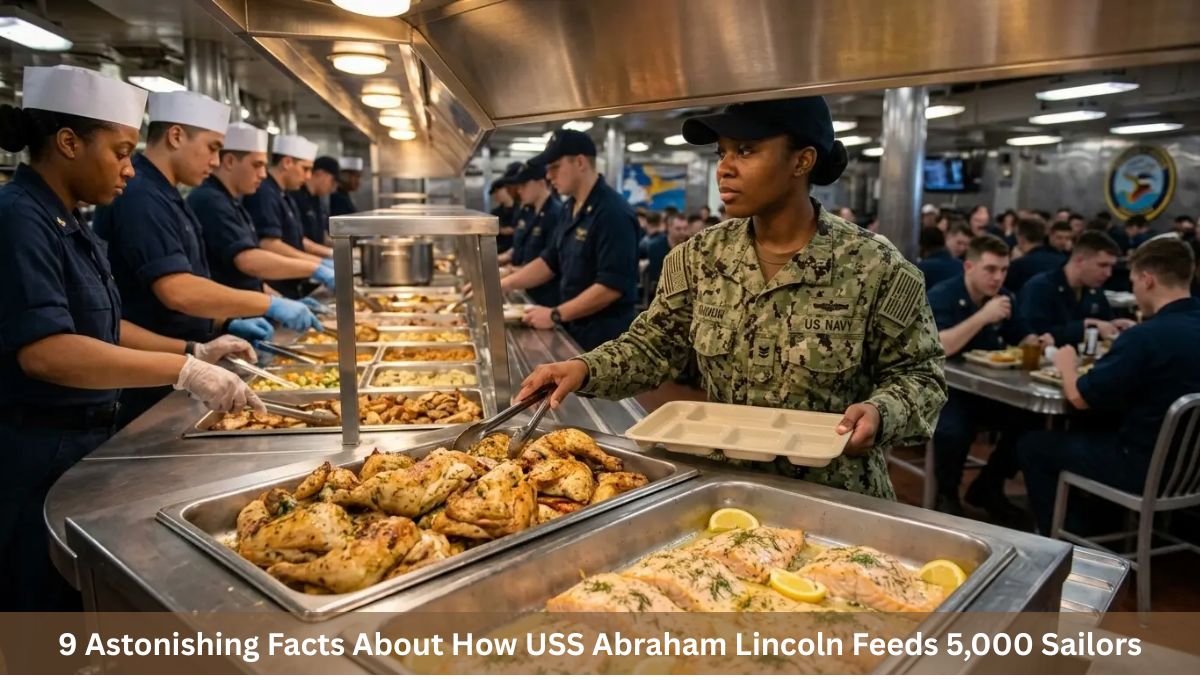
9 Astonishing Facts About How USS Abraham Lincoln Feeds 5,000 Sailors with precision logistics at sea. Feeding a small town is a logistical challenge. Feeding one in the middle of the ocean—without access to supermarkets, farms, or steady supply lines—is something else entirely.
That’s exactly what happens every day aboard the USS Abraham Lincoln, one of the United States Navy’s most powerful aircraft carriers.
Carrying over 5,000 personnel, this nuclear-powered vessel operates like a fully self-sustaining city.
And at the heart of its daily operations lies one of the most impressive large-scale food systems in the world.
From serving over 18,000 meals daily to managing millions of dollars in food logistics each month, the ship’s culinary operation is a masterclass in precision, planning, and endurance.
9 Astonishing Facts About How USS Abraham Lincoln Feeds 5,000 Sailors
The 100,000-Tonne Floating City
A Self-Sustaining Giant
The USS Abraham Lincoln (CVN-72) is a Nimitz-class nuclear-powered aircraft carrier displacing more than 104,000 tonnes.
Designed for long deployments, it can operate for months without returning to port. But while its nuclear reactors power the ship, it’s food that powers the crew.
A Population at Sea
With approximately 5,000 to 5,600 sailors and aircrew onboard, the carrier functions like a dense urban environment.
It includes sleeping quarters, medical facilities, workspaces—and multiple large dining halls known as galleys.
Feeding this population is not just about survival. It’s about maintaining morale, energy, and operational readiness in high-pressure environments.
1. 18,000 Meals Every Single Day
Around-the-Clock Food Production
Every 24 hours, the ship’s culinary specialists prepare between 17,000 and 18,000 meals.
That includes breakfast, lunch, dinner, and an essential fourth meal—“midrats,” or midnight rations.
Meals are served continuously to match the ship’s non-stop operations. Whether it’s a pilot returning from a mission or a technician starting a night shift, hot food is always available.
Precision and Coordination
This massive output requires tight coordination between chefs, supply officers, and logistics teams.
Timing is critical, especially when feeding thousands of people working on rotating schedules.
2. Massive Daily Food Consumption
By the Numbers
The scale of daily consumption aboard the USS Abraham Lincoln is staggering:
- 2,500 pounds of chicken
- 1,600 pounds of meat
- 350 pounds of lettuce
- 160 gallons of milk
- 30 cases of cereal
- 20,000 cups of coffee
Coffee, in particular, is essential. With long shifts and high-stress operations, caffeine becomes the fuel that keeps the crew alert and functioning.
Nutrition Meets Volume
Despite the sheer scale, meals are carefully planned to meet strict nutritional standards. Fresh produce is prioritized, even with storage limitations, to ensure a balanced diet.
3. A $2 Million Monthly Food Budget
The Cost of Feeding 5,000 People
Maintaining this level of food service comes at a significant cost. The USS Abraham Lincoln spends up to $2 million per month on food supplies.
On a weekly basis, that translates to as much as $455,000—comparable to feeding a large city district.
Strategic Spending
Every dollar is carefully allocated. The Navy must balance cost efficiency with nutritional quality, ensuring sailors receive the energy they need without unnecessary waste.
4. The 21-Day Menu Cycle Explained
Why Meals Repeat Every Three Weeks
One of the most interesting aspects of life aboard the carrier is its strict 21-day rotating menu.
This system replaces an older 35-day cycle and is designed for maximum efficiency.
By repeating meals every three weeks, supply officers can accurately predict food requirements and minimize waste.
Simplifying Inventory
The standardized cycle has reduced the number of ingredients needed from around 1,200 to just 500 core items. This simplification is crucial given the limited storage space on board.
5. Performance-Based Nutrition
Fueling High-Intensity Work
Life on an aircraft carrier is physically demanding. Sailors often work 12 to 16-hour shifts, especially during flight operations.
To sustain this workload, meals are designed to deliver between 2,800 and 3,000 calories per day for most personnel.
Balanced Diets
Menus are carefully crafted to balance protein, carbohydrates, fats, and essential nutrients. Sodium and fat levels are monitored closely to maintain long-term health.
This approach ensures that every meal contributes directly to mission readiness.
6. 24/7 Kitchen Operations
The Never-Ending Galley
Unlike restaurants on land, the ship’s kitchens never close. They operate 24 hours a day, seven days a week.
This is essential because the crew works in shifts around the clock. There is no single “mealtime” for everyone.
The Role of Midrats
“Midrats,” or midnight rations, are a critical part of this system. These late-night meals serve sailors working overnight shifts, ensuring they remain energized and focused.
7. Mid-Ocean Resupply Missions
Underway Replenishment (UNREP)
Since the carrier operates far from land, it relies on resupply missions conducted at sea. Every 7 to 10 days, supply ships deliver massive quantities of food.
Using a system called Underway Replenishment (UNREP), pallets are transferred between moving ships via cables.
Vertical Replenishment (VERTREP)
Helicopters also play a role through Vertical Replenishment (VERTREP), dropping supplies directly onto the flight deck.
In a single resupply operation, up to 317,000 kilograms of food can be delivered.
8. Moving Food Through a Warship
The “Strike Down” Process
Once food arrives onboard, it must be quickly moved below deck to avoid disrupting flight operations. This process, known as “strike down,” involves forklifts and pallet systems.
Internal Transport Systems
Instead of standard cargo lifts, the carrier uses specialized systems:
- Stores elevators
- Package conveyors
- Refrigerated storage units
These systems move food efficiently from the upper decks to storage areas deep within the ship.
9. Feeding Multiple Dining Areas
Five Mess Decks
The USS Abraham Lincoln operates several dining areas to serve different groups:
- Main mess decks for enlisted sailors
- Chief Petty Officer (CPO) mess
- Wardroom for officers
- Flag mess for senior leadership
Each area has its own galley, ensuring efficient service across the ship.
Maintaining Morale
Food plays a major role in maintaining morale during long deployments. Variety, quality, and consistency all contribute to the well-being of the crew.
Addressing Food Shortage Claims
Recent Reports
There have been recent claims suggesting food shortages aboard the USS Abraham Lincoln and other US Navy ships operating near the Strait of Hormuz.
Images circulating online showed limited meal portions, raising concerns about supply issues.
Official Response
However, US Navy officials have denied these claims, stating that there is no shortage of food and that all personnel are receiving adequate meals.
They emphasized that the ship’s logistical systems are designed to handle extended deployments without compromising food availability.
The Bigger Picture: Logistics as a Force Multiplier
More Than Just Food
The ability to consistently feed 5,000 people at sea is not just a logistical achievement—it’s a strategic advantage.
Well-fed crews are more alert, more efficient, and better prepared to handle the demands of military operations.
Precision Planning
From the 21-day menu cycle to mid-ocean resupply missions, every aspect of the system is designed for reliability and efficiency.
This level of planning ensures that the USS Abraham Lincoln remains mission-ready at all times.
Life Lessons from a Warship Kitchen
Efficiency Under Pressure
The ship’s food system demonstrates how large-scale operations can succeed with proper planning and coordination.
Adaptability
Despite strict systems, the crew must remain flexible, adapting to changing conditions and unexpected challenges.
Teamwork
Feeding thousands of people daily requires seamless collaboration across multiple departments.
The USS Abraham Lincoln is more than a warship—it’s a floating city sustained by one of the most advanced food logistics systems in the world.
From preparing 18,000 meals a day to managing a $2 million monthly budget, every aspect of its culinary operation reflects precision, discipline, and innovation.
In the end, it’s not just about feeding sailors—it’s about fueling a force that operates at the frontlines of global security.
And behind every successful mission is a system ensuring that no one onboard goes hungry.
Final Thoughts
For global audiences, the story of the USS Abraham Lincoln offers a fascinating glimpse into the unseen side of military operations.
While fighter jets and advanced weapons often grab headlines, it’s the everyday systems—like food supply—that truly sustain long-term missions.
Because even in the most advanced war machine, human endurance begins with something simple:
a well-prepared meal.
Also Read: 10 Explosive Reasons the US Sent 2,500 Marines and USS Tripoli to the Middle East Amid Iran War
Also Read: Cookies, deodorant, socks. Iran war puts military packages in limbo
Related Posts:
- Insights from Pakistan Navy’s $1 Billion Arabian Sea…
- 9 Explosive Impacts After US Submarine Sinks Iran’s…

- Over 20% of the Ocean Is Darkening: A Growing Threat…

- 7 Stunning Facts About Trump's First Flight on the…

- 15 Explosive Signals as the US Masses War-Ready…
- Donald Trump’s Helicopter Marine One Makes Emergency…